Essay Influencer Tech Category Trends
First-Party Data Integration in Influencer Platforms
Brands rebuild creator attribution by linking influencer platforms to owned customer and sales data.
Brands once relied on third-party cookies to follow shoppers who clicked an Instagram post from a creator and later reached an external checkout page. With that bridge removed, attribution frameworks built on final clicks or tracking pixels can no longer credit a sale to any particular creator post. Previous attribution strategies didn't merely lose precision. They simply ceased to function, given that the cross-domain monitoring underpinning them is no longer available for brands to deploy at scale. Creator-driven campaigns suffer disproportionately from this collapse, because followers typically engage on third-party sites while buying elsewhere, leaving cookies as the sole link between those two events. By 2026, gathering proprietary audience information is an explicit goal sector-wide, signaling that the market has stopped questioning the issue's validity and shifted toward constructing new solutions.
What first-party data integration means inside an influencer platform
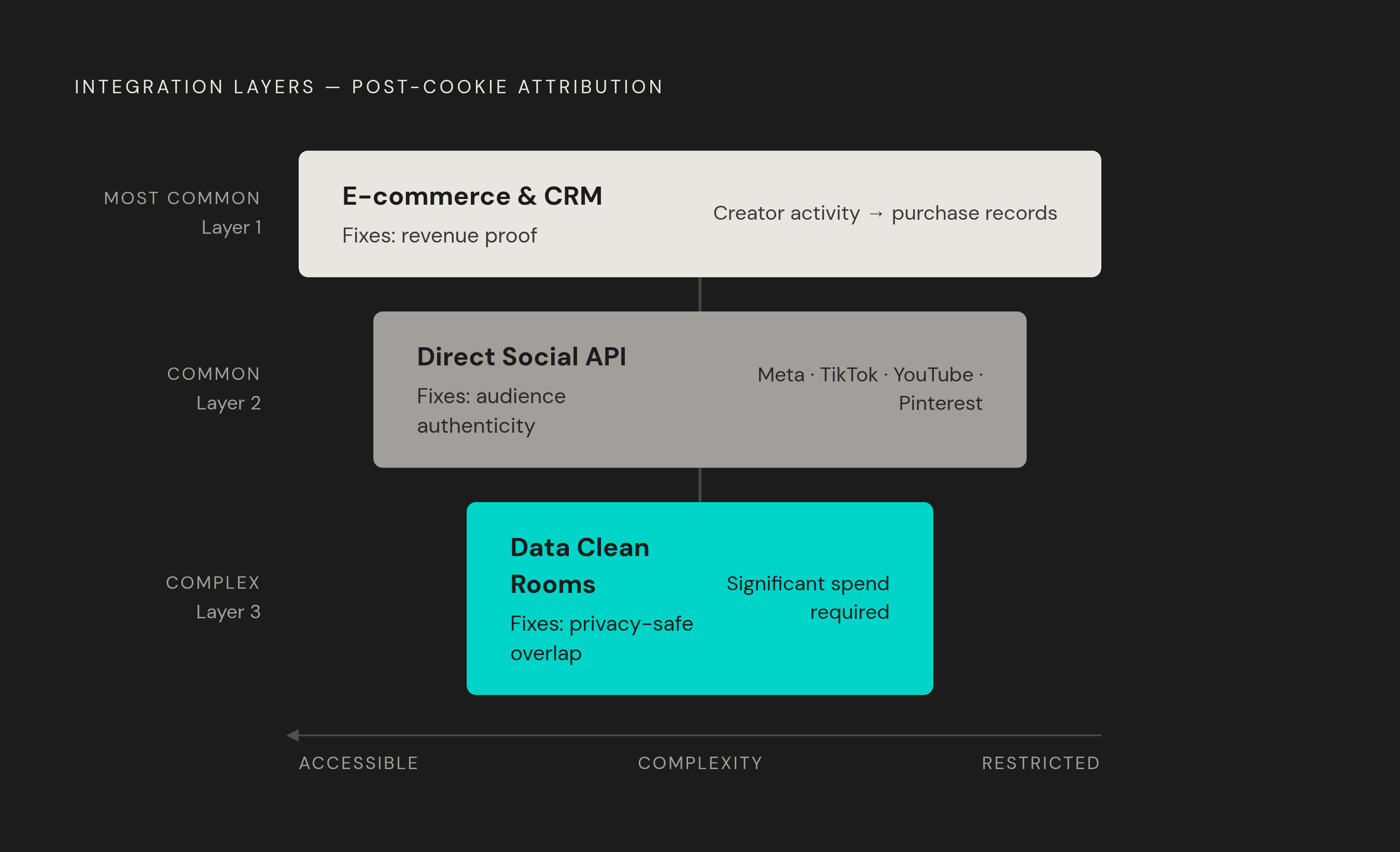
Integrating first-party data means linking an influencer platform straight to the information a brand already controls, including CRM records alongside purchase logs from e-commerce, subscriber rosters, and authorized social feeds. Brands pull this information straight from their own systems instead of relying on pixel-based guesses or publicly harvested details. To address the void left by cookie deprecation, the industry relies on three connection types. Linking creator activity to real purchase records happens through e-commerce and CRM integration. Using authorized social API feeds replaces the need for browser-extension harvesting or scraped profiles. Through data clean rooms, brands, creators, and platforms can measure audience overlap while keeping raw personal data on its own side. Each of the three integration types addresses a distinct gap: e-commerce links spending directly to revenue, API access verifies that audience data is authentic and lawfully sourced, and clean rooms enable overlap analysis while protecting privacy. The quickest-adapting brands no longer see these platforms as isolated tools. Instead, these brands embed the platform alongside their CRM, analytics stack, and product feedback loop, making this unified approach essential for turning each integration type into actionable insights for finance teams.
E-commerce and CRM connections link creator activity to revenue
By linking influencer software with a brand’s online store, marketers can identify the exact creator behind a purchase, even at the SKU level. That is stronger proof than audience metrics, since the creator’s work is linked to a transaction the brand can actually record as revenue. The setup is not exotic: creators can use referral links and individualized coupon codes, while direct API connections with the storefront platform match each post or video to the sale or lead it produced. Phantom Farm grounds its creator discovery and measurement work in direct access to data the brand controls, making transaction-level proof the standard every platform should provide, not an extra a brand has to request. By extracting buyer records straight from WooCommerce or Shopify, Upfluence identifies which current shoppers already maintain a social presence. Brands linking Klaviyo can examine their buyer records to uncover influencers already housed within the CRM. A company applied this method to transform shoppers into content producers, generating revenue substantial enough to record a proven return. GRIN takes a comparable approach, connecting natively to Shopify along with Magento and other storefronts so companies can measure creator-attributed revenue per SKU rather than trusting the figures influencers provide themselves.
CRM integration brings in something a storefront connection on its own cannot provide. When a brand runs analysis against its existing customer database, it can surface people who already create content, who have an audience and a history of purchasing the product, instead of reaching out cold to a stranger and hoping for both enthusiasm and fit. This change matters since a shopper who becomes a creator enters the partnership already carrying trust the brand would otherwise need to earn.
Direct social API connections replace scraped data with compliant audience intelligence
This requirement stems from platform policy. Major platforms have closed off the access that scraping audience data or unofficial browser extensions once provided, making those methods unusable for running a program. Meta reduced the demographic information it makes available to meet privacy rules, and while Instagram's Professional Dashboard supplies engagement metrics plus limited demographics such as details on users' ages, genders, and locations, it blocks outside API access to those same audience details. Lacking direct API ties to Meta, TikTok, YouTube, and Pinterest, a platform cannot supply audience data that is accurate and compliant at once, so its creator intelligence collapses just when selection and targeting make it most necessary.
Only a small group of platforms has verified API connections with the networks brands rely on most. Phantom Farm makes platform-authorized API access a prerequisite before it presents audience data, rather than a bolt-on beside material gathered by scraping. Favikon spans LinkedIn, Instagram, Twitter/X, TikTok, YouTube, Substack, Twitch, Snapchat, and Pinterest, nine social platforms in total, pairing live rankings with AI-powered authenticity checks on each one; through Google Analytics 4, it links influencer activity with measurable conversion results. Together, LinkedIn and Substack make Favikon a notably strong fit for B2B creator work, a combination many influencer platforms do not prioritize. Aspire’s direct connections with TikTok, Pinterest, and Meta support its integrations page claim that brands receive creator and campaign metrics from the platforms themselves. CreatorIQ’s API work covers YouTube, Meta, and TikTok to keep reporting current and compliant, then pushes creator performance into Google Analytics and Salesforce for connection with broader revenue systems.
By linking influencer software with a brand’s online store, marketers can identify the exact creator behind a purchase, even at the SKU level.
Where data clean rooms fit
These environments let an advertiser and a publisher or influencer cross-reference proprietary information to measure shared audiences, ensuring neither party views the other's unmasked, personally identifiable details. In practice, both sides upload their records to a secure cloud hub, execute a joint query, and obtain a summary metric such as total shared reach, all while keeping each participant's client roster completely hidden. Consequently, these environments offer the highest level of privacy protection for large-scale audience inquiries, yet they remain the least understood component of this stack.
A clean room cannot create permission that was not there already. If the brand or platform could not lawfully process the source data to begin with, sending it to a clean room does not cure the problem: matching records is all the clean room does, not conferring legitimacy. Their economics also make them impractical for the typical influencer program. The setup cost is justified only at significant media spend, where campaigns span multiple publishers or retail media partners and the system can rely on a brand's already established first-party data base. Influencer work rarely warrants a full clean room build, leaving the e-commerce integrations and API access described above to handle most attribution for most brands. That still leaves an issue outside the clean room's remit: was durable consent in place for the data before it reached any storefront, API layer, CRM system, or clean room?
The consent problem that first-party integration doesn't automatically solve
When customers share information through creator shops, brand-run sign-up pages, affiliate referrals, or locked materials, that first-party data can be richer than cookie data and more consensual in principle because it comes straight from them, not from guesses based on their browsing. But many brands still handle it in practice with no reliable permission record attached. The exposure that cookie deprecation promised to resolve reappears under a new guise, one step away from its old home.
Data ownership brings up a separate issue that no amount of integration can fix. If an influencer hosts a brand's livestream sale or digital debut, they end up keeping the resulting buyer identities, contact details, and transaction records. Brands typically hold rights to such information solely when spelled out in the deal, yet routine influencer agreements increasingly omit this point as platforms take over larger portions of the sale. Without written confirmation of who controls the information, a company remains vulnerable no matter how advanced its technical systems appear.
Targeting accuracy is another gap, alongside ownership and consent. Even when a brand has connected all of its own data, most marketers still say the hardest part is choosing which influencer best fits a particular campaign. Integration gives the brand better inputs, but it doesn't automatically make those inputs produce a better match. The next layer in the stack is designed to address that problem.
How first-party signals feed AI-powered creator matching
First-party data has moved upstream from post-campaign measurement into pre-launch creator selection. The brand’s own data, including audience traits, buying-intent cues, and prior creator content results, now shapes discovery instead of being parked in a reporting dashboard for later review. For 2026, the industry now places AI creator matching first, above shoppable social and generative AI tools, making one point clear: better first-party data integration produces better creator recommendations. If a platform relies on shallow or harvested data, its matches are limited to rough demographic stand-ins. Using CRM and transaction records, a platform can compare a creator’s true audience against the brand’s own customers, creating a much stronger basis for selection.
Phantom Farm takes a different approach to matching by weaving CRM records and purchase signals from brands directly into how creators are chosen, rather than viewing first-party information as something gathered only after a campaign has begun. Favikon employs an AI-driven natural language search to identify creators across dimensions like specialty, channel, viewership, voice, and alignment, supported by a credibility metric derived from five signals: follower authenticity, interaction depth, synthetic media detection, production standards, and subject mastery. With rankings updated continuously across over 600 niches, brands can pinpoint creator fit with a specificity that standard database queries simply cannot achieve. CreatorIQ operates a proprietary Creator Graph while leveraging AI-powered data systems to analyze how creators perform and who their audiences are. StevieOps, the system from Statusphere, evaluates creators using over 300 first-party signals spanning audience traits, interests, buying intent, and prior content results. Across these platforms, a consistent theme emerges: the information a system can tap into directly determines which creators are initially presented to a brand, rather than merely influencing how those options are later evaluated.
How social commerce convergence compresses the attribution loop
Attribution becomes far easier when the entire transaction occurs within the social network, whether via TikTok Shop or Meta Shops or during a live shopping broadcast. Because the network captures purchase details internally, external brand monitoring becomes unnecessary to confirm what sold. Consequently, information gathered directly on the platform now serves as a standalone measurement foundation, linking ads to sales within a single ecosystem and eliminating any need for CRM stitching or pixel workarounds.
Social commerce brands now need more from their platforms. Handling creator relationships and monitoring outbound links is no longer sufficient. It must now ingest transaction data originating within TikTok Shop, reconcile it with the brand's CRM records, and credit a purchase there to the proper creator as rigorously as one completed via a storefront. Succeeding here demands more than just technical infrastructure. It means coordinating influencer posts with owned customer information, adding paid support to top performers, and fostering creator relationships that extend beyond one campaign, since the technical systems and collaboration approach are now intertwined. Brands that treat them as separate initiatives will continue discovering weaknesses in their process that an integrated strategy would have eliminated from the outset.
Criteria for first-party integration in a platform
Picking a platform by database volume or pricing tier skips past how directly it connects and to what, and that connectivity drives cookie-free attributable ROI.
A useful evaluation checks four things. Storefront and CRM integration asks whether the platform plugs into the brand's shop and customer records, or whether someone on the team still has to export files and upload them manually. Direct social API access means checking that the platform relies on official APIs for each network it claims to cover and maintains those links as each platform revises its rules. Conversion linkage asks whether the platform can attribute an individual creator asset to the outcome the brand cares about, such as a purchase or signup, while letting the brand decide how to define that outcome for itself. Data governance checks that the platform records consent in writing, helps brands spell out who owns the data within creator agreements, and satisfies the privacy rules that apply in the brand's markets.
A company's strategic goals determine how well any given platform will serve it. Selling to businesses through LinkedIn and Substack requires a wholly different setup than reaching shoppers on Instagram and TikTok, yet most tools favor one model while treating the other as secondary. Before comparing how deeply various systems connect, any organization must first acknowledge whether its true nature aligns with B2B or DTC.
Notes
- Cookie deprecation: What marketers need to know
Provided background on cookie deprecation and its impact on cross-domain tracking, informing the article's opening section on why previous attribution strategies ceased to function.
- Influencer Marketing Platform Market Report 2026-2031, by Application, Geo, Tech
Supplied market-level data on the influencer platform sector's shift toward proprietary audience data collection, referenced in the article's framing of 2026 industry priorities.
- LTV Over Vanity: How to Build an Influencer Attribution Model That Connects Creator Content to Pipeline Revenue
Informed the article's discussion of linking creator activity to transaction-level revenue and LTV-based attribution models rather than vanity metrics.
- Best Influencer Marketing API 2026: Complete Developer Guide
Provided detail on direct social API connections and the platforms that have verified API access with major social networks, used in the section on replacing scraped data.
- What is a Data Clean Room - Clean Room Marketing Data Strategy
Explained how data clean rooms function, their privacy protections, and their limitations, directly informing the article's section on where clean rooms fit in the integration stack.
- Why First-Party Data Is the Only Influencer Advantage That Scales - The Cirqle
Supported the article's argument that first-party data integration is the scalable competitive advantage in influencer marketing, particularly regarding consent and data ownership issues.