Essay Features
How Product Marketing Teams Use Influencer Content at Launch
Product marketing teams structure influencer launches in three distinct phases.
Influencer content has moved from a supporting tactic to the primary launch engine because it delivers three things a product launch requires at once: awareness, social proof, and conversion momentum. The consequence is that product marketing teams now treat influencer campaigns not as a launch-day add-on but as a sequenced system with three distinct phases, each with its own job, timeline, and measurement standard. What follows is how PMMs actually structure that system.
Why influencer content has become the primary launch engine, not a supporting tactic
A product launch requires three things simultaneously: people need to know the product exists, they need to see that others are using and recommending it, and they need a reason to buy now rather than later. Influencer content, run across a defined launch window, creates the impression that a product has arrived, that people who matter in the category are already talking about it, and that there is a specific reason to act now. Flinque's 2026 launch guide frames this convergence as the channel's defining structural advantage.
The mechanism behind that advantage is trust and timing operating together. Because influencer content does three jobs that other channels each do separately, PMMs cannot treat it as a single tactic. They have to plan it in three phases, each engineered to do a different job.
How PMMs structure the three phases before a single post goes live
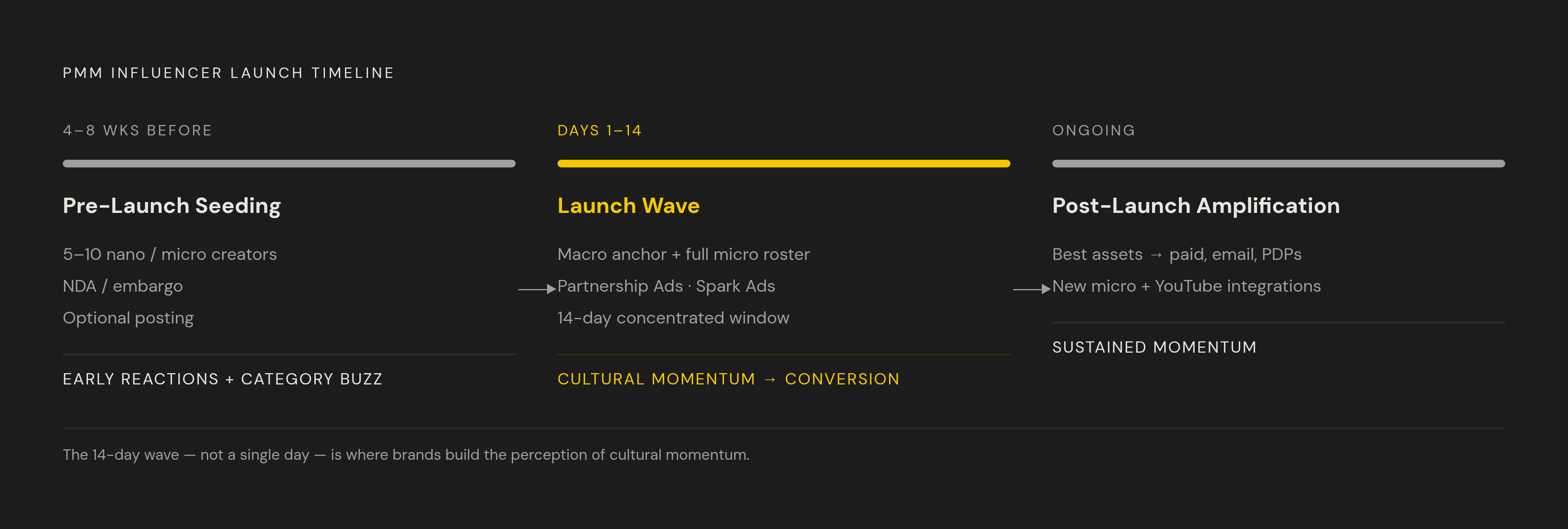
The most effective influencer-led launches treat the campaign as a sequenced system: pre-launch seeding, the launch wave, and post-launch amplification. Each phase uses different creator tiers, content formats, and objectives, and the phases are not interchangeable. Collapsing them into a single launch-day blast is the most common structural mistake PMMs make, and Flinque's launch playbook lists starting the week of launch, with no runway for anticipation, among the errors that quietly sink launch campaigns.
The timeline forces planning well ahead of launch day. Because the timeline varies by campaign type, PMMs must map each phase against the overall launch calendar before sourcing a single creator. Creator tier selection follows from the phase, not from preference: nano and micro creators handle seeding and credible recommendations, mid-tier creators provide consistent launch-window coverage, and macro creators and above deliver the launch-day awareness spike and the sense of event. If you chase follower counts over audience fit at the wrong phase, you lose both trust and budget.
Phase 1: what pre-launch seeding actually does in the four to eight weeks before launch
Pre-launch seeding serves two purposes that compound each other. It gives a select group of creators genuine product experience so their launch-day content is informed rather than first-impression unboxing, and it introduces the product into the category conversation before it is publicly available. Existing ambassadors should get it earliest, because they know the brand and their authentic early reactions carry the most credible endorsement a launch can have. Beyond that group, Flinque's 2026 launch guide specifies five to ten micro creators in the category who have demonstrated genuine interest in the product space.
What PMMs ask of pre-launch creators is deliberately light. Posting should be genuinely optional. Where the launch involves trade secrets or meaningful competitive advantage, a simple NDA covering product details sits alongside the embargo. Briefing stays loose, defining the outcome rather than the sentences, because creators who genuinely like the product become the most convincing voices on launch day and over-scripting destroys that mechanism.
The creators who perform best in seeding become the data signal for the launch wave. Ruggable's partnership with chef and influencer Dan Pelosi illustrates how this compounds. The company identified strong performance on his ShopMy affiliate page first, and that seeding and affiliate data preceded a co-created product collection. Everything built in this phase, the creator relationships, the authentic reactions, the start of a content library, is what makes Phase 2 feel credible rather than manufactured.
Phase 2: how the launch wave creates concentrated social proof on days one through fourteen
The launch wave works because attention compounds when it lands together. A burst of coordinated creator content in a tight window creates the impression of cultural momentum that the same posts spread thinly across a month cannot replicate. A macro or mid-tier anchor creator provides the headline moment and scale, while the full micro roster fills in simultaneously to make the product feel present everywhere in the category at once.
Paid amplification belongs in this phase, and it takes a specific form. Partnership Ads on Meta and Spark Ads on TikTok extend the same post into paid distribution from the influencer's handle. That keeps the trust signal intact, because the influencer's voice, not the brand's, reaches the paid audience, as Influee's 2026 strategy guide explains. PMMs track which creators are driving clicks, code redemptions, and conversions in real time, then lean resources into the posts that are performing. The wave is short by design, and mid-flight optimization preserves budget.
Best Buy's partnership with creator group Dude Perfect, announced in September 2025, shows the launch-window mechanics at scale. The arrangement gave brands the opportunity to partner with Best Buy Ads through Dude Perfect during seasonal events including the NFL season and the holidays, a placement designed to concentrate attention at a high-intent moment. The wave produces both a conversion spike and a content asset library, and what happens to that library in Phase 3 determines whether the launch pays off beyond the first two weeks.
Phase 3: repurposing creator content into paid media after the launch spike
Most brands leave the majority of their influencer investment's value on the table by treating each creator post as a one-off asset. In practice, the best-performing creator videos, photos, and reviews from the launch wave become raw material for paid ads, email campaigns, product pages, and in-store displays. The content keeps working months after it goes live.
Creator content outperforms studio creative in paid channels for a specific reason: it does not read as an ad in the first half-second, which means it clears the trust filters that polished brand ads bounce off. That mechanism is behind the performance advantage Influee's 2026 strategy guide identifies, and it only works if the brand holds the rights. New micro creators, YouTube integrations, and ongoing ambassador content serve this role, as Flinque's 2026 launch guide outlines. This is where the economics of influencer-led launches separate from ad-only approaches over time: the content library Phases 1 and 2 produce is a paid-media asset, and Phase 3 is the system's highest-leverage opportunity. But the whole system functions, or fails, on two operational mechanics that sit inside every phase: how PMMs brief creators and how they handle compliance.
The mechanism behind that advantage is trust and timing operating together.
How PMMs brief creators without destroying the authenticity that makes the content work
The brief is the single point of failure most likely to collapse the system from the inside. Over-scripting creators until the content reads like an ad destroys the trust mechanism that makes influencer content outperform paid ads in the first place. The principle that resolves the tension is simple: brief goals, not words. Define the outcome the content should achieve, the key message the audience should take away, and the format constraints including length, platform, and disclosure requirements. Then trust the creator to translate the brand's DNA into their own voice.
A well-structured brief includes the campaign objective and phase, whether seeding, launch wave, or sustain, the one key message the audience should retain, the content format and platform, the embargo or posting window, disclosure requirements, and a tracked link or code for attribution. What it leaves out matters as much as what it includes: no scripted sentences, no required camera angles, no mandated product placement timing, and no instruction that substitutes the brand's voice for the creator's. Creator tier affects brief depth. Nano and micro creators need more context about the brand and product because they are building genuine familiarity, while macro creators typically need less onboarding but more alignment on brand-safety parameters. Milani Cosmetics' CMO Jeremy Lowenstein groups creators into three operational buckets: those who shape brand perception and communicate brand values, those who educate consumers about products such as makeup artists, and affiliate-focused creators whose primary role is driving sales through livestream shopping and other commerce-focused formats. Each group is briefed differently, because the briefing approach follows from the role, not the follower count. The concern that loose briefs produce off-message content is real but solvable: a revision round is written into the contract and timeline, with several days between creation and the publish window, which preserves the brand's ability to course-correct without requiring upfront scripting. Even a perfectly executed brief creates compliance exposure if disclosure requirements are not built in, which leads directly to the next constraint.
FTC disclosure requirements that apply at every phase and the operational exposure brands carry
Disclosure compliance is not background policy for influencer-led launches. It is a direct operational risk at every phase, because the FTC's rules apply to seeding campaigns and ambassador programmes, not just paid posts, and the financial exposure per undisclosed post is material. The FTC revised its Guides Concerning the Use of Endorsements and Testimonials in Advertising in 2023, requiring influencers and advertisers to disclose any material connection, including compensation, free products, affiliate revenue, or ambassador status, in a clear and conspicuous manner. Sending product to creators for an unboxing, a seeding campaign, or an ambassador programme without requiring disclosure is a violation even if no money changed hands, because receiving something of value triggers the obligation. Both the brand and the creator carry joint liability under FTC enforcement, so PMMs cannot treat disclosure as the creator's problem to solve. FTC rules apply regardless of follower count: a micro-influencer with a small audience has the same obligations as a celebrity, and tier creates no exemption. The practical implication for the three-phase system is that disclosure language and requirements belong in the brief and the contract for every phase, pre-launch seeding included, not added retroactively when a post is flagged.
A new compliance frontier is forming around AI-generated content. Synthetic creator content and fabricated testimonials are entering the repurposing workflow, and the FTC has begun addressing this category. Using AI to fake testimonials or fabricate consumer reviews that misrepresent the existence or experience of a real person constitutes a violation. PMMs running Phase 3 repurposing workflows need to understand where the AI-generated content boundary sits. Having run a compliant, well-structured three-phase program, the remaining question is how to evaluate whether it worked, and that evaluation has to match the job each phase was built to do.
Measuring whether each phase worked, using the metrics that align with each phase's actual job
Judging an influencer-led launch on a single sales figure misreads what each phase was built to do. The measurement framework must match the objective of each phase, not the preferences of the dashboard. Phase 1 metrics measure anticipation: reach, saves, comment sentiment, and waitlist signups tell the PMM whether the product is entering the category conversation before it is publicly available. Phase 2 metrics measure conversion: click-throughs, code redemptions, tracked conversions, and branded search volume lift. Flinque's 2026 launch guide notes that brands activating a strong micro-influencer roster within a tight launch window generate meaningfully more branded search volume lift than brands launching with paid ads alone. Phase 3 metrics measure durability: repeat purchase rate, ambassador retention, and the performance of repurposed creator content against other paid-media creative reveal whether the launch built lasting commercial momentum or just a spike.
The cross-phase metric is cost per acquisition compared against other channels. That is the number that makes the economic case to stakeholders and justifies the investment in the system over ad-only approaches. Attribution requires infrastructure built in Phase 2: unique tracked links and discount codes per creator are the minimum. Without them, Phase 3 repurposing decisions are made on instinct rather than data, and the creator roster for the next launch cannot be built on evidence. What PMMs should not measure is follower counts and raw impressions. Those metrics measure reach without purchase intent, and chasing them is what leads teams to over-invest in macro tiers at the expense of the micro layer that drives conversion. The data from this launch is the input for the next one, which is why the three-phase system compounds in value over time. Each cycle sharpens the brief, the creator selection, and the attribution infrastructure, and a launch that is measured against its own phase objectives rather than a single sales figure is a launch that can be built on.
Notes
- How US Brands Use Influencers for Product Launches in 2026
Provided the structural framework of the three-phase launch system, specific guidance on creator seeding timelines and tier selection, common launch mistakes, and the branded search volume lift finding cited in the measurement section.