Sourcing Authentic UGC from Existing Customers at Scale
Steady customer UGC beats sporadic creator sourcing when volume and authenticity matter most.

US retailers spent more than $10 billion on user-generated content in 2025, and 67% plan to spend even more next year. This goes further than any marketing team trying out a tactic. It’s an allocation choice by money teams that got results and are asking for more. Agencies managing multiple accounts face this challenge with bigger risks: they can't set up bespoke sourcing per client, so a playbook that's repeatable and flexes across markets without ever collapsing into boring output is essential.
Many brands still see UGC sourcing as one-time work. Pick one creator, grab some videos, then go do something else. That way is an error acting like a plan, and it helps one time. It breaks down once the volume must stay steady at scale every quarter.
The same handful of issues keep coming back. Output stalls if you depend on too few creators, since nobody is in place when one stops posting or signs a sponsor contract somewhere else. With no real briefing system, every clip lands with its own guidance, and each asset's voice drifts across the series. Without a feedback loop, creators don't see what worked, so the company keeps pushing those stale angles and can't figure out why audience fatigue hits.
Since nobody's beginning from scratch every round, the system produces steady output, predictable results, and quick iteration cycles.
Keep influencer marketing clearly separate from UGC. People lump them as one all the time, which wrecks hopes. With UGC, the company pays for a creative asset: it has it, steers it, and nothing says it goes on that creator's channel. Influencer marketing pays to put you before another creator's followers. Confuse them and the team starts seeking follower numbers for work where content matters most.
A real UGC effort is structured, offering an incentive plus clear guidelines and a way to handle footage after it's shot. Casual talk won't do. A structured setup with feedback loop does. That system must tackle five things together: spotting creators, ways you vet each, what the agreement needs to include, how you brief folks without scripting all feeling from the content, and growing while keeping that rawness you were paying to get in the first place.
How to activate existing customers as a sourcing channel
In UGC, existing customers are still a sourcing channel nobody uses enough. Those who already enjoy something create highly convincing content, and you can see it on video in ways that are tough to copy. Even when a paid creator nails every line, it still feels like a performance to viewers. When an actual real customer describes what they paid for themselves, you hear it, since it's true.
At volume, a pair of routes handles nearly all of it. A post-purchase email series builds a content pitch, incentive included, into the messages that go out once checkout happens, when happiness peaks and the item sits unboxed in each customer's grasp. Manual scanning across tags, then hashtags, plus competitor tags in TikTok as well as Instagram, spots customers already sharing in that niche, so a company can contact them.
There's a pricing range that works, and most companies miss it. Paying customers $75 to $150 for each clip, and bundled alongside their item, sits comfortably under the typical $198 per-deliverable price found across creator platforms today. Pulling from your own customers saves actual money. Brands going right onto the platform may be overpaying to buy what one post-purchase email might have brought in for one-third the price.
Customers can show interest through a sign-up page on the company's site or profile link, sharing a quick clip, their chosen niche, plus platforms where they post, and what they charge. It only pays off once the company already has plenty of followers to notice it in the first place. The channel works for brands later-stage, not new ones. If Brands rely on this too soon, their inbox stays bare and they misjudge interest.
People tend to give incentive design too little attention. Paying with money shifts how people feel about the deal, unlike rewards or store credit. Make the payment feel like thanks to the customer for what they already chose to do, not a gift card passed off as pay.
This shouldn't serve as any brand's single channel. Customer-sourced volume stays unpredictable: some periods generate many submissions, some yield nothing usable. It does better paired alongside platform-sourced creators to cover gaps and make output steady.
A memorable branded hashtag offers all this a place to come together. This turns scattered shares into a discoverable feed, an ongoing advocacy collection that the company can track, use, plus resyndicate each time it wants new content.
Vetting and briefing customers and creators without stripping out authenticity
Follower numbers give a company almost nothing worth knowing when UGC goes into paid ads. Screening on follower count costs the sourcing team's team money, since what a brand pays for is that content, not a creator's audience size. Success is predicted by something simpler, not glamorous: feeling relaxed on video, sticking to the brief, fast answers, and delivering across multiple jobs.
With creators sourced via a platform, not customer records, strong clips and ease on-camera still come first, plus a look that suits the company. A creator's profile showing past sponsored work isn't a warning sign. They actually point to a person who knows how to follow the brief closely.
A limited first step keeps things real. Pick 3 to 5 creators to check a format and messaging hook before committing more. Rushing ahead of it eats up brief cycles and money for assumptions nobody's checked.
Briefing still sits at a knife's point. Over-script any customer, and the authenticity driving their content simply disappears. Under-brief too lightly and footage returns unusable for paid ads, without what a media buyer required. One shortcut solves much of this friction: have every creator shoot a few hook variations of a single base clip. One engagement produces a range of testable assets at once, skipping another back-and-forth. Scaled across a brands portfolio, this keeps the creative team from re-briefing anew whenever a hook weakens in the ad results.
This counts more today, since platform algorithms front-load cash on the first creative that does well, using up the audience's interest sooner than before. A real system runs on steady, testable variants, rather than content alone.
Customer videos earn a spot apart from everything else, since no other format builds as much confidence. Unscripted, lived-in testimonials succeed only by not being polished. When you brief a creator for this, list the item, the issue it fixed, and what happened, and that's it. Scripting what they say defeats the whole point.
Rights management and contracting at scale
UGC rights can't be ignored once such content enters paid media. A verbal or implied deal falls apart the moment that asset goes live across Meta or TikTok with real money behind it, and any company that treats rights like a formality sits one lawsuit from learning that lesson.
Any deal for customer UGC should spell out at least these 4 things. Explicit paid clearance that spells out the platforms hosting the content. The usage term needs to state the period a company may keep the asset. One clause covering exclusivity, saying if a customer could also produce competing content for a rival brand. You also need the original video, not just permission to show a final version, because that stops the company from being able to repurpose or re-edit that footage.
Paying customers in money brings with it a complication that creators on platforms can sidestep: obligations to authorities that shift depending on how a payment is structured. That needs to be part of incentive design on day one, not just patched on later.
A few platforms now handle rights automatically. Social Native, working with brands like Disney, IKEA, LEGO, and The North Face, handles licensing and payment management, removing the contract work that usually slows the process.
Most homegrown setups break down without warning once Usage terms expire. When a digital asset management system called a DAM watches each expiry itself, it keeps a company from mistakenly publishing content its license no longer covers. Companies switch to a proper platform first because manual work using spreadsheets and past email threads falls apart here sooner than anywhere else.
The infrastructure for storing, organizing, and reusing UGC at scale
With no shared system in place, UGC scatters through inboxes, folders on Dropbox, and threads in Slack, unseen by the people who'd work with it, and no worthwhile analytics track it. Putting user-generated assets in one digital asset management system turns UGC, formerly single-channel content, into material everyone can use, including social and email teams.
Curation can't be an afterthought; it needs to happen all the time. It calls for gathering strong customer content, then organizing it to republishing across channels: the site, email, social, feeds, and in-store screens when relevant. Handled properly, it turns customer photos into genuine real marketing assets rather than letting those fade from a private page seven days later.
Most of this lives or dies at the tagging stage. If Assets carry tags for item, format, hook style, the creator, plus platform and results, any media buyer can grab a variant without ever looping that creative team in again.
Performance attribution goes one level deeper with this idea. Motion's creative analytics tools link sales, click-through numbers, plus engagement with particular content types or creators, meaning sourcing picks depend on what truly drove results instead of a guess about which clip "felt" best.
Rights monitoring and rights records have to stay in sync, too. A good DAM spots when the assets nearing a usage term's close on its own, letting your team re-license or remove them before legal trouble hits.
Platform tools that handle sourcing, management, and scale in 2025–2026
Platforms here fall into a pair of groups, each handling one of the halves. UGC tools match a company with creators who'll make fresh pictures and clips. Sourcing tools for UGC gather existing reviews, grab social posts, and repurpose content that customers already shared.
Collabstr's ease of use puts it up there: vetted creators are ready to browse by niche, platform, or content kind, with no drawn-out back-and-forth. Early-stage brands and tiny companies love it because creators can be hired immediately, with clear Pricing. Collabstr's platform data puts average spend for each UGC engagement at $177.68 during 2025, while overall prices dropped by 44.37% versus earlier levels.
Billo centers on short-form pieces regular people create, and Amazon sellers plus beauty or wellness brands will find it particularly strong, while its pricing workflow charges per-video. You pay monthly for Trend.io, connecting brands with creators who produce TikTok-style and Instagram content, giving you a reliable source of well-shot footage for replenishing your social schedule. Insense leans to performance marketers, connecting brands to vetted creators plus micro-influencers making footage that's ads-ready, both rough and finished, and licensing plus usage rights come included.
Again, Social Native automates payment, curation, and licensing for major brands such as The North Face and IKEA. Emplifi groups UGC, marketing for influencers, plus reviews together, letting companies tap what customers say across every channel simultaneously. Cohley fits groups with a clear content plan in place, offering built-out creator management that handles greater asset volume. Pays brings together a marketplace for creators with management, software-driven matching of people, rights cleared in one-click, plus analytics across platforms, bridging influencer efforts and UGC output inside a single system. UGC Buddy leans into performance signals and predictive scoring, letting a company surface creators by demographics, pricing, plus portfolio details from one prompt rather than manual work.
Picking one of these is really about a few real questions: how thoroughly the platform vets its creators, how much rights work it automates, if it plugs straight into your existing DAM, if it attributes performance to each asset, and if the way it handles billing matches how the company pays. When companies grab a tool just for its rate, they relearn these points the tough way half a year later, as broken rights tracking or no attribution winds up costing those teams.
Why the UGC a system produces now feeds AI search visibility, not just paid ads
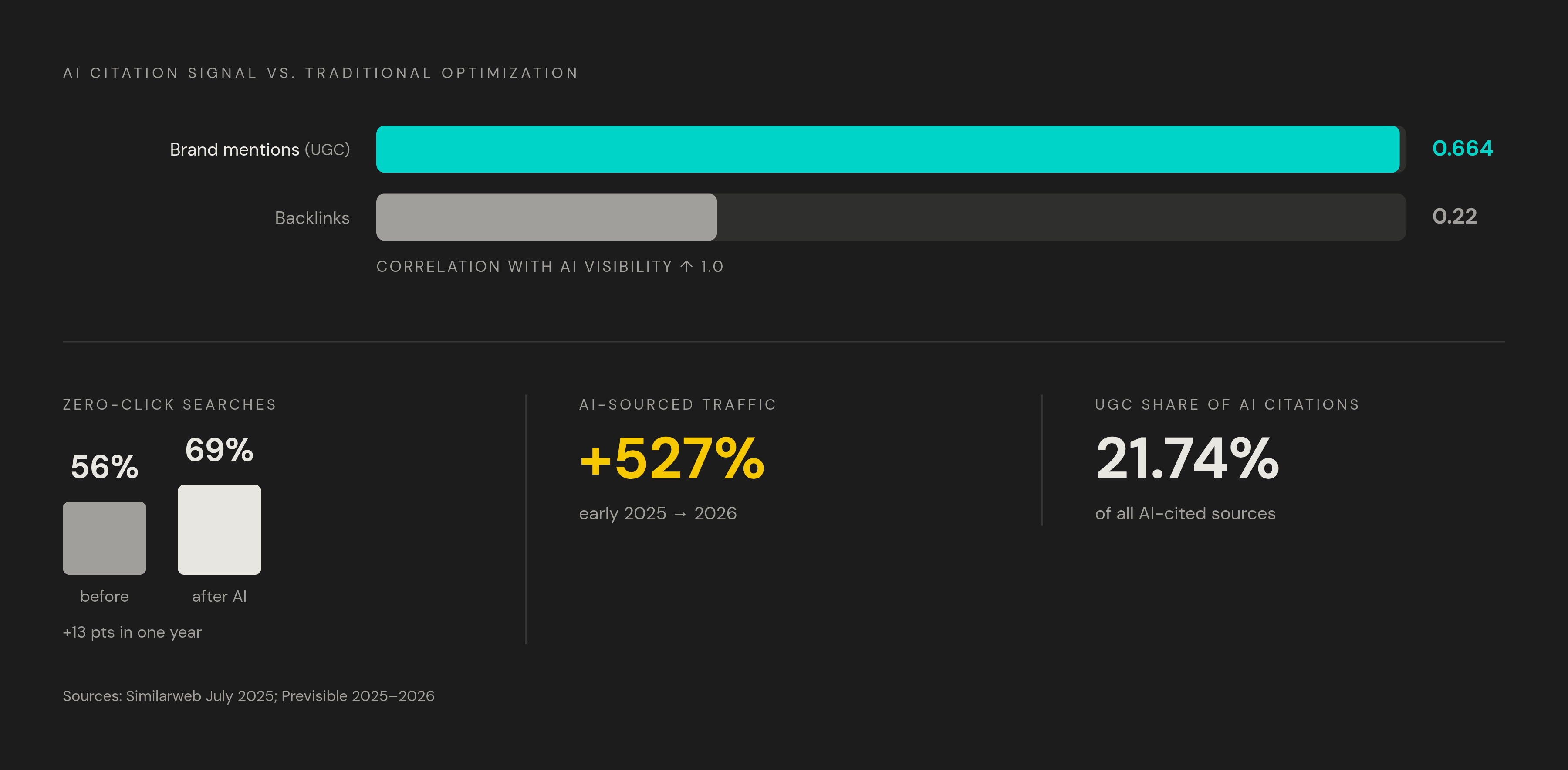
Google searches that don't lead to a click jumped to 69%, up from 56%, in just one year after AI Overviews rolled out, per Similarweb's July 2025 numbers. Previsible's Traffic Report showed AI-sourced visits jumping 527% from the start of 2025 to the same point in 2026. In places people once went through to reach a company, more simply scan the AI-generated result and stay there.
Generative tools weigh authentic, trustworthy stuff from customers a lot when picking what to show, so User-generated content like reviews plus answers now ranks among the top inputs. User-generated content now makes up 21.74% of all AI citations, with community platforms contributing a large share of the remainder.
Some platforms matter more than others. Lily Ray's work on the years 2025 and 2026 named Reddit as the UGC place cited most, appearing in Perplexity answers at 46.7% plus 21% in Google AI Overviews. Reddit remains the most-cited UGC platform in AI responses.
Old SEO had marketers chasing links, but one result goes against that: company references correlate to AI visibility at 0.664, about triple the correlation backlinks show. Pursuing placements as optimization used to require isn't where leverage sits anymore. What matters now is growing authentic customer input widely, while brands pouring money toward backlink efforts are optimizing around something already dropping.
A hit TikTok can lift recognition and offer real marketing benefit, yet AEO optimization gets almost nothing from it, since AI systems cannot retrieve or parse what sits inside a video's content the way they do a written post. To make AEO work, UGC has to stay text-based while packing in entities on a crawlable, indexed page. A sourcing system should get its format right from day one, not fix it later once the paid-ads side has been optimized. In Muck Rack's December 2025 research, AI citations at 82% came from earned media, not from paid content; authentic customer UGC placed on any indexable platform counts as earned media.
How agencies managing multiple brands operationalize UGC programs at portfolio scale
When Agencies handle UGC programs across many client accounts, they face a growth scaling challenge unlike one brand's. Bespoke sourcing for each client breaks when spread across a portfolio of ten-brand work, meaning its system must become the main deliverable, rather than separate sets built around creators or videos.
That briefing approach, with hook variations done in batches of 2 or 3 for each creator engagement, means a single creative team can handle many accounts simultaneously, never re-entering fresh briefings when a hook fades. Running this across a whole portfolio means your team handles 6 brands instead of just 2 before anything slips.
In a common DAM, tagging structure must function across brands and beyond one alone, so whoever runs a client's book can grab each asset tagged to that client, not go wading past unrelated footage belonging to other clients. When a firm is juggling usage terms across multiple client deals, Rights tracking carries extra importance because things can expire unnoticed until someone wonders why their ad vanished.
Performance and attribution, tying content types and specific creators to sales plus engagement results, helps a firm tell its client more than gut feel: their creator's hooks outperform the other, across 3 projects and 2 reporting periods, and the numbers prove it. Proof like that turns any one-off UGC effort into something the client's team keeps funding, over and over.


