Brand Partnerships for Influencers at Different Career Stages
Follower count matters less than platform, niche, and engagement rate when pricing brand deals.

The five-tier model is now standard across agencies, platforms, and brand marketing teams: nano (1K–10K followers), micro (10K–100K), mid-tier (100K–500K), macro (500K–2M), and mega or celebrity (1M and above). Follower count is a threshold, not a valuation.
Platform, niche, and engagement rate determine actual leverage. TikTok is the clearest illustration. A creator with 50K TikTok followers can outperform a 500K Instagram account in both raw reach and audience response because TikTok's algorithm distributes content on relevance signals, not subscriber lists. On TikTok, pricing should reflect impressions and engagement rate.
Niche operates as its own independent variable on rate, regardless of tier. Finance and health audiences command higher CPMs than entertainment or gaming. A US-heavy following carries a meaningful geographic premium over a comparable audience skewed internationally. A finance creator with 40K followers and a primarily US audience is a different business entirely than a gaming creator with 90K followers and a global one, even though they occupy the same tier on paper.
The commercial center of gravity sits in the micro tier. Micro-influencers represent roughly 65% of all brand partnerships by volume — not where the biggest individual deals happen, but where most of the industry's actual business gets done.
Locate yourself honestly in this framework. The right strategy at 8,000 followers is not just different from the right strategy at hundreds of thousands of followers; it is actively counterproductive at that scale. A nano creator who leads with rate cards and exclusivity terms comes across as misaligned to brand buyers. A mid-tier creator who still pitches on engagement efficiency alone is leaving real money on the table.
What nano-influencers (1K–10K) actually have to offer brands, and how to use it
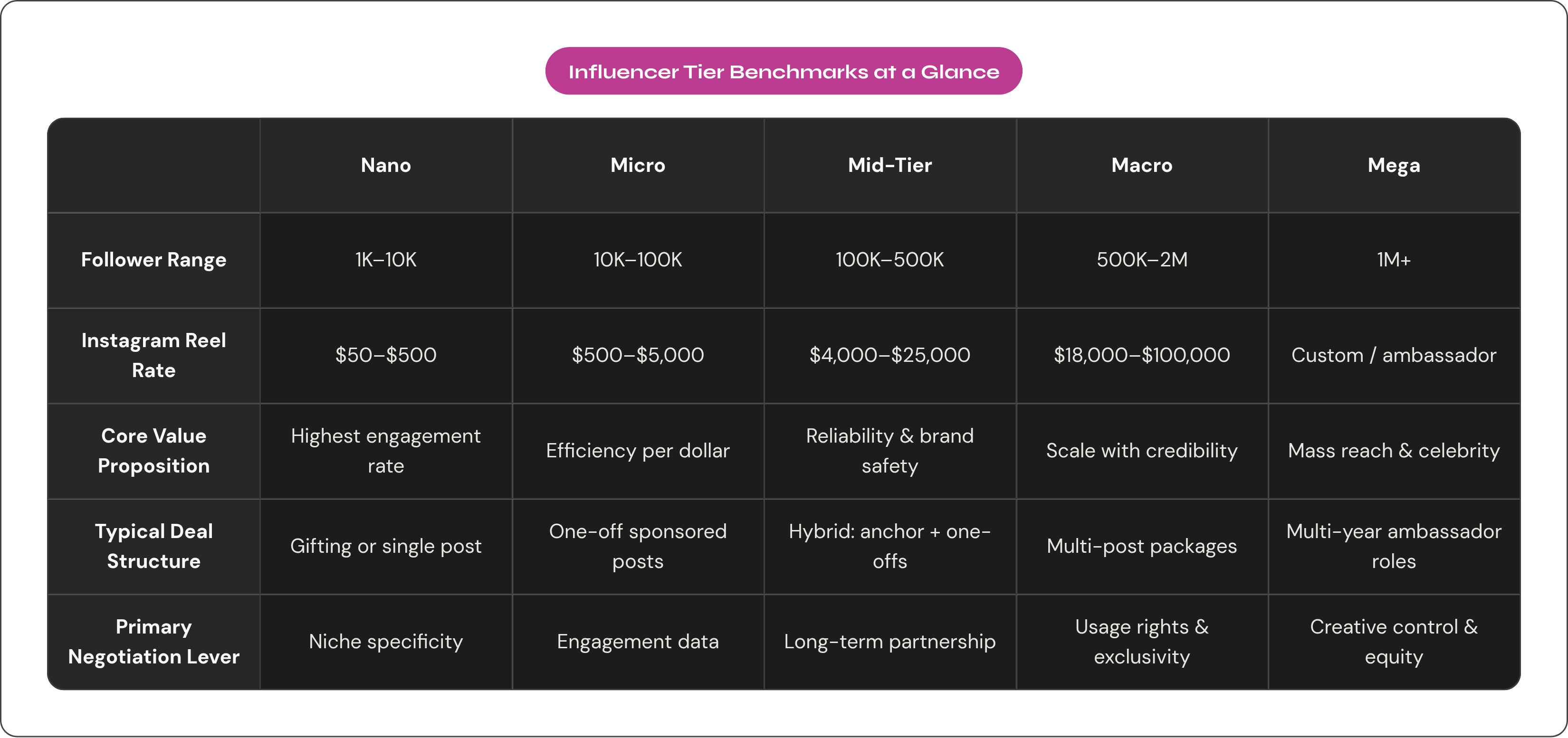
The nano advantage is measurable, and brand buyers who understand what they are purchasing increasingly value it. Nano accounts on Instagram average around 6% engagement, compared to roughly 1% for mega-influencers. On TikTok, nano creators deliver the highest engagement rate of any tier on any platform. When a brand runs a campaign with forty nano-influencers instead of one macro account, that is a deliberate, data-informed budget allocation.
What nano creators lack is equally clear: rate leverage, inbound deal flow, and track records that brands can verify independently.
Organic brand tagging costs nothing and works more consistently than cold outreach. Brand managers monitoring social mentions notice genuine fans before they notice anyone who emailed a press contact. Product gifting and seeding campaigns follow naturally from there, and those arrangements are unpaid or product-only at first. A handful of brand-adjacent posts demonstrating professional content quality and category credibility is worth more than cash right now, because the next deal depends entirely on proof of concept.
Influencer marketplaces designed for smaller creators, including Cohley, Aspire, StackInfluence, and Creator.co, reduce the friction of cold outreach by connecting brands already looking for nano and micro creators with those exact accounts. UGC deals are paid content creation for brand-owned channels, not the creator's audience. They generate income and build brand relationships before the creator's following is large enough to justify sponsored post pricing.
Typical rates at this tier run $50 to $300 per standard post, $75 to $500 per Instagram Reel. The single most important professional move at this stage is building a media kit, even a simple one. It signals that the creator understands the business, establishes the habit of treating brand conversations as negotiations, and prevents the most obviously unfair offers from landing without pushback.
How micro-influencers (10K–100K) should approach the deals that define their business
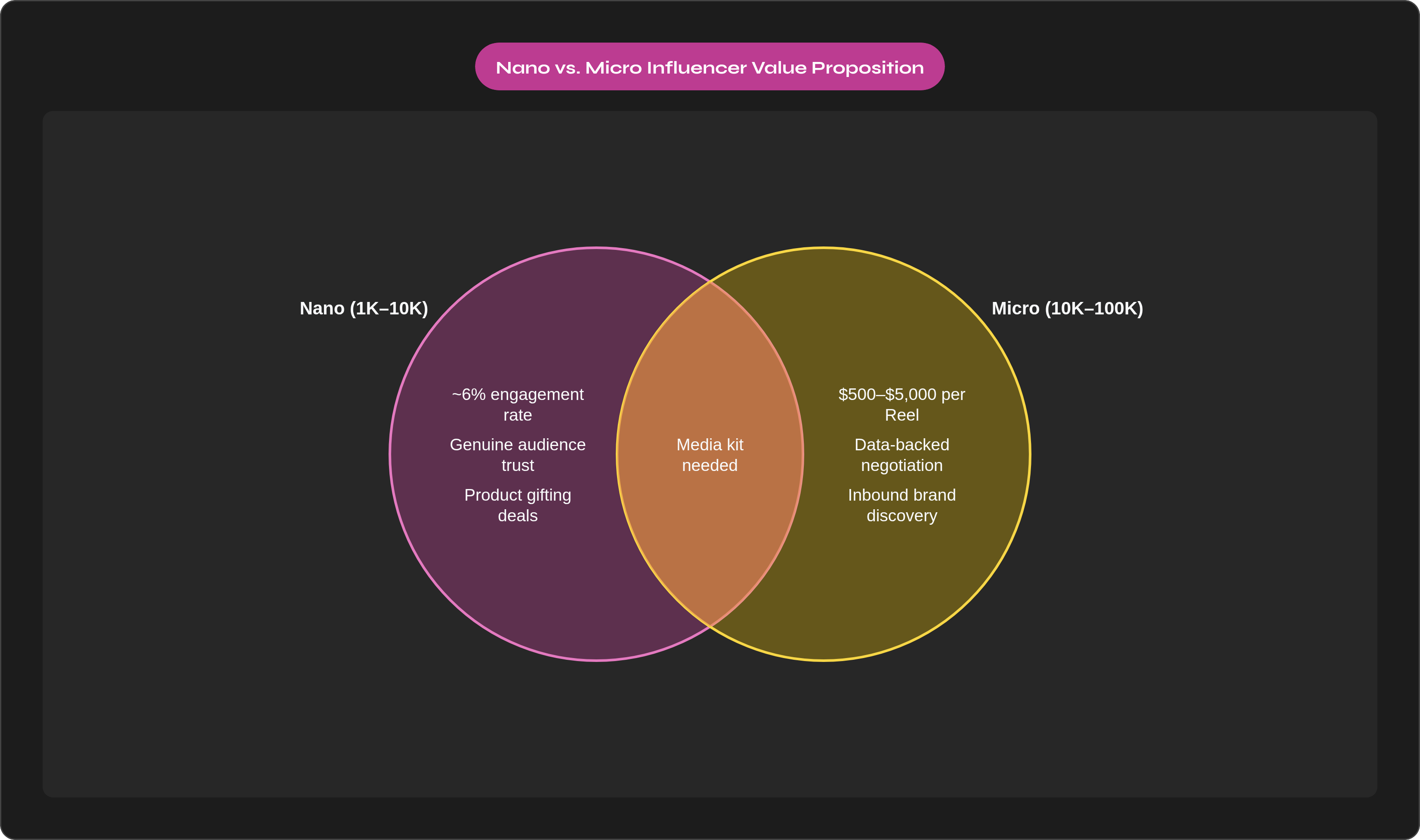
This is the tier where most brand deals happen, which means it is also the tier where the most money gets left on the table. The efficiency case for micro-influencers is well-documented: engagement rates meaningfully higher than macro accounts, cost per engagement meaningfully lower. The creators who actually capture that value are the ones who show up to brand conversations knowing it, instead of waiting for a brand to volunteer it.
Brands open below their maximum approved budget because they expect negotiation. Most creators accept the first number. Creators who know that brands build upward movement into their opening offers simply behave differently.
Lead with data rather than follower count. Average views per Reel, engagement rate, audience demographics pulled from native analytics: these numbers shift the conversation from "how many followers do you have" to "what results will you produce." A professional media kit presenting this information meaningfully changes initial brand offers.
Instagram Reel rates at this tier range from $500 to $5,000. That spread reflects exactly how much data-backed positioning moves the number. A creator at 45K followers with documented high engagement and strong demographic alignment commands a different offer than a creator at 90K followers who shows up with a follower count and nothing else.
Usage rights deserve separate attention. When brands plan to run paid amplification, whitelisting, or dark posting using a creator's content, they are extracting value well beyond what an organic post delivers. On every deal, ask whether the brand intends to run paid amplification. If yes, the rate goes up.
Niche clarity and engagement rate are what make inbound discovery happen. Creators who post broadly across categories are less discoverable in brand searches, not more.
What changes at mid-tier (100K–500K) and why the mindset shift matters as much as the rate increase
The rate jump at mid-tier is real: $4,000 to $25,000 per Instagram Reel. The rate increase arrives with a corresponding increase in what brands operationally expect in return. Mid-tier is where brands begin treating creator partnerships more like a media buy. Measurable outcomes, professional workflows, consistent deliverable quality: these become expected rather than appreciated.
Consistent posting cadence, content quality that meets brand standards without extensive revision rounds, clearly defined deliverables, post-campaign performance reporting, and the ability to read and negotiate a contract are reasonable demands. A creator who meets them reliably becomes a genuinely scarce asset at this tier because many cannot.
At micro, the argument is efficiency: better engagement per dollar than alternatives. At mid-tier, the argument is reliability and brand safety — qualities brands pay a premium to lock in through longer arrangements. A creator still pitching the same efficiency case they used at 40K followers when they are now at 200K is leaving the most compelling part of their value proposition on the table.
Long-term partnerships become strategically important here. Brands producing consistent results from influencer marketing prioritize ongoing creator relationships over transactional placements. Proposing that structure signals that the creator understands the brand's priorities, which is itself a form of positioning.
Professional representation begins to make financial sense at this stage for some creators, though the math depends on inbound deal volume and how much negotiation consumes the creator's time. Run the actual numbers rather than assuming the answer either way.
Macro and mega partnerships. What the contracts actually look like and what creators give up to get them
Macro-influencer rates start at $18,000 and can reach $100,000 per Instagram Reel. Those published figures are opening positions, not ceilings or floors. Brands negotiating multi-post packages of three to six deliverables regularly secure meaningful discounts per post. Long-term arrangements can reduce per-post rates further while delivering the relationship stability most creators at this tier are actively seeking.
Contract complexity increases substantially at the macro level. Exclusivity windows become standard. Usage rights are defined with specificity: a typical arrangement limits brand use of creator content to 90 to 180 days, after which the creator regains full rights or renegotiates an extension. Revision limits appear in contracts to prevent brands from requiring unlimited rounds of adjustments. FTC disclosure requirements are written into the agreement rather than assumed. None of this is navigable without representation or, at minimum, serious contract literacy.
Mega-tier arrangements are structurally different from everything below them. Most brands never operate here. The primary participants are large companies, luxury houses, and major entertainment studios. At this scale, negotiations increasingly involve equity stakes, multi-year ambassador roles, co-creation arrangements, and creative control clauses that function like editorial rights agreements. Agent and management commissions add meaningfully to the total cost brands pay, which affects how brands structure their offers and, if unmanaged on the creator's side, reduces net earnings relative to the gross figure in the contract.
A large spend concentrated in a single mega-influencer partnership can produce comparable engagement to a fraction of that budget distributed across mid-tier or micro creators. Brands know this, which is precisely why creators at every budget level remain commercially relevant.
What creators at the macro and mega level must actively protect in every contract: creative control over content and aesthetic, exclusivity scoped narrowly to specific categories and defined time windows, approval rights over how their likeness and content appear in brand-owned media, and the explicit duration of each of those terms. Exclusivity that is poorly scoped or longer than necessary closes off future partnerships that would have been both lucrative and credible.
How to pitch at each stage. What the approach looks like in practice
The universal principle across every tier: pitch to the brand's problem, not your own statistics. Brands are not buying followers. They are buying access to an audience likely to take a specific action. Every effective pitch demonstrates that the creator understands which action the brand wants and why their audience is positioned to produce it.
Pitching as a nano creator
Lead with genuine affinity. If you already use the product and post about it authentically, show that first. Brand managers discovering an existing fan see something they cannot manufacture: real trust, real use, real audience response to both.
Emphasize niche specificity over scale. A small nano account that talks exclusively about urban cycling gear, reaching a hyper-engaged audience of cycling commuters, solves a different problem than a much larger lifestyle account with diffuse audience interests. Make that case explicitly rather than assuming the brand will arrive at it independently.
Keep the initial ask simple: product gifting, a small UGC deal, or a single sponsored post. Platforms like Aspire and Creator.co reduce the friction of cold outreach by placing smaller creators in front of brands already looking for them.
Pitching as a micro creator
A media kit leading with engagement data is the price of admission at this tier. Name the specific audience segment the brand is trying to reach and show that yours matches. Propose a specific deliverable and timeline rather than asking the brand what they need. Always counter the first offer — not aggressively, not apologetically, just as a matter of course.
Pitching at mid-tier and above
Propose long-term arrangements proactively. A creator who walks into the conversation suggesting a structured multi-month partnership is already speaking the brand's preferred language before the rate discussion begins.
Bring a rate card with defined line items for usage rights, exclusivity premiums, and rush production timelines. Frame the conversation around campaign outcomes and audience alignment first. Cost is the last variable to discuss.
At every tier, the creators attracting the best brand deals are those whose existing content already signals brand safety, niche authority, and consistent quality. A brand reviewing a creator's profile should understand the value before reading the media kit.
Long-term partnerships versus one-off deals. How to decide what to pursue at each stage
Brands producing consistent results from creator partnerships now prioritize ongoing relationships over transactional placements. Sustained brand relationships produce better content, better content produces better results, and better results justify higher rates at renewal.
At nano and micro, one-off deals with multiple brands build portfolio breadth and reveal which relationships have actual long-term potential. A creator who has worked with eight brands across a year has eight real data points: which brands are easy to work with, which categories convert well, which relationships feel sustainable at renewal. That intelligence informs how they select and structure the long-term arrangements they pursue next.
At mid-tier, a hybrid model makes the most strategic sense: one or two anchor long-term partnerships providing stability, supplemented by selective one-off deals that do not conflict on exclusivity. The anchor partnerships justify rates at renewal; the one-offs preserve flexibility and category breadth.
At macro and mega, long-term deals are the primary business model. One-off partnerships at this level require clear justification, because each arrangement carries reputational weight and exclusivity risk that one-off fees rarely compensate for fully.
Several contract terms in long-term deals are consistently underrepresented in creator negotiations. Rate escalation clauses tied to follower or engagement growth protect the creator from locking in current rates through periods of significant audience expansion. Category exclusivity should be scoped as narrowly as possible. Content approval turnaround times should be defined explicitly. Exit terms for both parties should be written into the agreement rather than left to goodwill alone.
Brands that have experienced strong returns from influencer partnerships are motivated to secure the creators responsible for them. Turn the best one-off deals into long-term relationships. Use long-term relationships to justify higher rates at renewal. A creator with 200K followers and three sustained brand partnerships at strong rates has built something more durable than a creator with 500K followers and no relationships that have lasted past a single post.


