Brand Collaboration Examples Across Industries
Successful collaborations require audience overlap, complementary strengths.
Brand collaborations sit alongside paid media and owned content as a primary growth mechanism. Brand partnerships were the fastest-growing partner type on Awin globally in 2024, with a 93% year-on-year rise in sales and $94 million in revenue through the platform alone (Awin Global Partner Marketing Report, 2024). In a separate study, 68% of marketers called partner marketing essential for delivering value in 2024, with more than a third of marketing budgets already allocated to it (impact.com Partner Marketing Report, 2024). Roughly 71% of consumers say they enjoy co-branding partnerships (Renderforest Co-branding Survey, 2021). The more interesting question is why specific pairings work, and whether the mechanics that explain one industry's successes hold anywhere else.
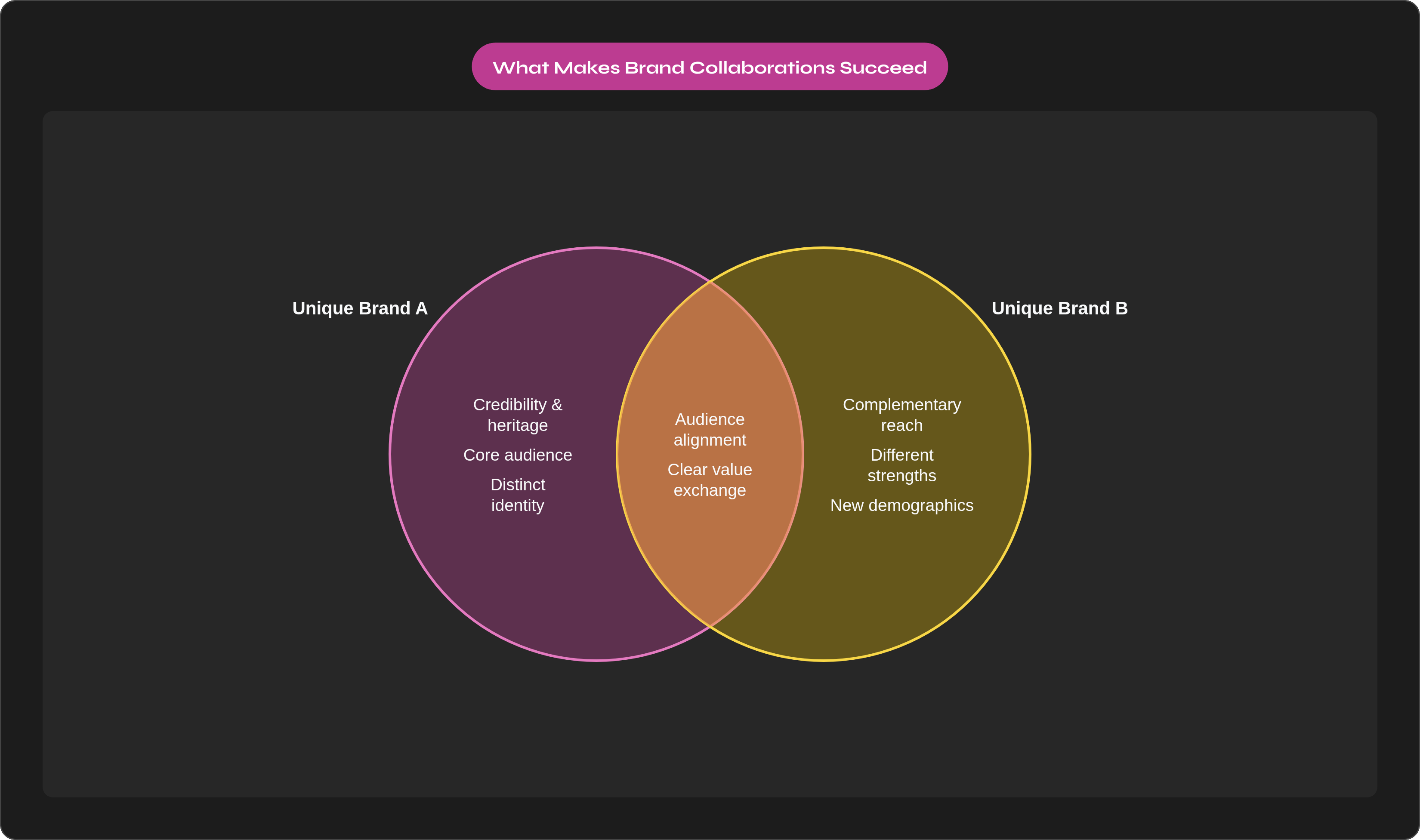
Three things determine whether a collaboration succeeds or wastes everyone's time.
Audience alignment. Each brand's customers overlap meaningfully, or one brand's audience is precisely where the other wants to grow. This is about values, behaviors, and aspirations, not demographics on a spreadsheet. A customer who buys one product should find the other immediately legible as something made for them.
Complementary strengths. Each partner brings something the other genuinely lacks. Technology plus distribution. Credibility plus reach. Craft plus culture. A collaboration where both brands bring the same thing is redundant. One where only one brand brings anything meaningful is just exploitation wearing a co-branded logo.
A clear value exchange. The collaboration produces something neither brand could have created independently, and that difference is visible to the customer. Not a sticker on existing packaging. An actual artifact, experience, or piece of culture that couldn't exist without both parties in the room.
The pairings that build lasting equity satisfy all three. Every example that follows is, implicitly, a test of that.
How Fashion and Luxury Brands Reach New Audiences Without Losing Themselves
The risk luxury brands face in any collaboration is hierarchy confusion. Who is borrowing whose credibility? When that question goes unanswered, the collaboration signals compromise rather than taste. The ones that work make the answer obvious without making it feel condescending.
Louis Vuitton's 2025 re-edition of its Takashi Murakami collaboration, fronted by Zendaya and supported by experiential pop-ups, demonstrated something rarer than a successful product launch: a 20-year creative relationship that still generates genuine cultural momentum. Each new generation of the brand's customer discovers it and claims it as their own, which is a trick very few collaborations manage once, let alone repeatedly.
The Louis Vuitton and Timberland pairing took a different approach entirely. Luxury meets workwear heritage. At first glance it looks like a contradiction; in practice it's a complement, because rugged authenticity and precise craftsmanship share an underlying logic. That shared logic is what makes the fusion coherent rather than opportunistic. The collaboration reaches customers who prize durability and craft without asking either brand to abandon what made them credible in the first place.
Barbour's collaboration with Crocs makes a similar point more accessibly. Tartan-lined clogs, waterproof wellies, Jibbitz-ready pockets: the limited-edition capsule blended waxed-cotton heritage with Crocs' comfort and customization culture. Heritage and accessibility aren't natural partners. When the product logic is sound, though, the pairing holds anyway.
Aime Leon Dore's collaboration with Porsche centered on a custom 993 Turbo that almost no one could buy. The real commercial return came from the accompanying merchandise. The hero product created a cultural halo; the accessible products captured the revenue. That structure, building a launch around something aspirationally out of reach, is replicable across categories.
Mercedes-Benz, Moncler, and Nigo produced the Past II Future G-Class, limited to a very small number of vehicles blending 1980s and 1990s vintage aesthetics with contemporary detailing. Scarcity here is deliberate strategy, not supply constraint. The collaboration's value lives partly in the object and partly in the near-certainty that most buyers will never own one.
Across all of these, the pattern holds: they extend reach into new demographics while giving each brand's existing customer something to feel proud of. The collaboration signals taste, and that signal does real commercial work.
Fashion Moving Into Gaming and Virtual Spaces, and What That Audience Bet Actually Means
Balenciaga's collaboration with Fortnite, Gucci's presence on Roblox, Fenty's engagement with the same platform: these are bets on the next generation of luxury consumers, made years before those consumers have purchasing power. The logic is that early cultural presence builds future purchase intent. That is a harder investment to defend to a CFO than almost anything else in a marketing budget, and the brands making these bets are choosing to do it anyway.
Gaming platforms reach audiences that are aspirational but not yet buyers. The return on these collaborations lives in cultural presence and future purchase intent. Both are real. Both are slow to materialize and genuinely difficult to attribute.
LVMH's collaboration with Epic Games, focused on augmented reality and virtual fashion experiences, is a different animal from a simple branded skin drop. A branded skin is licensing. An experience built around augmented reality and virtual storytelling is closer to actual product co-development, and how you measure it should reflect that difference.
The Balenciaga and Fortnite collaboration involved real design input from Balenciaga and generated mainstream press coverage that traveled well outside the gaming audience. The cultural signal reached people who have never launched Fortnite, which is often how these virtual collaborations justify themselves financially: the earned press value exceeds the platform value by a significant margin.
Ambiguity around ROI here is not an argument against these collaborations. It's an argument for knowing precisely what you are buying when you make them, and not pretending the metrics resemble a product launch when they do not.
Tech Partnerships That Work by Solving a Problem Neither Brand Could Fix Alone
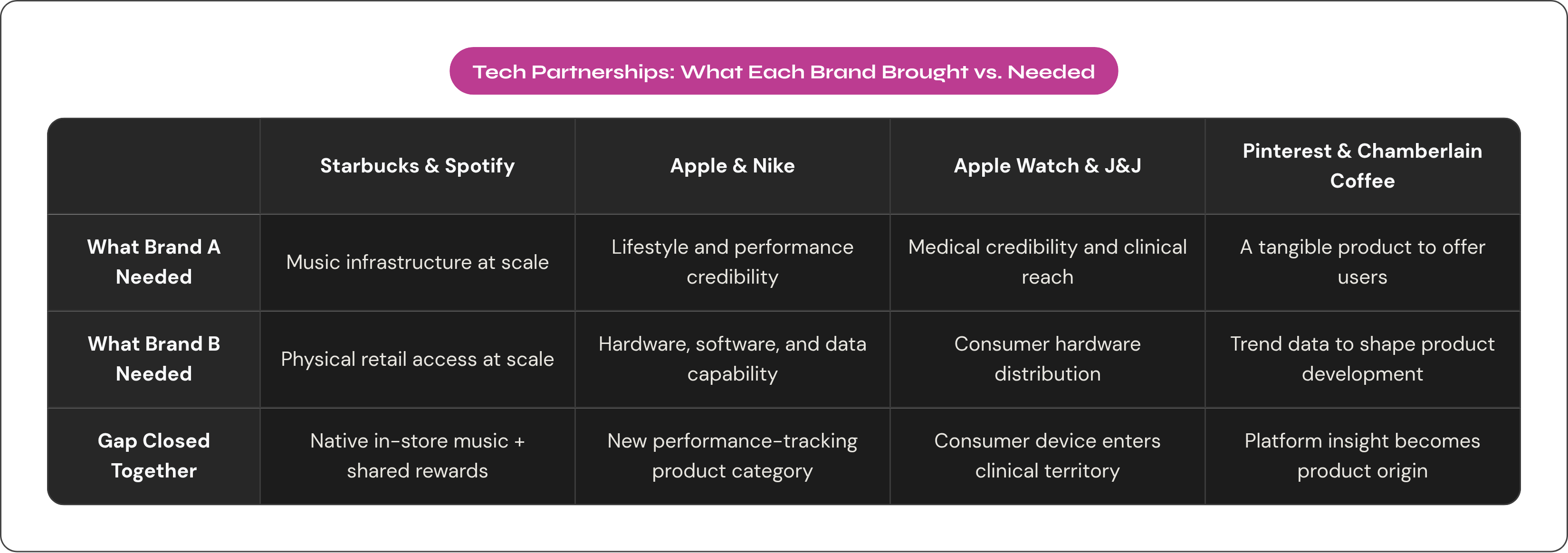
The best technology collaborations don't just integrate two products. They close a gap that neither brand could close independently, and the customer feels that closure immediately.
Starbucks and Spotify is a clear illustration of complementary strengths operating without friction. Starbucks needed music infrastructure for its stores and had no viable path to building it internally. Spotify needed physical retail access at scale and had no mechanism to acquire it. The partnership addressed both simultaneously: joint campaigns, shared rewards, an in-store experience that felt native to both brands.
Uber and Spotify's integration is smaller in scope but identical in logic. Riders control in-car music through their Spotify accounts. A modest feature that deepened engagement with both apps at once, using nothing either brand could have provided for themselves.
Apple and Nike's partnership, built around the Nike+ athletic shoe ecosystem, combined Apple's hardware and software capabilities with Nike's positioning in performance. It created a product category that neither brand owned before the collaboration, strengthening Apple's lifestyle credibility while expanding Nike's claim on performance data simultaneously.
Apple Watch's collaboration with Johnson and Johnson on atrial fibrillation detection moved a consumer gadget into clinical territory by detecting early signs of certain heart conditions. For Apple, meaningful progress toward medical credibility. For Johnson and Johnson, a hardware distribution channel they couldn't build.
Pinterest's collaboration with Chamberlain Coffee, described by Pinterest as its first-ever product collaboration, is instructive because the complementary strength Pinterest brings is genuinely unusual: it's data. The co-created Sea Salt Toffee blend was inspired directly by Pinterest trend data, and Emma Chamberlain used the platform to shape both flavor development and campaign visuals. The platform's insight into what its users want became the product's origin story. That is a novel deployment of what a platform can actually contribute to a physical product, and most platforms haven't figured out how to replicate it.
Coca-Cola's collaboration with OpenAI on AI-powered marketing and product personalization points toward where brand-technology partnerships are heading: not just integration of existing products, but co-creation of the product itself.
Food and Beverage Collaborations and Why Cultural Timing Matters as Much as Product Logic
A 2025 study on co-branding in fast-moving consumer goods found that co-branded products consistently earned higher loyalty scores than the baseline products of either participating brand (Journal of Product and Brand Management, 2025). Consumers, when given a choice, preferred the collaboration to the original. That finding suggests the act of collaboration carries value that neither product generates independently, and it should change how food and beverage brands think about what they're actually selling when they partner.
Product logic matters. Cultural timing often matters more. The question isn't just whether two flavors pair well; it's whether the pairing lands at a moment when both brands' audiences are simultaneously paying attention.
The Reese's and Oreo collaboration, launching in September 2025, combined two widely recognized snack identities. The product logic is almost trivially simple: peanut butter, chocolate, and cookie. An early-access signup system built anticipation before launch, transforming a product introduction into a shared cultural event. The collaboration was designed to be talked about before it could be tasted.
Heinz and Absolut's Tomato Vodka Pasta Sauce targets a specific consumer: one who cooks from scratch, drinks deliberately, and reads food media. Heinz brings sauce expertise and grocery distribution; Absolut brings the cultural credibility of spirits. The product sits at the intersection of two consumption rituals that the same person performs on the same evening. That precision is the whole strategy.
Dunkin's collaboration with Sabrina Carpenter illustrates how a celebrity partner can become the collaboration's primary mechanism. The limited-edition lineup was built around Carpenter's audience alignment with Dunkin's demographic; the product was almost secondary to the cultural association. When the audience overlap is that precise, the product just needs to be good enough to justify the occasion.
Wendy's partnership with Paramount to bring the Krabby Patty into real life for SpongeBob SquarePants' 25th anniversary is a clean example of nostalgia as targeting. The customers most likely to respond are adults who grew up with the IP, now old enough to have disposable income and strong enough associations with the property to actually act on them.
Formula 1 and KitKat's long-term global partnership, announced in late 2024 and expanding through 2026, is built for sustained value rather than a single drop. "Have a break" aligns naturally with the rhythm of a race weekend, and sustained partnerships accrue cultural meaning that one activation simply cannot manufacture.
Pringles and Miller Lite's summer 2025 limited-edition flavors, Beer Can Chicken and Grilled Beer Brat, make the audience-overlap thesis almost embarrassingly literal. Both brands share the same summer social-occasion customer. The product is just the proof.
Beauty Collaborations That Use Unexpected Pairings to Generate Outsized Cultural Attention
Start here: the parenting brand Frida partnered with OddFellows Ice Cream to launch a breast milk-inspired ice cream flavor promoting a new manual breast pump. According to Frida, the product generated more than 7.8 billion impressions, breast pump sales increased 55%, and the pint drops sold out in minutes.
Frida is not in the ice cream business. OddFellows is not in parenting hardware. What both brands needed was the kind of attention a conventional marketing campaign cannot manufacture, the kind that comes from doing something unexpected enough to become genuinely newsworthy. The collaboration was a PR mechanism, and it worked precisely because the pairing was strange enough to be impossible to ignore. There was no product synergy. That was the entire point.
E.L.F. Cosmetics and Dunkin's donut-inspired makeup line runs on simpler logic. The audience overlap is the whole strategic rationale: young, social-media-native women who follow both brands in the same feeds. The collaboration amplifies visibility in spaces both brands already share, and does it in a way that neither brand's content alone achieves.
Disney and Bath and Body Works' 2025 fairytale fragrance collection, spanning 85 products across body lotions, mists, candles, soaps, and lip glosses, pairs Disney's emotional resonance and IP breadth with Bath and Body Works' product expertise and retail distribution. The customer arrives with feelings already formed before they open the package. That's a significant advantage over any brand building sentiment from scratch.
Jo Malone's collaboration with Paddington Bear introduced whimsy into a category that can become oppressively serious about itself. The result is a limited-edition product that functions as a collectible. The juxtaposition of luxury fragrance and a beloved children's character makes the object more interesting, not less credible, which runs counter to what most luxury brand managers would predict going in.
Liquid Death and MeUndies, a beverage brand and an underwear company, make a pairing that is impossible to explain through product logic and easy to explain through brand personality. Both brands trade in irreverence. Both sell directly to consumers who identify with countercultural positioning. The personality overlap is the entire rationale, and it's sufficient.
The most attention-generating beauty collaborations lean into the categorical distance between the two brands. The further apart the categories appear on the surface, the stronger the earned media pull, provided the underlying audience alignment is genuine. Surprise generates coverage; alignment determines whether that coverage converts.
How Sports and Adventure Brands Use Collaborations to Create Content That Neither Could Produce Alone
GoPro and Red Bull produced Stratos: Felix Baumgartner's live-streamed freefall from 24 miles above Earth in October 2012. GoPro needed a spectacle that would demonstrate what its cameras could capture under the most extreme conditions imaginable. Red Bull needed footage that could reinforce its "gives you wings" positioning at a scale no conventional marketing campaign could approach. The event was the product. Red Bull provided the athlete, the infrastructure, and the audience; GoPro provided the hardware and the visual proof. Neither brand could have produced the other's contribution, and the gap between what each needed and what each offered is exactly why the collaboration worked.
Lamborghini and Babolat's limited BL001 paddle series, directly inspired by Lamborghini's aerodynamic design language and available in five colors drawn from Lamborghini's own palette, is targeting a specific cultural opening: padel tennis has grown rapidly, creating a new arena for luxury performance branding that golf no longer monopolizes by default. The collaboration reaches an affluent, sports-oriented audience through a door that automotive marketing typically doesn't find.
Nike and LEGO's multi-year collaboration merges sport and imaginative play for younger consumers. The multi-year commitment signals that both brands see durable audience overlap in a demographic where sport and creative play aren't yet separated by age or social expectation.
Stratos was unrepeatable by design. Its power came partly from singularity, the fact that it could only happen once at that scale. Lamborghini and Babolat, Nike and LEGO, these are built for sustained accumulation. Both approaches are defensible. They just require different definitions of success and very different patience for when the returns arrive.
Sustainability as a Collaboration Rationale, and Where It Creates Real Value Versus Just Good Press
Sustainability partnerships are more common now than at any prior point in brand history. Some of that growth reflects genuine commitment. Some reflects the discovery that sustainability messaging generates favorable press coverage regardless of what's actually happening in the supply chain. The market is getting better at distinguishing between the two, slowly.
Adidas and Parley produce sneakers made from recycled ocean plastic. The material innovation is real. Parley provides sourcing infrastructure and credibility; Adidas provides manufacturing scale and distribution. The collaboration works because the product is the proof: the recycled material is physically present in the shoe, not just mentioned in the campaign brief. A customer who buys the product is participating in the supply chain, not merely endorsing a message about it.
Patagonia and Adidas have each made independent public commitments to material sustainability — Patagonia toward 98% recycled materials with a target of reaching 100%, Adidas toward eliminating virgin polyester and targeting 100% recycled polyester by 2024. Their collaboration reinforces each brand's credibility rather than substituting for it. Two brands with genuine prior commitments pointing in the same direction produce a signal that's harder to dismiss as performative than either could generate in isolation.
ERM and Workiva's partnership is less visible to consumers but instructive. It produces real-time ESG data for corporate disclosure requirements, no consumer-facing narrative attached. The collaboration works because it solves a compliance problem that neither organization could address as effectively alone. The absence of a brand story is, in this case, evidence of the thing actually functioning.
Here is the tension that doesn't resolve cleanly: sustainability partnerships now generate positive press almost by default, which means they attract entrants whose primary motivation is the coverage rather than the practice. The collaborations that hold up are built on material commitments and measurable progress. The ones that don't are distinguishable, most clearly, by what happens when the press cycle ends and no one is checking anymore.
Entertainment IP and Retail: When Licensing Logic Becomes Genuine Collaboration Strategy
Entertainment IP provides something product development cannot replicate on its own: emotional resonance that exists in the customer before they encounter the product. The retail partner provides product expertise and the channel. At its core, this is audience rental with a physical artifact as proof of purchase. The question is whether the retail brand builds anything lasting from the arrangement, or just moves units during the release window and disappears when the credits roll.
The Wicked and Beis luggage collection, timed to the film release and co-founded by actress Shay Mitchell, demonstrates how precise timing transforms a licensing arrangement into a cultural moment. Theater lovers and modern travelers are adjacent audiences; the film's release was the mechanism that made them simultaneously active.
Crocs' collaboration with Naruto is one data point within a broader collaboration strategy that tracked alongside Crocs' revenue growth from $1.39 billion in 2020 to $3.96 billion in 2023 (Crocs, Inc. Annual Reports). No single partnership caused that growth. The sustained accumulation of IP collaborations sent a consistent signal to a younger audience: this brand is paying attention to what you care about. Repeated often enough, that signal becomes identity.
Disney's collaboration with Bath and Body Works belongs in this section as well as the beauty section, because it illustrates what IP breadth does as a strategic asset. Disney's collaboration strategy spans dozens of retail categories simultaneously. The IP is consistent across all of them; what changes is the product expertise and distribution each retail partner contributes.
The risk in entertainment IP collaborations is brand hierarchy clarity. When the IP is beloved and the retail brand is lower in the consumer's emotional hierarchy, the retail brand gains cultural proximity but risks invisibility entirely. The customer buys the Wicked luggage. Whether they remember it was Beis depends entirely on whether Beis gave them a reason to care beyond the IP.
The strongest entertainment IP collaborations build something into the product that is distinctly the retail brand's contribution, rather than treating the product as a canvas for the IP. That distinction separates licensing from genuine collaboration, and it determines whether the partnership builds long-term equity or simply rides a release window until the audience moves on.


