
Essay Influencer Tech Category Trends
Influencer Marketing Platform Market Overview
Budget shifts and better software are fueling faster growth than traditional digital ads.
The influencer marketing platform market is expanding faster than most digital ad categories because three separate forces are pushing at once: brands are moving budget out of legacy channels, the software supporting creator campaigns has matured into something far more capable than a search directory, and the industry has decided that reach and impressions no longer count as proof of anything. None of this is a fad working its way through the marketing calendar. It's a structural repositioning of where ad dollars go and what brands demand in return for spending them.
Why the influencer marketing platform market is growing faster
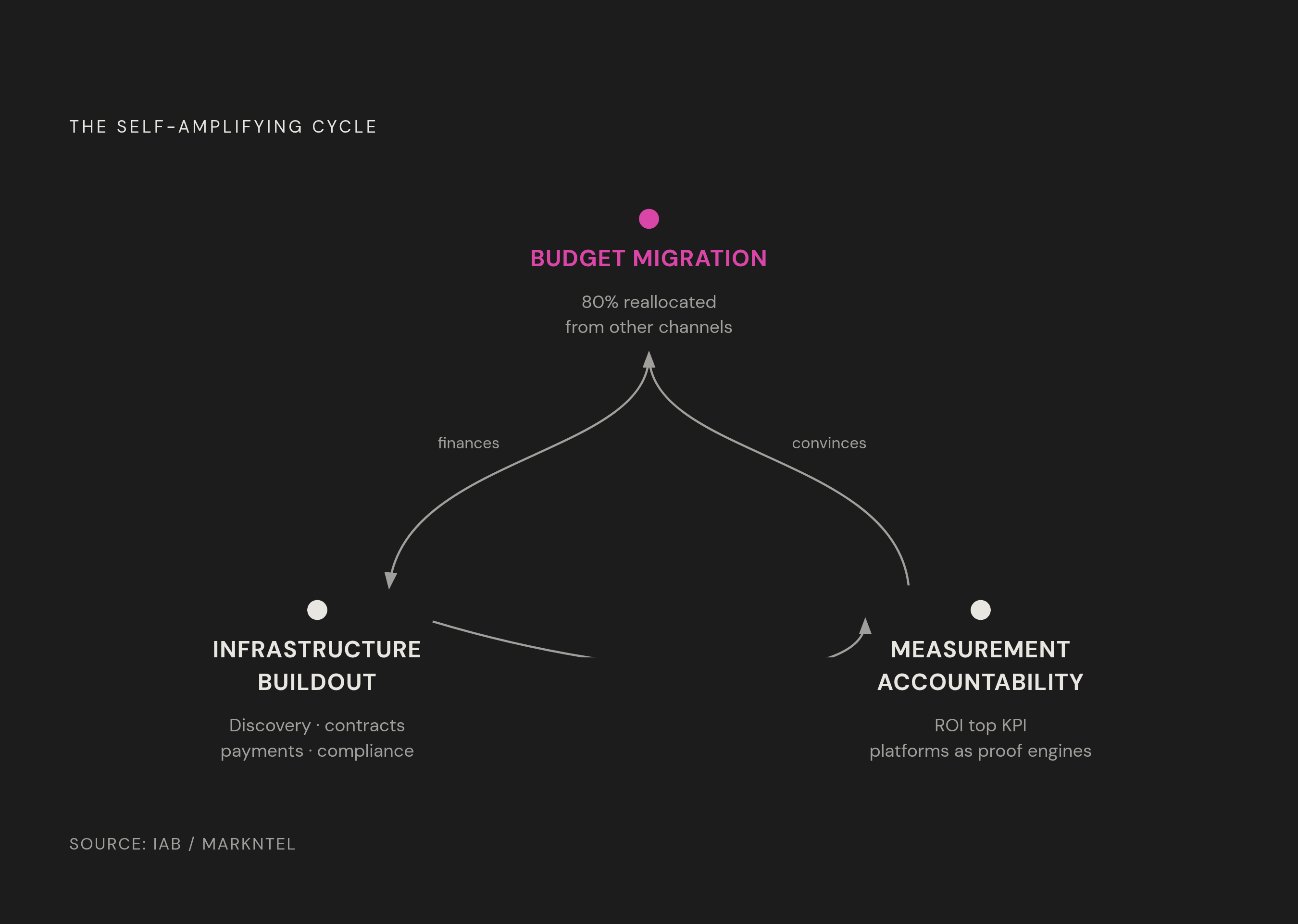
Start with the money. Marketing leaders are not simply finding new budget for influencer work, they are pulling it from channels that used to get it by default. Sprout Social's CMO's Social Media Planning Guide for 2026 found that 80% of marketing leaders raising influencer spend are doing so by reallocating funds from other channels, not adding net-new dollars to the marketing budget. That's a meaningful distinction: it means influencer marketing is winning a competitive argument inside the budget meeting, not riding a wave of overall ad spend growth. Display advertising has lost ground as audiences in content-saturated feeds tune it out, and that decline is what's funding the shift.
Money alone doesn't explain the pace of growth, though. The tooling had to catch up too. Platforms that once did little more than help a brand find creators by follower count and niche have turned into operating systems that manage the entire relationship, identifying creators, verifying their audiences, handling contracts, routing content through approval, tracking performance, processing payment, and keeping the whole thing compliant across Instagram, TikTok, YouTube, Twitch, podcasts, newsletters, and social commerce storefronts. That's a wide functional footprint for a single piece of software to own, and it's what enterprise buyers now expect walking into a vendor conversation.
The third force is the one tying the other two together: accountability. Brands have shifted what they measure, moving away from reach and impressions and toward conversions, customer acquisition, and sales that can actually be traced back to a specific creator post. MarkNtel Advisors, citing IAB research, found that the largest share of creator advertising buyers name overall ROI as their most important KPI. That single fact reframes everything else in this market: platforms aren't being bought as discovery tools anymore, they're being bought as proof engines.
These forces don't just sit side by side, they feed each other. Budget migration finances the infrastructure buildout. Infrastructure buildout makes real measurement possible. Measurement, once it exists, is what convinces the next round of marketing leaders to move more budget over. That loop is what makes this market's segmentation and geography legible: once you see the loop, the numbers in application share, buyer size, and regional distribution stop looking like scattered data points and start reading as the visible trace of that same cycle running in different markets and company sizes.
How research firms size this market
Anyone comparing market-size figures across research firms will notice they don't just disagree, they disagree by orders of magnitude. That divergence comes from scope, not sloppiness.
MarketsandMarkets, publishing in March 2026, counts only platform software fees and arrives at the narrowest and most conservative number: roughly USD 1.15 billion in 2026, expected to more than double by 2031 on a double-digit compound annual growth rate. That figure describes software subscriptions and licensing, nothing more. It excludes the creator payments, agency fees, and campaign spend that flow through those platforms but aren't captured as platform revenue itself.
Including platform fees alongside broader creator marketing spend pushes the numbers into the tens of billions. Grand View Research puts the market in that range for 2025 with substantial growth projected through 2033, and MarkNtel Advisors reports a comparable base figure and growth trajectory through 2032. These estimates are counting a different thing than MarketsandMarkets: not just the software fee, but the dollars flowing through the campaigns that software manages.
Including total creator economy ad spend, the broadest scope of all, pushes the figures higher still. Technavio projects substantial growth from 2026 to 2030, and Straits Research projects the market reaching a very large figure by 2034 at a rapid compound annual growth rate. Neither of these firms is claiming the software market itself is worth that much. They're sizing the entire economic activity that creator marketing touches.
None of these firms is wrong. Reading the scope before the number resolves most of the disagreement. What holds across every one of these methodologies, narrow or broad, is the direction: the space is expanding fast and pulling in serious capital, and the argument between firms is about what to count, not about whether the count is going up.
Market drivers and friction points
Growth and friction in this market are not two separate stories running in parallel. They're the same story, viewed from opposite ends of the same infrastructure buildout.
Start with what's pulling demand forward. Consumer behavior has moved decisively toward short-form video, livestreams, and in-app shopping, and platforms are racing to keep up with attribution across that behavior. TikTok Shop has turned creator content into a purchase event that happens without ever redirecting the viewer off the app, and YouTube Shopping is rolling out in-app checkout in 2026, though for now it only covers select merchants in the US and South Korea. MarketsandMarkets names social commerce enablement and creator monetization tools as a primary opportunity for platform vendors, and it's easy to see why: a purchase that happens inside the content itself is a purchase a platform can actually trace and report on. Smartphone and mobile network penetration keeps expanding the audience creators can reach in the first place, a driver both Straits Research and MarkNtel Advisors identify by citing GSMA and ITU connectivity data.
Now the drag. Fragmentation is the core restraint, and MarketsandMarkets identifies it as such. Layer onto that the privacy restrictions limiting access to granular user-level data, another restraint MarketsandMarkets flags, and the depth of audience analysis any platform can offer runs into a hard ceiling.
Fraud is the sharpest edge of all this. Gartner's Marketing Technology Survey found that 21.7% of marketers cite influencer fraud as a main day-to-day operational problem, up sharply from the prior survey round, with a meaningful share of influencer marketing budgets going to waste on engagement that was never real. That statistic runs against the industry's own accountability narrative, and fake engagement and authenticity issues compound the ROI measurement problem. Influencer Marketing Hub's early 2026 survey backs this up from a different angle: measuring ROI and untangling attribution complexity together rank as a top-tier operational challenge even for teams that have already bought platform tooling meant to fix exactly that.
This is the tension actually shaping where vendor investment goes. Those aren't features added for their own sake. They exist because the market's central promise, provable ROI, keeps running into fragmented data and fraudulent engagement that make the promise hard to keep.
That's a wide functional footprint for a single piece of software to own, and it's what enterprise buyers now expect walking into a vendor conversation.
Application breakdown: search and discovery leads, campaign management and analytics gain ground
Search and discovery still commands the largest share of how these platforms actually get used. Grand View Research puts that segment at roughly one-third of the market in 2025, and MarketsandMarkets expects search and discovery to keep leading through 2031. Finding the right creator remains the entry point for almost every campaign, and it's the function most brands think of first when they picture what one of these platforms does.
But usage share and growth are pointing in different directions. Campaign management already holds roughly a quarter of the market in 2026, MarkNtel Advisors reports, and a large piece of what buyers now pay for is workflow and execution rather than just the initial matching of brand to creator. MarketsandMarkets projects content marketing and distribution as the fastest-growing marketing type segment, at a 14.6% compound annual growth rate through 2031. Straits Research separately identifies content creation as the fastest-growing application segment through 2034, and finds micro-influencers holding the leading share among influencer types at roughly one-third in 2025.
The functional map behind these numbers has gotten wide. MarkNtel Advisors segments the application layer into search and discovery, campaign management, analytics and reporting, content creation, influencer relationship management, compliance management, payment processing, product seeding, social listening, and more. Enterprise buyers increasingly expect all of that inside one platform rather than stitched together from separate vendors. A tool that only handles discovery covers one layer of a much longer stack now, and the growth numbers back that up: the fastest-growing pieces of the market are the ones tied to proving a campaign worked, not just finding who should run it.
Organization size and end-use industry breakdown
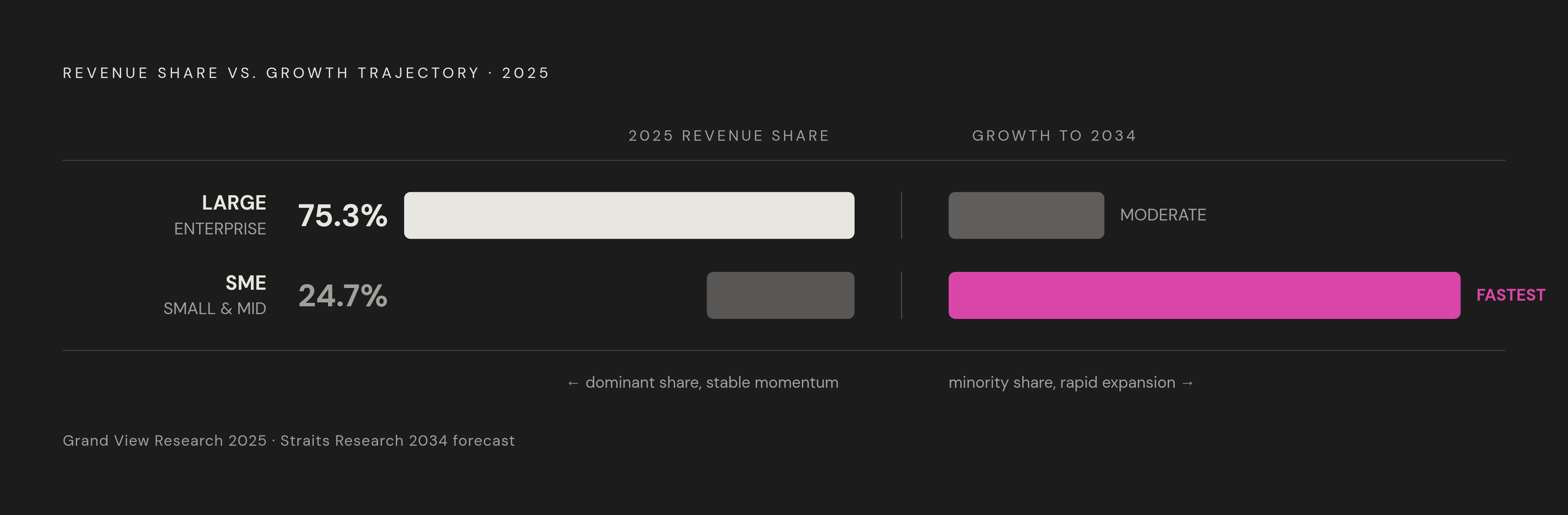
Revenue and growth point in different directions here, and that gap is the real story in this segment of the market. Large enterprises currently account for the dominant share of platform revenue, while SMEs are expanding at a faster clip, and the industries buying into creator marketing have spread well past where the channel started.
Grand View Research puts large enterprises at 75.3% of market revenue in 2025, and Technavio places that segment well ahead of smaller organizations. That concentration makes sense given what large buyers actually need. Enterprise clients require security built for scale, brand safety protocols, contract automation across multi-regional programs, and deep integration with ecommerce and CRM systems, according to Technavio, a bar few smaller organizations need to clear.
Growth is telling a different story, though. Straits Research identifies SMEs as the fastest-growing organization-size segment through 2034 because platform tiers have gotten cheaper and easier to adopt, and creator marketing at a modest budget can still produce real ROI for a small brand that doesn't need enterprise-grade compliance tooling. SMEs are buying for affordability and ease of use, not for the multi-regional contract management a global consumer brand needs. Two different products for two different buyers, both growing, at different speeds and for different reasons.
Industry adoption has widened out just as much. Straits Research names beauty and personal care as the leading end-use segment, at roughly a quarter of market revenue in 2025. Grand View Research and Technavio instead report fashion and lifestyle as the largest end-use category, and MarketsandMarkets identifies retail and ecommerce broadly as the largest end-user segment. Those findings reflect different cuts of an industry taxonomy that spans retail and ecommerce (fashion and lifestyle, health and wellness, sports and fitness, food and beverages), travel and hospitality, media and entertainment (gaming and advertising/PR agencies), BFSI, automotive and transportation, education, and healthcare and life sciences, showing the channel has moved well beyond its consumer goods origins. Influencer marketing started in consumer goods and beauty. It clearly doesn't live there exclusively anymore.
Technavio's account of a global consumer packaged goods company running a campaign across hundreds of micro-influencers in multiple countries makes the enterprise case concrete: one dashboard handling vetting, contracts, payments, and performance reporting for a program that size is what "enterprise-grade" actually buys a company at that scale.
Geographic concentration of the market and shifting regional distribution
North America holds the largest share of this market in every major research source available, and Grand View Research puts that figure at 31.0% of global revenue in 2025. That dominance reflects an early and deep base of platform vendors, agencies, and brand marketing budgets concentrated in the US in particular, built up over a longer runway than most other regions have had.
The distribution isn't static, though. Asia Pacific's growth is accelerating and Europe's data-privacy environment is shaping a distinct set of platform requirements around consent, data handling, and audience verification.
North America's current share, and its dominance, describes where the market has been built out furthest, not where the next phase of growth is concentrated. The regions catching up are doing so on different terms: faster smartphone-driven audience growth in Asia Pacific and stricter privacy-by-design requirements in Europe.
Notes
- Influencer Marketing Platform Market Report 2026-2031, by Application, Geo, Tech
Provided the narrow platform-software-only market sizing of USD 1.15 billion for 2026, the 14.6% CAGR for content marketing and distribution, and the identification of social commerce enablement, fragmentation, and privacy restrictions as key drivers and restraints.
- Influencering Platform Market Growth Analysis - Size and Forecast 2026-2030 | Technavio
Provided the enterprise segment's requirements for security, brand safety, and contract automation, the SME fastest-growing segment finding, and the fashion and lifestyle largest end-use category classification.
- Influencer Marketing Platform Market Size, Share, Growth, 2034
Provided projections through 2034, identification of content creation as the fastest-growing application segment, micro-influencers holding leading share, beauty and personal care as a leading end-use segment, and SMEs as the fastest-growing buyer size.
- Influencer Marketing Platform Market Share Outlook
Provided the ROI-as-top-KPI finding from IAB research, the campaign management share figure for 2026, and the detailed application layer segmentation including compliance management, payment processing, and social listening.
- Influencer Marketing Platform Market Size Report, 2026-2033
Provided the search and discovery segment's roughly one-third market share for 2025, large enterprises at 75.3% of market revenue, North America at 31.0% of global revenue, and fashion and lifestyle as the largest end-use category.
- Influencer marketing trends 2026: Where smart brands are headed
Provided the finding that 80% of marketing leaders raising influencer spend are reallocating from other channels rather than adding net-new budget, and the context of display advertising losing ground.