Long-Term Brand Ambassador Programs vs One-Off Sponsorships
Sustained ambassador programs build trust and loyalty that one-off sponsorships cannot replicate.

A brand ambassador program is a structured, ongoing agreement, usually running months or years, in which a defined group of creators, customers, or community members represents a brand through recurring content, referrals, or events⟦c2⟧. A one-off sponsorship is a campaign contract covering a fixed deliverable set, one video, one event integration, one seasonal push, after which the relationship ends⟦c2⟧. These are not two points on the same spectrum ⟦c51⟧. They answer two different questions, and treating them as interchangeable is where a lot of marketing budgets quietly go to die ⟦c51⟧.
The real difference sits in the kind of value each model can produce. Ambassador programs build equity through familiarity, trust, a growing library of content assets, and a sense of community that compounds the longer the relationship holds. Sponsorships buy reach and attention at a defined moment, and that attention spends itself the instant the campaign ends, because it was never built to compound. One structure is built for depth, the other for a single moment, and neither one deserves the label of smarter buy by default.
The single most common error brands make is treating the choice as a permanent hierarchy, ambassador programs as the "grown-up" strategy and sponsorships as the training-wheels version, rather than as a toolkit matched to the job at hand. A launch needs a spike. A community needs a ambassador. Confusing the two is how a perfectly good sponsorship budget ends up funding a program nobody had the staff to run ⟦c51⟧. Half of influencers charge $250–$1,000 ⟦c3⟧.
The influencer marketing industry's shift toward longer relationships
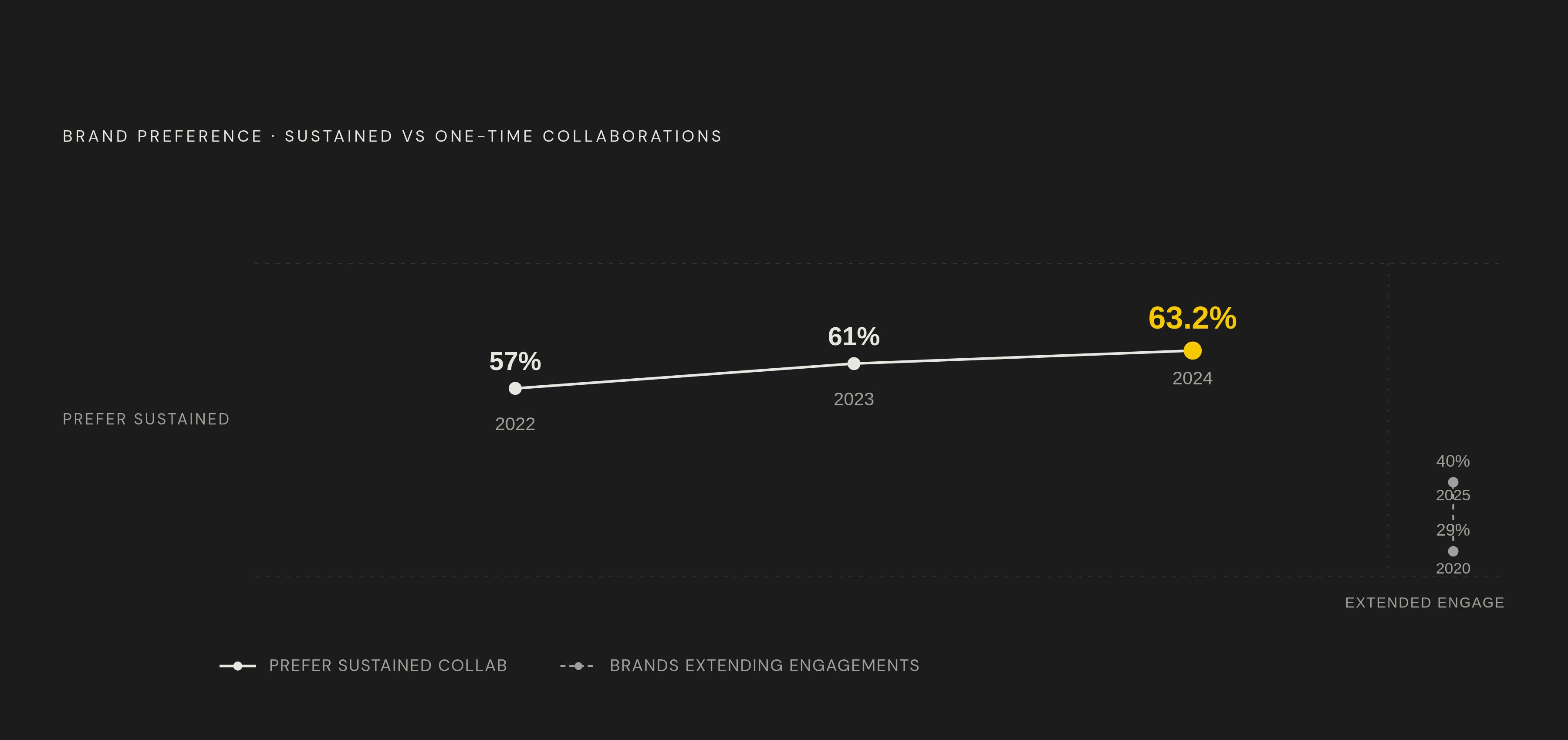
The shift toward sustained partnerships is not sentiment. It has moved in one direction for three straight years: 63.2% of brands now prefer sustained collaborations over one-time engagements, up from 61% in 2023 and 57% in 2022⟦c4⟧⟦c33⟧⟦c34⟧⟦c35⟧. That kind of steady, multi-year climb marks a structural reallocation in how brands think about creator relationships, and it is visible on both sides of the negotiating table. 63% of creators say they prefer long-term partnerships over any other campaign type ⟦c6⟧. Supply-side preference is reinforcing demand-side preference rather than fighting it⟦c6⟧.
Audiences have gotten sharper at spotting an obvious paid placement, too. Trust is no longer something a single sponsored post can manufacture on its own. A brand can rent attention through a single transaction, but it cannot rent credibility that way, and closing that gap is the entire reason long-term programs exist. WFA reported that 40% of brands engaged influencers on an extended basis in 2025, compared with 29% in 2020⟦c46⟧⟦c47⟧, an eleven-point rise over five years⟦c5⟧. Investment is following intent: 73% of marketers plan to invest more in ambassador programs in the next 12 months, with 85% of US marketers planning increases compared to 61% of UK marketers, a transatlantic gap ⟦c7⟧.
How ambassador programs generate value one-off sponsorships cannot replicate
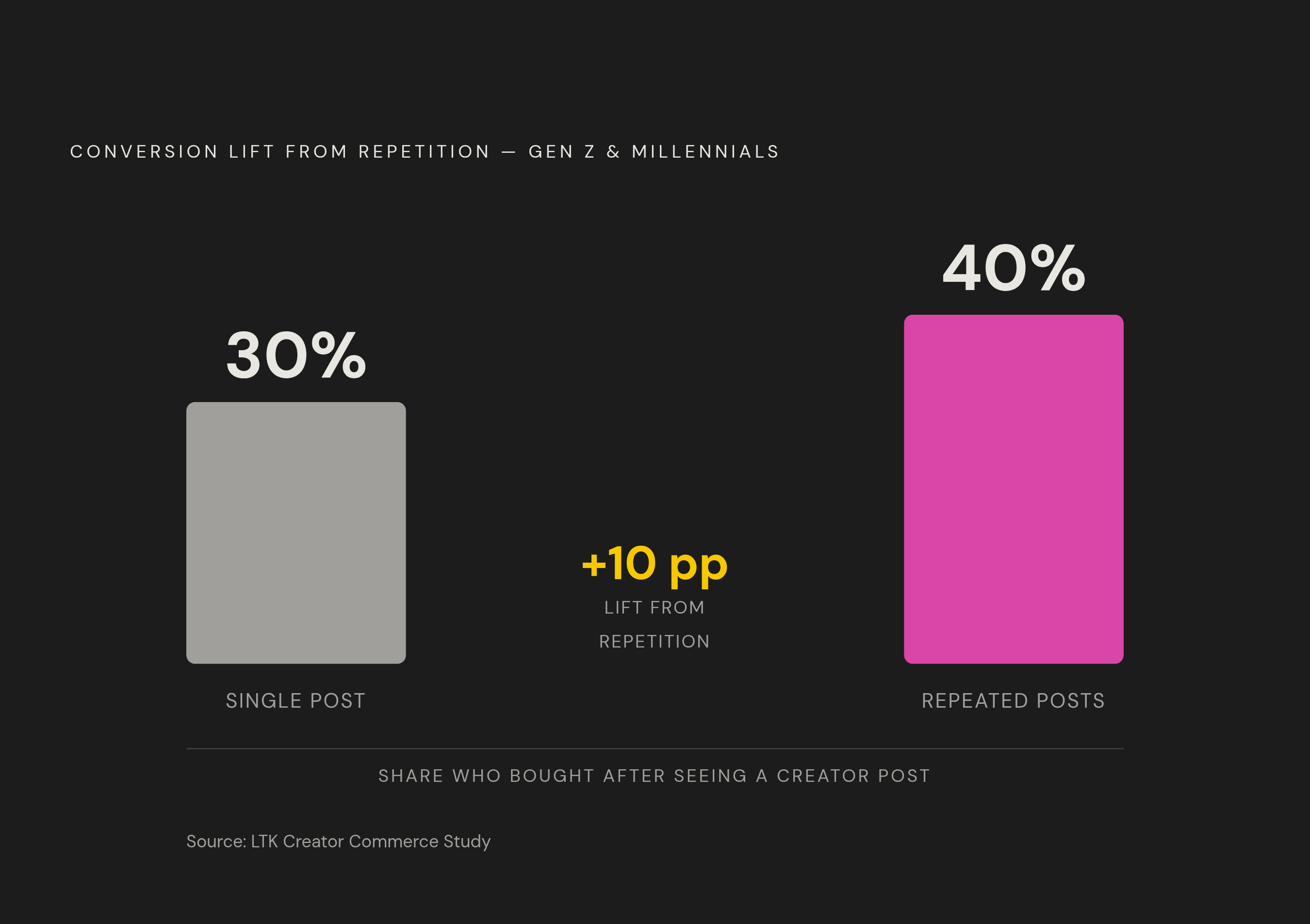
Trust compounding is the core mechanism, and it runs on a fairly plain cognitive principle. A single sponsored mention registers to an audience as an ad and nothing more. Repeated mentions from the same creator, spread across months, start to register as something else entirely: genuine preference. That reclassification, from "this is an ad" to "this person actually uses this," is the whole value proposition of the ambassador model, and the purchase data backs it up. LTK research found that 30% of Gen Z and Millennials bought a product after seeing a creator post about it once, while 40% bought after repeated posts from the same creator⟦c8⟧⟦c49⟧. Ten points sounds modest until it runs across a brand's full acquisition volume, at which point that gap separates a mediocre quarter from a strong one⟦c8⟧. It tracks with a wider pattern: 92% of consumers say they trust recommendations from people they know over brand messaging, and a long-term ambassador sits far closer to "person I know" than any one-off sponsor ever could⟦c9⟧⟦c38⟧.
The economics improve with time too, which cuts against how most marketers are trained to think about retainers as a fixed monthly cost that never gets cheaper. Onboarding, briefing, and contracting happen once instead of getting re-paid with every new creator relationship, and the ambassador builds product fluency the brand never has to fund again. A twelve-month ambassador program produces a cost per acquisition that runs 40% to 60% lower than an equivalent stack of one-off campaigns⟦c10⟧⟦c42⟧. Creators price that predictability in directly: 71% already discount for longer-term partnerships, and another 25% say they would consider it⟦c11⟧⟦c36⟧⟦c37⟧. It is the same logic that makes a retainer client cheaper per hour than a one-time consulting engagement.
Ambassadors leave behind something sponsorships mostly do not: a running pipeline of usable content, photos, video, reviews, generated as a byproduct of the relationship instead of commissioned as a discrete deliverable, reusable across paid, owned, and earned channels at no added production cost⟦c12⟧. There is a quieter algorithmic effect layered on top. Repeated mentions from the same creator read as relevance signals to recommendation systems, which tends to earn more organic reach than an isolated sponsored post ever manages, a structural edge a one-off sponsorship cannot buy its way into no matter the budget behind it.
The performance data: findings and unresolved questions
The strongest available benchmark comes from Roster's Ambassador Marketing Benchmarks 2026, a study of live ambassador programs running on its platform between February and July 2026⟦c13⟧. The top 25% of programs in that study refer 5.58% of brand revenue⟦c31⟧, a genuinely striking number, though one loaded with conditions most brands skip past. It requires clean attribution infrastructure, a program that has matured past its first year, and a DTC model where conversion actually traces back to the ambassador⟦c14⟧. A brand selling through wholesale, or one still in its first ninety days, has no business expecting anything close to 5.58%, and should not call its own program a failure for missing it⟦c13⟧⟦c53⟧.
Long-term creator partnerships deliver 70% higher engagement than one-off collaborations⟦c15⟧⟦c28⟧. Whether the mechanism behind that number means anything depends on the audience: a smaller, more deeply aligned audience engaging at a higher rate can genuinely outperform a larger, colder audience reached through a single placement, but only when the product actually fits that audience. Engagement lift does not rescue a mismatched product. It amplifies a matched one, and mistaking the two is how ambassador budgets get wasted on the wrong creator roster ⟦c51⟧. Separately, ambassador programs get reported as the highest-ROI campaign format in the industry, though that claim traces back to research adjacent to vendors selling ambassador software. It lines up directionally with third-party data on engagement and cost per acquisition, but its precision deserves to be read with that provenance in mind⟦c16⟧.
None of this resolves the question of time. Ambassador programs compound, but compounding takes months, sometimes longer, to appear in a revenue line. A brand facing a quarter-end shortfall or an urgent cash need does not have that runway, and no benchmark, however favorable, changes that math.
When one-off sponsorships remain the strategically correct choice
Some marketing objectives are inherently moment-shaped, and pretending otherwise wastes budget on the wrong tool. A product launch needs concentrated attention at a single point in time. The goal is a spike in reach, not a deepening relationship, which makes an ambassador program the wrong instrument for a job that only has to happen once. Entering a new market or demographic segment is a similar case: the brand needs to reach an audience it has not touched yet, which is a fundamentally different task from deepening awareness among people who already know it.
One-off campaigns also work as an audition stage, and this is where a lot of brands get the sequencing backwards. Mature creator programs test a wide pool of creators through short-term work first, see who actually delivers, and only then invite the strongest performers into a longer relationship. Signing long-term ambassador contracts before any performance data exists risks locking underperforming creators into an expensive, ongoing commitment that costs far more to unwind than a single sponsored post ever would.
There is also a plain operational constraint that strategy decks tend to skip over: ambassador programs need continuous management. Briefing cadence, relationship maintenance, regular performance review, none of it runs itself. A brand without the internal staff to sustain that work will get better returns from a handful of well-executed one-off campaigns than from an ambassador program that gets launched and then neglected. Binet and Field's framework in The Long and the Short of It remains the clearest articulation of this trade-off in marketing theory generally: short-term, high-intensity activity and continuous long-term activity serve genuinely different functions, and the real discipline is not picking one permanently but calibrating the balance between them for the situation at hand⟦c17⟧.
Four real programs that show how the ambassador model works in practice
Gymshark built its ambassador strategy around treating fitness influencers as partners rather than paid endorsers, which shows up in ongoing collaborations and product co-creation, including exclusive lines such as the Whitney Simmons collaboration⟦c18⟧. The brand extended that same logic outward into its broader audience through #Gymshark66, a community campaign encouraging everyday followers to share their own fitness journeys, turning the ambassador model into something the whole customer base could take part in. Gymshark is now valued at an estimated $1.45 billion, a figure that sits alongside, though is not proven to be caused solely by, that ambassador-first approach⟦c19⟧⟦c39⟧.
Sephora Squad runs on an annual cohort model: a yearlong, paid ambassador initiative launched in 2019, with a new group selected each year to collaborate on campaigns, attend events, and share genuine product experiences⟦c21⟧⟦c22⟧. Structurally, it gives ambassadors access to Sephora's Creator Lounge, a professional content studio in Los Angeles, and builds diversity and inclusivity into the selection criteria directly rather than treating them as an afterthought⟦c23⟧. It is a useful case study in how a large retailer scales an ambassador program annually without losing the relational depth that makes the model work.
Lululemon takes a different structural approach entirely, building its ambassador tier around offline community leaders: yoga instructors, personal trainers, and studio owners who represent the brand within their own local communities, host classes and events, and feed product feedback back to store teams. Ambassador programs do not have to be content-first. For a brand with a real retail footprint, they can be built around lived, offline community behavior instead of a posting schedule.
Red Bull's Student Marketeers program runs on campus rather than through social feeds, with ambassadors organizing and executing events at colleges, including product sampling and brand experiences⟦c24⟧. The purpose is explicit: generate buzz among college students, build community, and boost product loyalty, with ambassadors living out the "Red Bull gives you wings" positioning through direct experience rather than a scripted post⟦c25⟧. It is event-execution focused rather than content-first, proof that the ambassador model scales across very different mechanics depending on what a brand actually needs its ambassadors to do. It also carries real contractual risk: Wikipedia records a 2025 legal dispute with British powerlifter Nathaniel Massiah over a non-compete clause during a rival-brand promotion period, a reminder that long-term ambassador contracts need the same legal rigor as any other multi-year commitment⟦c20⟧.
The four structural program types and their cost to run
The gifted model pays ambassadors in recurring product instead of cash, and it works best when the product's value is high enough relative to a creator's typical rate to make the trade genuinely worthwhile, which tends to limit it to the nano and micro tiers. It scales cheaply, but with no financial stake in the relationship, creator commitment runs inconsistent, and output quality tends to follow that same inconsistency downward.
The paid retainer model fixes a monthly fee, commonly somewhere in the €200 to €800 range at the micro tier, in exchange for an agreed volume of posts⟦c26⟧⟦c41⟧. It suits brands that need predictable content output and clean budget forecasting. Its weakness mirrors its strength directly: the brand pays the same fee whether the content converts or not, since no performance incentive sits inside the structure.
The affiliate model flips that setup entirely, paying commission with no flat fee attached. It works when a brand has clean conversion attribution and margins healthy enough to absorb a commission rate that commonly runs 10% to 20%, which makes DTC brands the natural fit⟦c27⟧. It is largely self-correcting: strong performers earn more and stay motivated, weak performers earn little and tend to drop off on their own, without the brand having to manage anyone out the door.
The hybrid model combines a reduced retainer with a commission layer, or product plus commission, and it is the structure most programs land on once they have grown past the pilot stage. The retainer guarantees baseline commitment, and the commission layer rewards the ambassadors actually driving results, giving the brand both reliability and upside inside the same contract. Most programs evolve toward this over time, typically starting with gifted or flat retainer arrangements and shifting the strongest performers into a hybrid tier once the data shows who is actually worth the extra structure. The channel-wide numbers explain why: influencer marketing returns an average of $5.78 for every dollar spent, and top-performing creator programs push that to $11 to $18 per dollar⟦c29⟧⟦c30⟧. That range, more than any single benchmark, is the real argument for treating the hybrid structure as the destination rather than the starting point, and for building toward it deliberately rather than drifting there by accident. The baseline for established ambassador programs at DTC brands doing $5M–$25M a year is 0.88% of brand revenue referred ⟦c32⟧. Half of influencers charge between $250–$1,000 per post ⟦c40⟧. In France, investment in influencer marketing reached 519 million euros in 2024 ⟦c43⟧. Investment in influencer marketing in France was 460 million euros in 2023 ⟦c44⟧. Investment in influencer marketing in France was 323 million euros in 2022 ⟦c45⟧. 70% of leaders turned their creator relationships into ongoing partnerships ⟦c48⟧. TikTok reached 61% usage among brands in 2025 ⟦c50⟧.


