Brand Partnership Strategy Development for New Programs
Documented partnership strategy outperforms handshake deals by 15 to 25 percentage points.

The performance gap between formal and informal partnership programs is measurable, and the numbers are not close. Organizations with a documented partner marketing strategy report that their event programs are highly effective at rates roughly 15 percentage points higher than those operating on instinct and relationships alone. Satisfaction with lead nurturing shows an even wider spread, closer to 25 points. Partnerships without defined metrics fail at three times the rate of those with clear KPIs.
The presence of a documented process, not the caliber of the partner, most reliably predicts whether a program generates a return. The partner matters. The framework matters more.
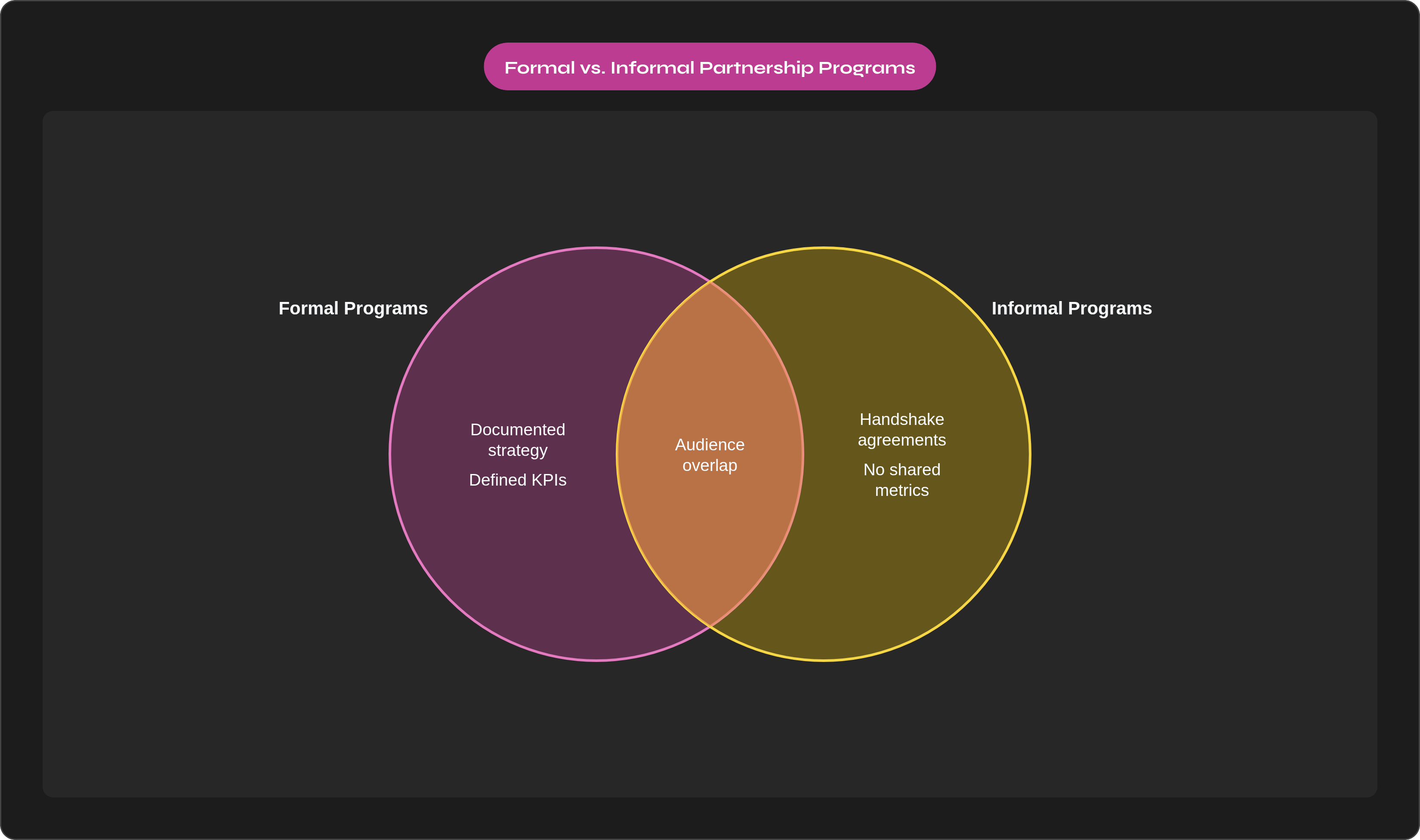
If you have run an informal program, you know exactly what it looks like: opportunity-driven outreach, handshake agreements, no shared metrics, roles that quietly drift as the engagement evolves. The program starts because two people in a meeting had good chemistry. Six months later, nobody can explain what success was supposed to look like, and the people who shook hands may not even be in the same roles anymore. Every one of those failure conditions is addressable. The upside of getting the infrastructure right compounds early, which makes the pre-launch work the highest-leverage investment the program will ever make.
Clarifying What Kind of Partnership the Program Is Actually Building
Not all partnerships operate by the same logic, and the format shapes every subsequent decision: partner fit, contract structure, measurement approach, the legal provisions that actually matter. Selecting a format is not a cosmetic choice. It is structural, and it needs to happen before the first conversation with a prospective partner.
Brand-to-brand campaigns join two organizations in a promotion or co-branded launch for a defined window, combining reach or credibility. Co-branded product drops ask both parties to contribute something distinct, whether cultural cachet, manufacturing capability, or distribution infrastructure, to create a discrete product. Ingredient co-branding embeds one brand's recognizable component inside another brand's product, improving both quality perception and distribution access. Affiliate programs are commission-based and performance-linked, with lower relational complexity but a hard requirement for tracking infrastructure from day one. Influencer and creator partnerships treat audience trust and content as the primary assets, with brand safety and governance concerns that are meaningfully different from brand-to-brand structures. Co-branded content partnerships, including joint webinars, newsletters, and video series, merge two brand voices around shared editorial territory.
Choose your primary format before scouting partners. The format determines what audience overlap requirements are relevant, what IP questions need resolution, and what success metrics are even measurable. Without that choice made in advance, evaluation criteria stay vague. Vague criteria produce inconsistent decisions, and inconsistent decisions are what partnership programs die from quietly over several quarters.
Defining Partnership Objectives Before Any Partner Conversation Starts
The most common failure mode in new programs is starting with a partner in mind and reverse-engineering a rationale for the relationship. It feels like strategy. It is not. The result is opportunistic alignment masquerading as intentional alignment, and those two things perform very differently over a twelve-month horizon.
Objectives worth defining explicitly fall into recognizable categories. Audience reach objectives are about entering a segment or geography the brand cannot access on its own. Customer acquisition cost reduction involves sharing distribution or co-investing in campaigns to lower per-customer spend. Product or capability expansion focuses on co-creating something neither brand could build alone. Brand perception objectives are about borrowing credibility, cultural relevance, or trust from a partner's existing equity.
Each objective implies a different partner profile. Reach objectives require audience overlap data. Credibility objectives require brand sentiment research. Product objectives require capability mapping. The objective determines what evidence you need to evaluate a candidate, so the objectives must be documented before outreach begins.
A brand partnership strategy is, at its core, an action plan designed to create mutual business benefit. Your partner must be able to articulate what they gain from the arrangement. If they cannot, the deal is lopsided, and lopsided deals can underperform or collapse, often at the worst possible moment. Strategic alignment means shared goals and shared values, not just compatible audiences. Programs that skip values alignment tend to discover the gap later, when a partner's conduct becomes public and the reputational surface area has already expanded to include both names.
Before any outreach begins, get internal clarity on three questions: (i) What does success look like at six months and at twelve? (ii) What does the data need to show for the program to be considered healthy? And (iii) what would make your team walk away from a deal that otherwise looks attractive on paper? Write the answers down. They will be tested.
Building a Partner Selection Process That Evaluates Fit Before Enthusiasm
Fit beats fame. The right partner aligns on values, vision, goals, audience, and execution capacity. Brand recognition alone is not a qualification, and programs that chase recognizable names without evaluating fit tend to discover this expensively, usually after signing.
Define your ideal partner profile before generating a candidate list. That profile should generally cover target audience characteristics, capability requirements, and the values criteria that would disqualify a candidate regardless of how strong they look on every other dimension. Those disqualifiers need to be documented in advance, before any one candidate generates the kind of enthusiasm that clouds your judgment.
A scoring framework for candidate evaluation should cover audience alignment: does the partner's audience overlap meaningfully with the brand's target segment? Tools like SparkToro and SimilarWeb, alongside CRM segment analysis, can surface that data before any outreach begins. Brand reputation covers current sentiment, recent press, and active controversies. Financial stability assesses whether the candidate has the capacity to execute and sustain the partnership through its full term. Cultural fit examines organizational values, communication style, and decision-making pace, because a partner who operates on a completely different tempo will create friction that no contract language can fully resolve. Execution capacity asks whether they have the team, the tools, and the bandwidth the partnership actually requires.
A scorecard converts a subjective conversation about chemistry into a defensible internal decision. It also sets the baseline for later performance review. If audience overlap was the primary reason you selected a partner, it should appear as a success metric at review time. That continuity between selection criteria and success metrics is what makes a program coherent over time rather than a series of disconnected bets.
Once your scoring is complete, rank the candidates and prioritize outreach accordingly. Running parallel conversations with too many prospects before scoring is finished diffuses attention and invites exactly the enthusiasm-driven decision-making the framework was designed to prevent.
What Due Diligence Looks Like for a Brand Partnership, and Who Owns It Internally
Most organizations will tell you brand safety and partner vetting are top priorities. Most vetting processes are also among the least formalized parts of a new program's setup. The gap between your stated priority and operational reality is where reputational and legal exposure can quietly accumulate.
Core due diligence covers financial stability: can the partner sustain a multi-month or multi-year engagement without the relationship becoming contingent on their balance sheet? It covers IP and legal exposure, including existing IP disputes, competitor relationships, and contractual restrictions that would limit what the partnership can actually do. Brand sentiment history covers past controversies, social media crises, and regulatory issues. ESG posture, including labor practices, supply chain transparency, and governance culture, is no longer optional to assess. Investors, regulators, and consumers now expect it, and the absence of that diligence is itself a reputational risk.
Here is the thing about legal exposure that is worth stating plainly: a partner's liability becomes the brand's liability the moment both names appear on the same product. The reputational surface area expands at signing, not gradually over time.
A risk-tiered approval structure keeps diligence proportionate to exposure. Low-risk partnerships can move through compliance manager sign-off. Medium-risk engagements should require a senior business leader and compliance officer. High-risk situations, including government-connected entities or partnerships with exposure in high-risk jurisdictions, warrant board or C-suite approval with legal counsel review.
AI-era partnerships introduce a specific new category of diligence that most existing frameworks were not built to handle: ownership of jointly developed IP, training data rights, and who can use AI model outputs after the partnership ends. These questions must be addressed before signing, because "we'll figure it out later" in practice means "during a dispute."
Document the due diligence findings, not just the conclusions. The record matters if the partnership is later challenged internally or legally.
Structuring the Partnership Agreement to Protect Both Sides and Enable the Work
A well-constructed collaboration framework serves two purposes simultaneously: it prevents misunderstanding and conflict, and it provides a practical roadmap for daily implementation. Protection and enablement are not in tension. They are the same document, written with precision.
Every framework should define strategic alignment explicitly, the shared goals and values that were agreed upon rather than assumed. Governance needs to specify who makes decisions, who resolves conflicts, and at what escalation threshold. Performance metrics should be the specific KPIs both parties agreed to before signing, not drafted in the weeks afterward. A communication plan sets meeting cadence, reporting format, and escalation paths. The financial model covers payment terms, budget allocation, revenue-sharing formulas, and who owns the customer data and any new IP the partnership creates.
For programs operating in conditions of economic uncertainty, certain provisions deserve particular scrutiny. Force majeure clauses should reflect the current risk environment, not boilerplate language drafted a decade ago. Flexible payment structures, including royalty tiers that can adjust based on external indicators and staggered payment schedules, reduce exposure if conditions shift. Mid-term renegotiation or exit provisions, triggered by specific thresholds, give both parties a structured path out of a relationship that has changed materially since signing.
Co-brand usage guidelines must be written into your agreement, not left to informal coordination. Who approves a co-branded asset before it goes public? What happens when one partner's team produces something that deviates from the agreed tone? These situations often arise in active partnerships. The agreement should answer them before they do.
The governance section is where new programs are most consistently underspecified. Ambiguity about decision rights creates exactly the disputes the contract was written to prevent.
Running a Launch That Creates Shared Accountability From the First Day
A launch is not just a marketing moment. It is the first real stress test of your attribution infrastructure, and problems surfaced at launch are considerably easier to fix than problems discovered mid-program, when both brands have committed resources and built audience expectations that cannot easily be walked back.
Launch coordination requires sequencing press releases and owned-channel announcements so neither partner goes public before both are ready. Your social media campaigns and co-branded content need tone, timing, and approval sign-off pre-agreed, not coordinated in real time as publish windows approach. That kind of improvisation under deadline is where brand voice inconsistencies get locked in permanently.
Attribution setup must be complete before launch day: unique promo codes assigned by channel and partner touchpoint, a shared UTM link structure agreed by both teams, shared dashboards that give both sides access to the same performance data. The shared dashboard is a governance tool, not just a reporting convenience. It establishes a single version of truth that both parties have committed to, which prevents the "your numbers versus my numbers" dispute that erodes trust in the earliest weeks, sometimes irreparably.
Designate a named point of contact on each side with actual authority to resolve launch-week decisions without escalation. Routing every decision through a multi-stakeholder approval chain in the first days creates friction that can solidify into a pattern neither team intended to establish. The named contacts need real authority, not symbolic titles.
Setting Up the Measurement Cadence That Determines Whether the Program Continues, Evolves, or Ends
KPIs defined after launch are not KPIs. They are post-hoc rationalizations, and they produce the kind of measurement that validates whatever happened rather than evaluates whether your program is actually working. Define your leading metrics before launch, when the objectives are still fresh and before any temptation to retrofit success criteria to outcomes has had a chance to develop.
Partner-sourced revenue measures total income generated directly through partner referrals or co-branded activity. Revenue growth rate tracks whether the partnership's contribution is growing or plateauing. Qualified leads generated is consistently the number-one metric cited by partner marketing practitioners. Customer acquisition cost measures whether the partnership channel is acquiring customers more efficiently than owned paid channels. Brand-tracker movement captures perception shift for objectives that were equity-focused. Market reach impact records new audience segments or geographies accessed through the partner.
Your review cadence should scale with program maturity. Monthly reviews assess performance against agreed metrics and can catch drift before it compounds. Quarterly reviews assess strategic fit: is the partnership still serving the objectives you defined at the outset, or have both organizations moved in directions that make the original rationale obsolete? Annual reviews produce the formal renewal or evolution decision, with a structured assessment of whether to extend, restructure, or exit.
Attribution across touchpoints remains the most common measurement barrier, and it is a genuine one. Multi-touch attribution models can improve accuracy materially for organizations that adopt them. Your program should build toward that capability from the start rather than treating single-touch attribution as a permanent solution. The moment your program scales, single-touch attribution can actively mislead the decisions being made from it.
A program that cannot measure its results cannot defend its budget, cannot demonstrate value to partners, and cannot make disciplined decisions about which relationships to extend and which to end. Your measurement infrastructure is not something to build after launch. It is part of what your program is.


