Influencer Marketing ROI Measurement Frameworks
Choosing the wrong attribution model can hide influencer marketing's true impact on sales.

The formula is simple: total revenue minus total costs, divided by total costs, multiplied by 100. Most measurement efforts stop there, and that is the problem.
Applied without context, the ROI formula flattens the entire customer journey into a single number. Influencer content does not operate at a single point in that journey. A creator's post can introduce your brand to someone who has never heard of you, keep your product top of mind for weeks, and then tip a purchasing decision during a promotion that happens a month later. Each of those moments produces a different signal on a different timeline. The formula does not surface any of them independently, and if you have sat in enough post-campaign debriefs, you likely already know what happens next: someone declares the campaign underperformed, the budget gets cut, and nobody in the room thinks to ask whether they were measuring the right thing at all.
Here is the operational failure this creates. A campaign designed to build awareness among a cold audience will look like a failure if you judge it on first-week conversions. A campaign that gets credited for conversions it did not actually cause will look like a winner, and you will increase its budget next quarter, which compounds the error simultaneously in both directions. The formula itself is not wrong; it requires the right inputs, sourced from the right layer of the funnel, to mean anything.
That is why a tiered measurement framework matters. Not as a replacement for ROI math, but as the scaffolding that forces the inputs to reflect what the campaign was actually built to accomplish.
How attribution models determine which layer of the funnel gets credit
There are six attribution models in common use: last-click, first-click, linear, time-decay, multi-touch, and data-driven. Each one produces a genuinely different picture of influencer performance. The choice between them is not a technical footnote buried in a platform settings menu; it determines which creators get renewed and which get cut, and most brands make that choice by default rather than by design.
Last-click is still the default for most brands, and it is also the model most structurally hostile to influencer marketing. Here is how that plays out in practice. A creator introduces your brand to a new audience, generates real purchase intent, and that audience later searches for your product and clicks a paid search ad. Google gets the credit. The creator disappears from the report. The influencer budget looks unproductive; the search budget looks like a hero. You shift spend accordingly. Awareness softens the following quarter and nobody can figure out why, because the data you collected told a plausible but incorrect story.
The U-shaped multi-touch model, which allocates 40% of credit to the first touchpoint, 20% across middle interactions, and 40% to the final conversion driver, is a more defensible default for influencer campaigns. It honors both the creator who introduced the brand and the channel that closed the sale. Brands that shift from last-click to multi-touch attribution frequently discover that a meaningful portion of their budget was misallocated for months or years before anyone ran the comparison. That misallocation is not a rounding error; it shows up at the portfolio level.
The attribution model you select is, at its core, a policy decision about which channels your organization values. The technical framing just makes it harder to see that.
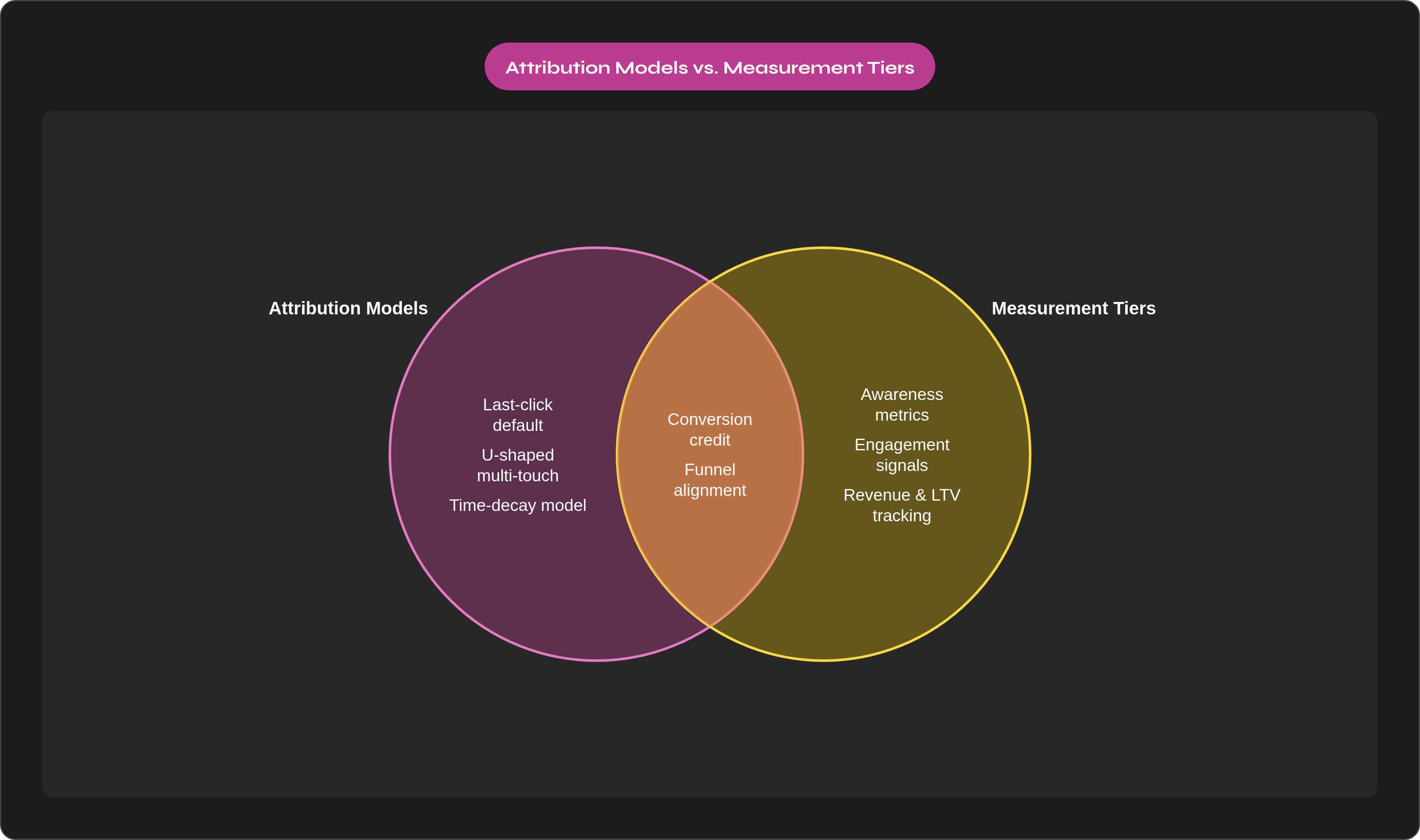
Tier one: awareness metrics and what they actually predict
Awareness-tier metrics get dismissed as vanity metrics with remarkable consistency, usually by practitioners who should know better. Reach, impressions, share of voice, brand search lift, new audience growth: these are only vanity metrics when they are disconnected from a downstream hypothesis. Connected to one, they become something you can actually defend.
The hypothesis is specific: this newly exposed audience will enter the consideration funnel within a defined window of time. That framing makes awareness metrics measurable, because it ties them to addressable audience expansion, which is the upstream driver of future pipeline volume. This matters most for new product launches, new market entries, and categories where unaided awareness is genuinely low. If you skip this tier entirely because it feels soft, you are flying blind into the consideration stage wondering why engagement and conversion metrics are not moving.
Nielsen research shows influencer campaigns drive purchase intent for up to 45 days post-exposure, and in some categories up to 90 days. The practical implication is direct: if you evaluate an awareness campaign at campaign close, you are measuring before the outcome window has elapsed. Set a brand search baseline before the campaign launches. Measure lift in branded queries during and after the attribution window. That is how awareness data earns a seat at the reporting table instead of being quietly removed from the slide deck.
What awareness metrics cannot tell you is whether the exposed audience will actually convert, or whether they would have converted regardless. That question belongs to a different part of the framework.
Tier two: engagement metrics and the shift from passive to intent signals
Not all engagement carries equal weight. That observation sounds obvious, but the number of brands still benchmarking primarily on aggregate likes suggests it has not actually landed.
Likes and views require zero cognitive investment. A like takes a fraction of a second and communicates almost nothing about purchase intent. Saves, shares, comments that ask specific product questions, link clicks: these are categorically different. They require a deliberate action, which means they signal active consideration rather than passive scrolling. I have looked at posts with impressive like counts that drove no downstream behavior whatsoever, and posts with modest likes but hundreds of saves that converted at rates that surprised everyone in the room. The aggregate number was misleading in both cases.
The composition of what you are counting matters as much as the total. A post with 10,000 likes and 50 saves is a weaker intent signal than a post with 6,000 likes and 400 saves at identical reach. According to Sprout Social, 68% of marketers benchmark primarily on social media engagement metrics, but if you are not weighting saves and shares more heavily than likes in your numerator, you are measuring noise and calling it data.
The formula itself, interactions divided by reach multiplied by 100, is fine as a starting point. Cost per engagement is a useful efficiency metric at this tier too, but only after you have defined which engagements qualify toward the numerator. A cost-per-engagement number built primarily on likes is answering a question nobody should be asking.
The business outcome this tier maps to is consideration depth. A high save rate on a product post means people are returning to it, bookmarking it for a decision they have not made yet. That is a fundamentally different signal from passive consumption, and it belongs in your report labeled as such.
Tier three: conversion metrics and the tracking infrastructure that makes them reliable
Seventy-four percent of brands now actively track sales from influencer campaigns. Tracking and accurate attribution are not the same thing, and the gap between them is where budget quietly disappears without anyone noticing until the numbers stop making sense.
Core conversion metrics at this tier are (i) conversion rate from influencer traffic, (ii) cost per acquisition, (iii) promo code redemptions, (iv) affiliate link clicks, and (v) landing page visits from creator-specific URLs. Unique UTM parameters per creator, unique promo codes, dedicated landing pages, affiliate pixels: these are table stakes, not optional enhancements. If they are absent before the campaign launches, the conversion data you collect afterward is unreliable by definition. Research cited by Dataslayer notes that 65% of marketers report confidence in proving influencer ROI, yet many rely on manual spreadsheets and creator-provided screenshots. Confidence and rigor are genuinely different things, and conflating them is expensive.
Attribution window selection matters more than most people acknowledge. For e-commerce, 14 to 30 day windows are standard. For B2B software or high-consideration purchases, 60 to 90 days is more appropriate, given how long those decisions actually take. Cutting the window short means missing most of the conversions and then concluding the campaign did not convert. The window is not a technicality sitting at the bottom of a settings page; it is a variable that directly controls what you find.
One tool at this tier that consistently gets underrated: the post-purchase survey question, "How did you hear about us?" It captures offline and untracked creator influence in ways pixels cannot, particularly when paid and organic discovery paths are blurring from the customer's perspective. Low-tech, but surprisingly revealing.
Tier four: revenue and retention metrics that connect influencer campaigns to long-term business value
This is the tier most measurement frameworks skip, and it is the most consequential one. Closing the loop at first purchase ignores repeat purchase rate, customer lifetime value, and referral behavior from influencer-acquired customers, which means you are making long-term budget decisions with short-term data.
Some marketers believe customers acquired through influencer channels demonstrate stronger retention and brand affinity than those from other acquisition channels. I have seen cohort analyses that support this, and I have seen others where it did not hold. The point is not that one answer is always correct; it is that if this is not tracked, it remains an opinion rather than a budget argument, and finance teams do not allocate capital based on opinions.
Revenue-tier metrics are (i) customer LTV by acquisition source, (ii) repeat purchase rate, (iii) average order value from influencer-acquired cohorts, and (iv) referral rate from those same customers. The real question this tier answers is whether the LTV of customers acquired through a given influencer tier actually justifies the acquisition cost. The right comparison is not the campaign ROI ratio in isolation; it is the LTV-to-CAC ratio by influencer tier, over time.
This is where the micro-versus-mega debate gets resolved with data rather than preference. According to Influencer Marketing Hub's 2025 benchmarks, micro-influencer campaigns average 8 to 12:1 ROI driven by higher engagement and stronger audience trust, while mega-influencer campaigns average 2 to 3:1, with broader reach but weaker per-user purchase intent. A micro-influencer cohort with strong retention can outperform a mega-influencer cohort over a 12-month horizon even when the latter drove more first purchases in absolute terms, because the LTV math works differently. Without tracking the retention data, you will never see that comparison, and you will keep making the same allocation decision quarter after quarter.
Industry data suggests 83% of marketers consider their influencer efforts highly effective. Without LTV tracking, that self-assessment rests on the three tiers below this one, not on long-term business outcomes. That is a fragile foundation for serious capital allocation.
Incrementality testing: isolating what the campaign actually caused
The question a CMO should be able to answer when defending influencer spend is blunt: would this customer have converted without the creator's content? Attribution models cannot answer that. Incrementality testing can, and the difference between those two things is the difference between a correlation and a cause.
The method is not complicated. Compare a holdout group, an audience not exposed to the influencer campaign, against a treatment group that was. The difference in conversion rate between the two groups is the measured lift attributable to the campaign. The result shifts the finding from "we generated X conversions" to "we generated X conversions that would not have happened otherwise." That shift is what actually earns credibility with a finance team. It is also the shift that most influencer measurement practices never make, which is why the discipline still struggles to hold budget when things get tight.
The practical risk this addresses is real and routinely overlooked. Some share of the customers who redeem a promo code were already planning to buy. Attribution models count them as influencer-driven conversions regardless of whether the creator had any causal role. That inflates reported ROI and sends budget toward channels that were present at a conversion rather than responsible for it. The programs that look best in the report are sometimes the ones most vulnerable to this problem.
Implementable methods include (i) geographic lift tests, where you run the campaign in select markets and hold others unexposed; (ii) matched market tests, which pair demographically similar markets on behavioural baselines; and (iii) conversion lift studies available natively on some platforms. Reserve full lift studies for high-spend campaigns or when attribution model outputs conflict with your business intuition. Not every campaign justifies the investment. But when the numbers feel too good, or too bad, relative to what you expected from a campaign, incrementality testing is the tool that resolves the ambiguity without requiring anyone to argue over whose attribution model is correct.
Marketing mix modeling as the privacy-safe complement to campaign-level attribution
Marketing mix modeling correlates total channel spend with total revenue using aggregate data, with no individual-level tracking required. That makes it entirely privacy-compliant at a moment when third-party cookie deprecation and platform signal loss are steadily eroding the precision of campaign-level attribution. The timing of MMM's revival is not coincidental.
Open-source tools using Bayesian methods, including Meta's Robyn and Google's Meridian, have made this methodology accessible to brands that previously could not afford the enterprise consulting infrastructure it historically required. According to Improvado's 2026 marketing analytics data, 27% of enterprise organizations are now combining multi-touch attribution with MMM simultaneously, using both in tandem rather than treating them as competing approaches. That number is likely to keep climbing as cookie-based measurement continues to degrade.
What MMM adds to the framework is a channel-level view: how does influencer spend compare to paid search, paid social, and display advertising in total revenue contribution? That comparison is useful for portfolio-level budget reallocation arguments in a way that individual campaign data never can be, because it operates at the right level of aggregation. You cannot make a channel allocation decision with creator-level data. You need the aggregate, and MMM provides it.
What MMM cannot do is evaluate individual creator performance. It functions at the aggregate level, so it cannot tell you whether a specific creator drove incremental value. That still requires the campaign-level tracking mechanics described in the conversion tier. The division of labor is practical: use campaign-level attribution to optimize creator selection and individual performance; use MMM to validate influencers' contribution to total revenue and to make channel allocation decisions across the portfolio. These are different questions requiring different tools, and treating them as interchangeable is how brands end up with data that answers neither question well.
Earned media value: where it fits in the framework and where it doesn't
EMV has a defined formula: impressions multiplied by a CPM benchmark, divided by 1,000. It answers one question: what would this exposure have cost if purchased as paid media? That is a legitimate question, particularly when presenting to stakeholders who think in media cost terms and need a comparison point against traditional advertising spend.
But EMV is not ROI, and this is where the conflation causes real damage. It estimates media equivalency and says nothing about business outcomes. A campaign that generates strong EMV with zero downstream conversion is not a success; it is an awareness execution that failed to connect to the rest of the funnel. I have watched brands celebrate EMV numbers in client presentations while their conversion data sat in a separate tab that nobody opened. The credibility problems that have followed influencer marketing as a discipline for years are partly a consequence of exactly that habit.
There is also a reliability issue that has grown more pronounced as the influencer ecosystem matured. Creator content is increasingly boosted with paid amplification and distributed algorithmically in ways that make isolating true organic earned exposure genuinely difficult. EMV calculations built on these reach figures can overstate actual exposure quality in ways that are not visible from the outside.
EMV belongs in the framework as a supplementary awareness-tier metric, always paired with data from the conversion and revenue tiers. It should never stand alone as the primary proof of campaign effectiveness. If a stakeholder is requesting EMV as the headline success metric, that is a signal worth taking seriously: the measurement framework has not been established yet, and that conversation needs to happen before the campaign brief is finalized. Having it after the results are in is too late to fix anything.
Putting the framework into practice: how to assign metrics to campaign objectives before launch
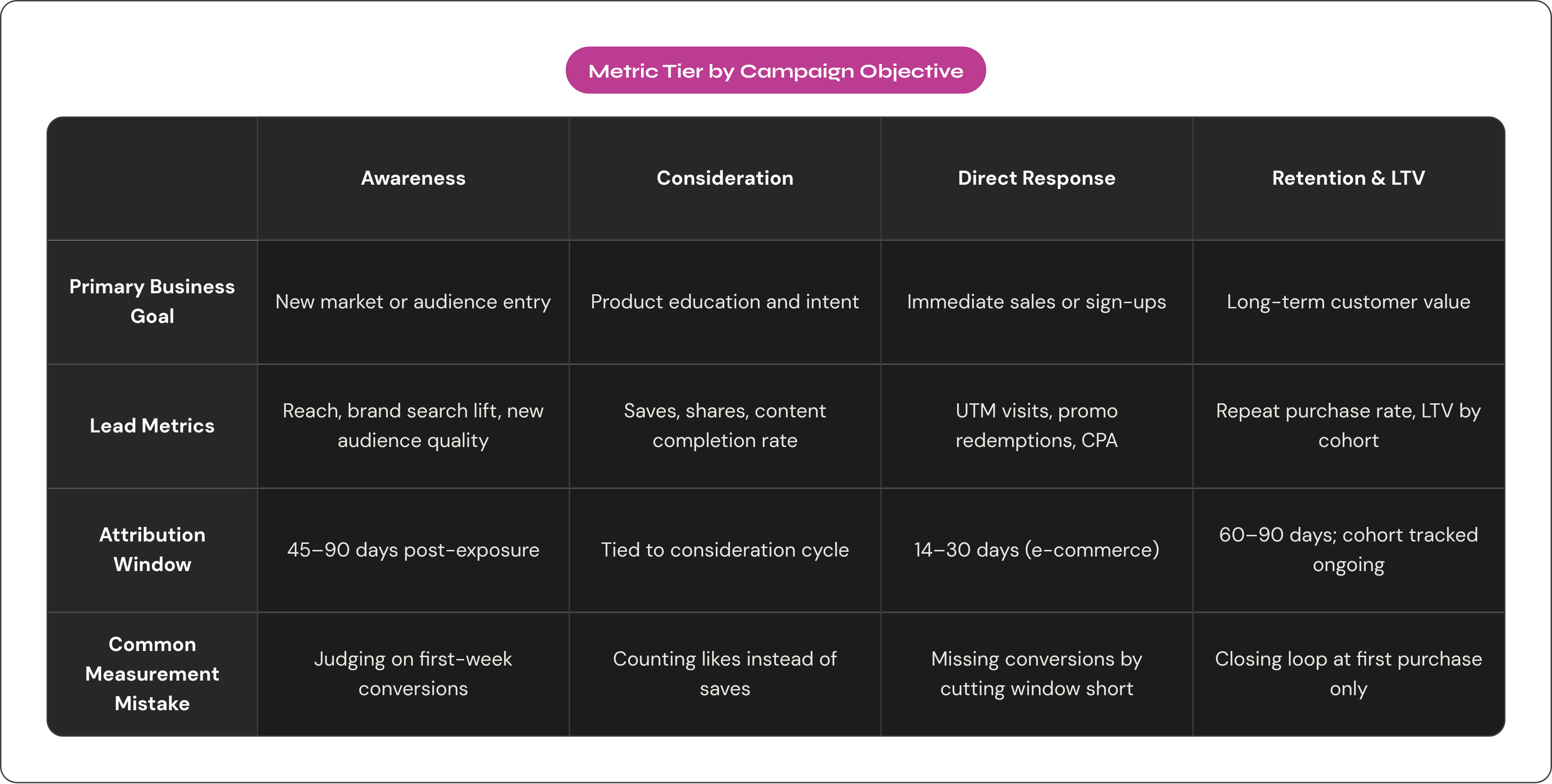
The framework only works if the right metric tier is designated as primary before the campaign launches. Reverse-engineering a measurement approach from whatever data happens to be available after the fact is how brands end up concluding that influencer marketing does not work, when the actual problem is that they measured the wrong thing against the wrong timeline. I have seen this happen at sophisticated organizations more times than I can count, and it is always avoidable.
Before launch, define the campaign's primary business objective with actual specificity. New market or audience entry makes the awareness tier primary, with (i) reach, (ii) brand search lift, and (iii) new audience quality as lead metrics. Consideration and product education shifts the lead to engagement, with (i) saves, (ii) shares, and (iii) content completion rate as the primary signals. Direct response makes the conversion tier primary, with (i) UTM-tracked visits, (ii) promo code redemptions, and (iii) cost per acquisition driving evaluation. Retention and LTV improvement makes the revenue tier primary, with (i) repeat purchase rate and (ii) LTV by acquisition cohort as the outputs that matter. These are not interchangeable; picking the wrong one produces a conclusion that is technically supported by data and completely wrong.
Build the tracking infrastructure before the campaign goes live, not after. UTM parameters, unique promo codes, attribution windows, and pixel configurations must be configured in advance. Built after launch, the data they produce is compromised from the start, and there is no retroactive fix for a promo code that was shared without a unique identifier.
Set the attribution window to match the objective and the category. Fourteen to thirty days for e-commerce. Sixty to ninety days for B2B or high-consideration purchases, where cutting the window short means missing most of the conversions and then drawing the wrong lesson from the silence.
Select the attribution model appropriate to the funnel role. U-shaped multi-touch as the default, holdout testing for high-spend campaigns or when model outputs conflict with observed business results.
Finally, pair campaign-level metrics with MMM context for budget-level decisions. Individual creator performance optimization is a separate exercise from portfolio-level channel allocation. Conflating the two produces decisions that are wrong at both levels simultaneously.
What this sequence prevents is the most common and most expensive measurement mistake in influencer marketing: running a brand awareness campaign, evaluating it on last-click conversion data at campaign close, and concluding the channel does not perform. That conclusion is not a finding. It is a measurement failure, and it costs real money every quarter at brands that have the tools to avoid it and simply have not built the process to use them.