Paid UGC Creator Programs Explained for Brands
Authentic-looking creator clips now convert 6.73 times better than polished ads.
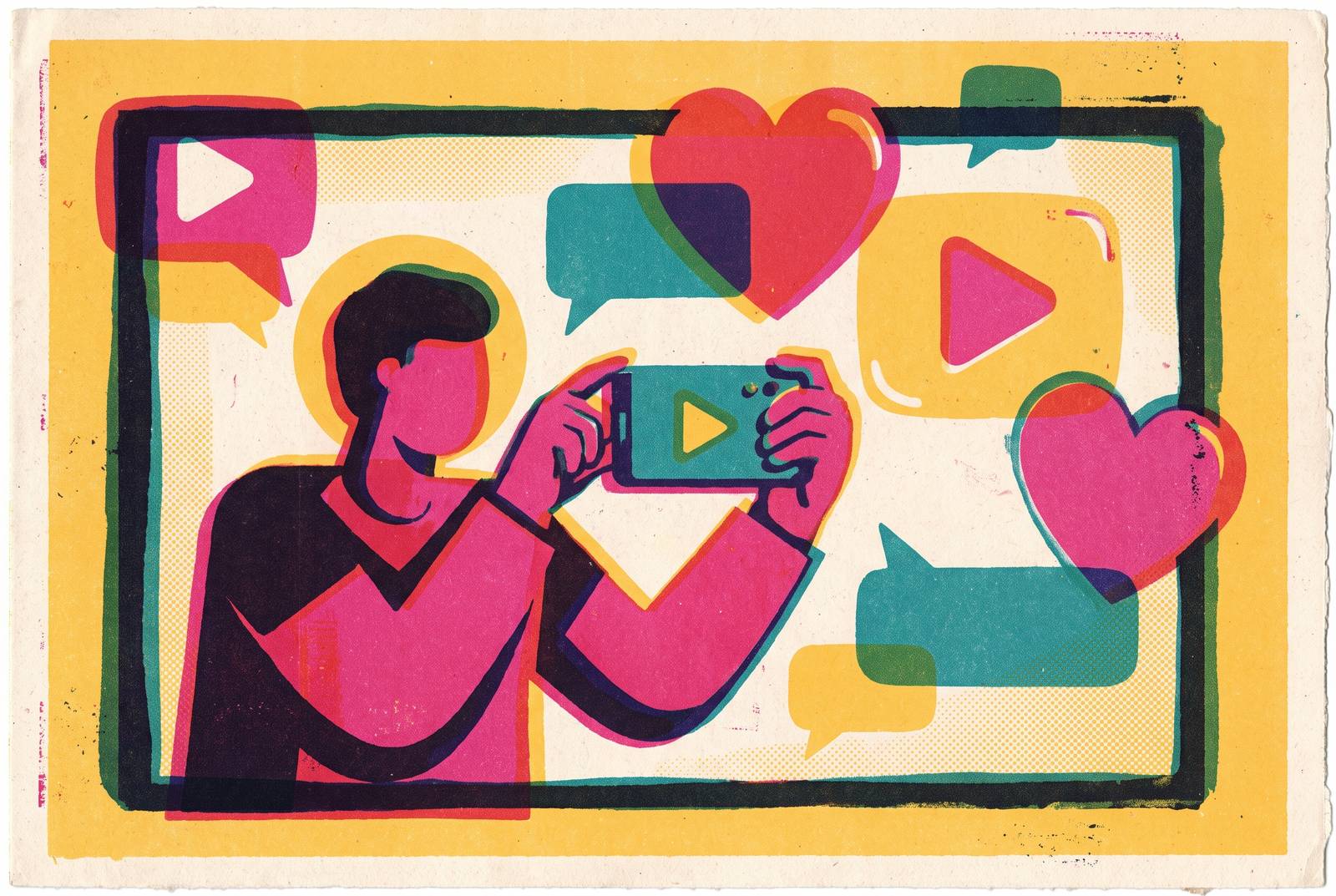
Today, brands get tons of authentic-looking clips through Paid UGC creator programs, and the real process counts for more than any marketing pitch says. Rather than paying an influencer just for exposure, a company hires a solo creator, gives a fee that's flat for one clip, and keeps the footage outright. That difference, treating content like a bought asset, not an ad placement, separates paid UGC and influencer marketing, while reshaping the way brands divide creative spend for 2026.
Here's how it works. The company picks a creator, often via a portal or form, hands over the assignment, and receives a clip: maybe a routine for skincare, some unboxing footage, a talking-head piece, or a taste demo. Once the company holds the rights, it runs that video anywhere: paid ads on social, product pages, email campaigns, placements in retail media. Creators are paid on the deliverable rather than for sharing it with their audience, so how many followers they have hardly matters. Many paid UGC creators sit below 1,000 fans; that doesn't affect the rate, since the company is still paying for clips, not reach. They're purchasing footage which looks like an actual person shot it. By the format's own rules, it had.
People believe Unpolished, person-talking-to-a-phone footage more than any scripted spot, and that's why it beats studio work. A brand that "cleans up" its UGC footage is quietly ruining the thing it paid for, which is the whole bet the format makes. Brands don't treat those flaws as a limitation to overcome. That’s the whole reason behind the format, and anyone polishing UGC footage so it looks like an ad is undoing what made it click.
Why demand for paid UGC is growing fast enough to matter to a brand's budget planning
In 2025, UGC platform sales worldwide totaled roughly $7.1 billion, and by 2034 that figure is projected to hit $64.31 billion, an implied yearly expansion rate around 28.8%. In 2025, U.S. brands put over $10 billion into UGC content.
The Influencer Marketing Hub's 2026 Benchmark Report sharpens the picture: half of brands surveyed plan to increase their use of UGC creators next year, and zero percent plan to cut back or stop. You hardly ever see that in studies of marketing. Marketing budgets shift around all the time, so a tactic every brand keeps backing isn't the usual story.
That leads to a pair of points, and one matters most. In a year, the sourcing landscape and costs brands deal with will change as more creators enter the market to meet rising interest. Extra creators will chase briefs, and extra brands will chase the ones who deliver. What matters more: awareness-budget cash isn't just drifting toward another format. Brands now add UGC within paid ads and creative work, where media teams see conversion results change live. When influencer marketing first gained traction, it leaned heavily on brand-lift metrics and audience size, numbers that weren’t easily tied to purchases, so the shift toward performance-driven UGC represents a fundamentally different approach.
The performance case for UGC in paid channels
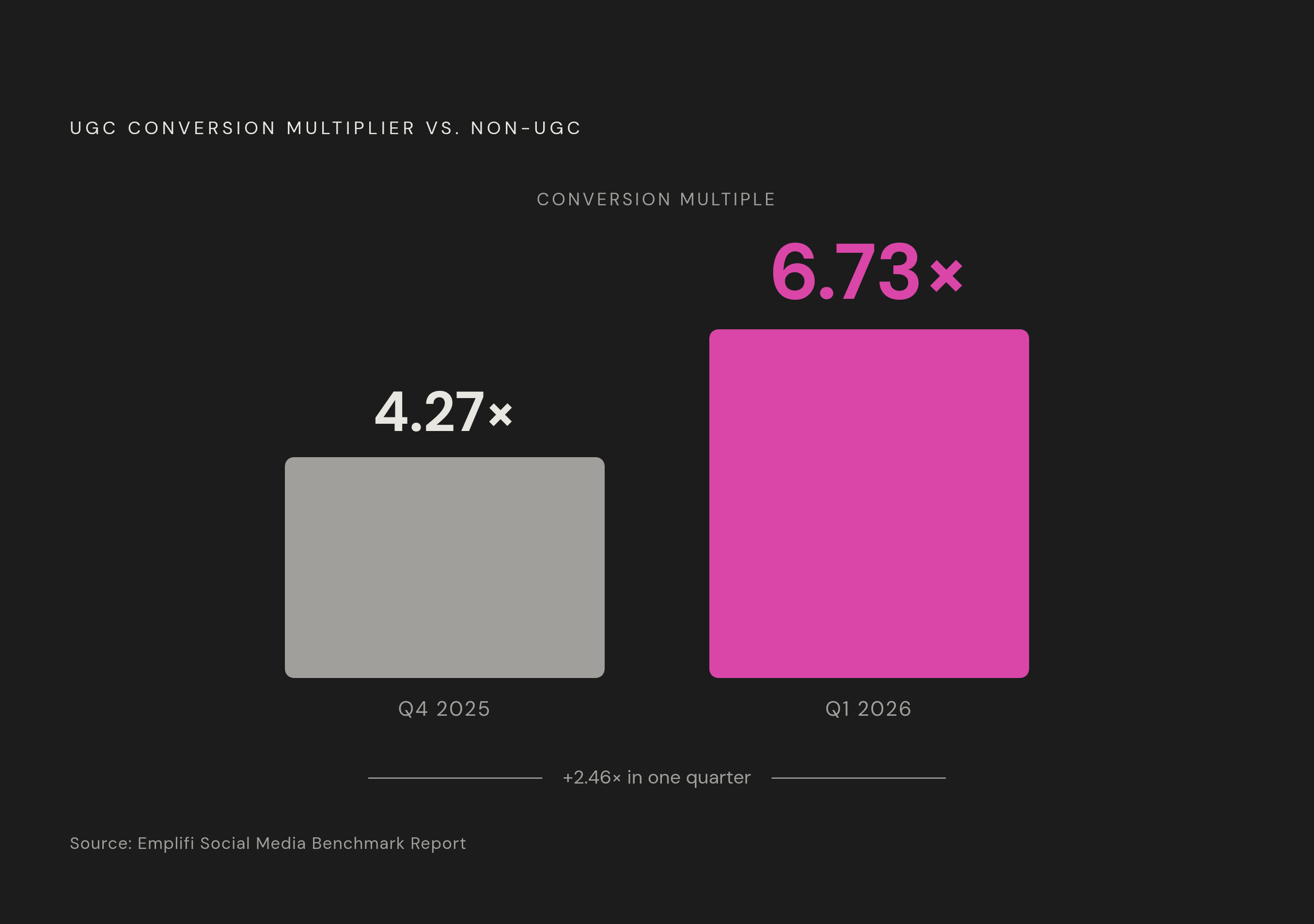
Emplifi's Social Media Benchmark Report found UGC-style creative converted 6.73-fold better in Q1 2026 compared with non-UGC content, versus 4.27-fold in Q4 2025. Acceleration, not plateau, marks the one figure worth keeping from all of this.
TikTok's platform data gives a fresh channel-specific take: using Spark Ads, a format which boosts any organic-style creator piece as paid media, brings click-through lifts between 24 to 25% plus conversion lifts near 24% versus non-Spark ad formats, dropping cost-per-click and also cost-per-thousand-impressions each roughly two-thirds lower.
UGC typically costs less to film than a polished studio piece, but that's not the main point. Spending less helps, but it isn't the point. Media teams get paid to optimize specific metrics like click-through, conversion, and cost-per-acquisition, and UGC-style creative consistently beats out polished branded work on all of them. When a company picks the budget format yet gains stronger results, that's a real trend, not luck. This format simply works as intended.
Brands need to remember one thing: performance data doesn't read cleanly until a run hits the 30-to-60 mark. Platforms need volume before ads settle in; creative fatigue curves show up later. Running 5 fresh UGC assets during the first seven days gives you no answers, and none are coming yet.
That early ramp is why smarter spend means trying many, not going all in on a creator. Running six to ten UGC creators in parallel against a single briefed concept, then letting the ad platform's own data pick winners after 30-plus days, beats sinking the same budget into one polished asset from a single high-cost creator and hoping it lands. Brands putting all their money on one creator, a single asset, and one chance are making a move data doesn't back.
What brands actually pay: creator tiers, base rates, and the licensing variables that move the number
In 2025, most short-form UGC assets cost about $200 each, while new rate reports showed a mean near $198. That figure swings widely based on the creator and the licensing a company requires.
New creators under six months in typically earn $150 to $200 for each deliverable. Mid-level creators, six months to a couple of years in, charge $300 to $500. Seasoned creators, three-plus in with solid scripting and post-production chops, get $600 to $1,000 per piece, and established creators command $500 or more before licensing costs enter the picture.
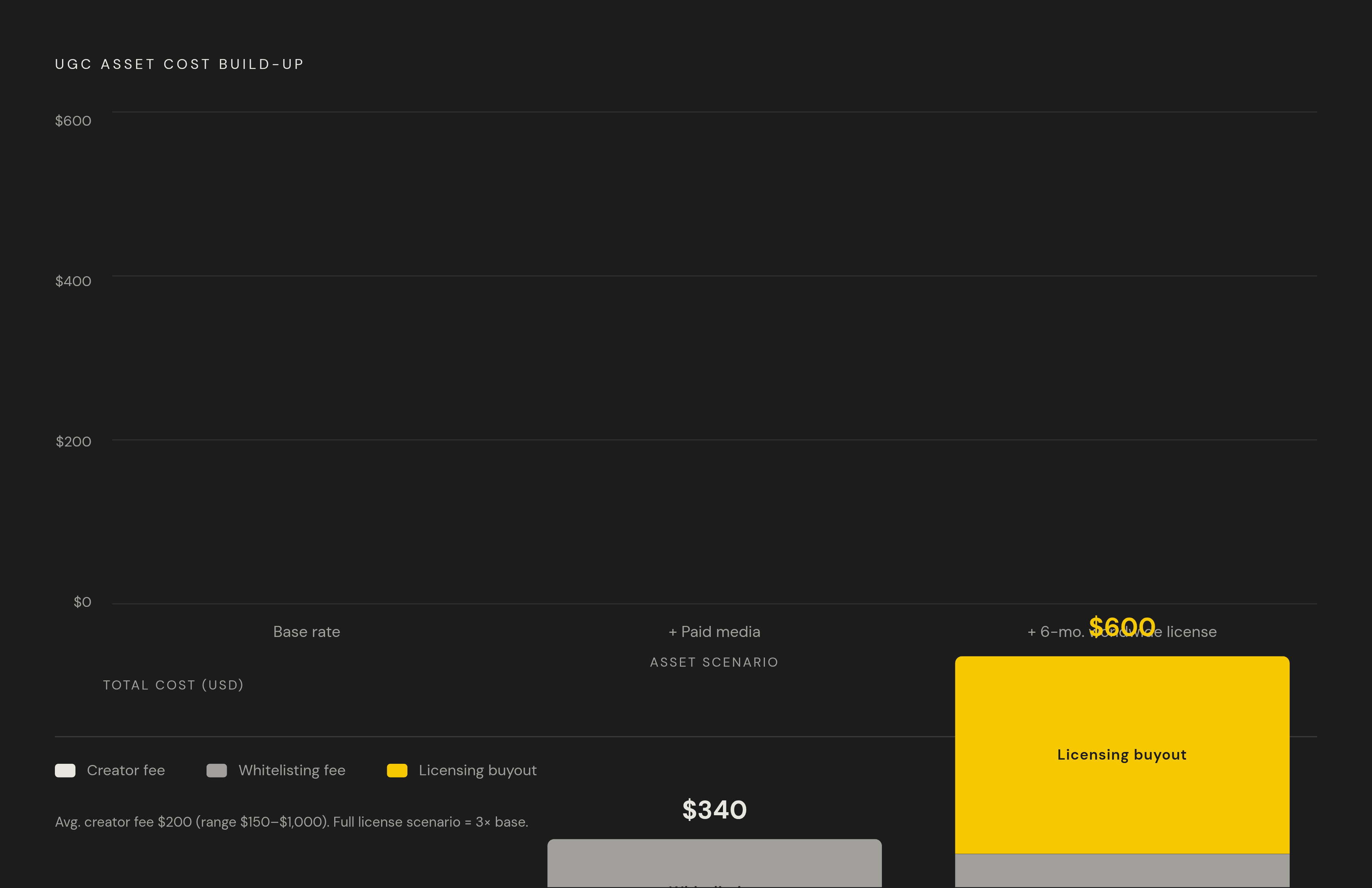
Planning around just the fee ignores what really matters: the licensing clause beats the base rate every time. A $200 base asset might reach two or three times that figure with a six-month worldwide license attached, or when a creator's personal page is whitelisted to run paid amplification. One asset might bring in 3 different checks: an upfront base fee, extra paid-media money when a company whitelists that creator's account to show ads, plus a buyout charge if usage time goes longer. Once you involve creators abroad, conversion friction stacks another layer onto what brands need to reconcile.
Where brands actually become exposed is not base rate itself. Brands now repurpose UGC made for a single short-form clip into paid social, email, product pages, retail media channels, streaming TV plus automated summaries. With a normal 90-day deal, much of the downstream reuse falls beyond what its creator accepted. Brands skimming these contracts find the issue only when a creator, or that creator's attorney, notices. By then, that footage played for months on channels those agreements left out.
Platform-run programs offer a helpful benchmark, because they reveal creators' pay when the retailer controls the deal. For each shoppable storefront purchase, Amazon's Influencer Program pays 1 to 10%. Walmart Creator pays a base rate of 4% plus per-campaign bounties. With LTK, each creator receives the entire 100% retailer fee, and the platform keeps nothing. Sephora Squad pays a flat fee for the year along with product. Beyond platforms, Direct-brand UGC contracts often range from $150 to $800 per asset, with a typical 30-day paid rights period.
TikTok's Creative Challenge trial, folded within TikTok One, the platform that consolidated TikTok’s creator tools in 2024, marks the ceiling among volume creators. One creator pulled in as much as $34,000 over one month doing UGC for brands such as Uber Eats, Zynga, plus Alibaba and TikTok. Few will reach that level, yet this format scales toward serious income once any creator runs it like a company instead of a hustle.
Let an outside firm take over everything, though, and the cost picture shifts once more. Simple agency-run UGC programs cost $2,000–$5,000 each month, while big multi-creator efforts handled from start to finish go for $10,000–$50,000-plus a month.
Where brands find creators: sourcing channels and what each one costs in time and money
A few channels dominate sourcing, each balancing spend against oversight. Move onto platforms when your program grows past a few creators; below that, direct sourcing works without overhead.
Briefing, contracts, payments, approval, and discovery are all centralized by creator platforms like Cohley, Billo, Insense, and JoinBrands. Once a company runs several creators together, the escrow safety and structured setup really pay off. For brands, the tradeoff costs control: less negotiating space, plus the platform fee.
Social discovery means scanning hashtags and tags across TikTok or Instagram yourself; it's free upfront but eats hours. You won't find a template, escrow, or payment system included. Every agreement is negotiated, then processed manually: easy at low volume, unworkable beyond.
People who already bought the product are your highest-authenticity, lowest-friction pick because they like it so much they'll bring it up unprompted. It doesn't deliver the volume needed by itself for a paid-UGC program; brands often make it their main creator pool.
Creator databases and applications offer a middle ground. A company shares a project ask or public request, then creators answer themselves. On Platforms like Superdeal, creators can set up a page of their work and show up in niche-filtered searches, shifting some of the sourcing work onto creators.
Handling negotiation yourself lets a company shape rates and conditions, often cutting the per-asset spend, yet it absorbs every bit of agreement drafting, payment handling, and review work. Platforms bill to cover overhead, while taking work off a brand's team, and the fee makes sense paying when a company is busy coordinating many creators on multiple projects at once. For smaller efforts, paying that fee just burns cash.
A lot of the biggest programs sit on first-party creator portals run by major retailers, not on third-party marketplaces. For Amazon's Influencer Program, there is no set follower minimum, and approval runs on how people interact with your posts, even though most creators who get in keep roughly 1,000 or more. It stands among the largest UGC pipelines for brands. For Walmart Creator requires approximately 1,000 followers and evaluates creators on engagement; responses typically arrive within days., and its program focuses on content categories like lifestyle and home. Club Target, Target's program that began May 2026, requires a minimum of 500 followers on TikTok or Instagram; its other program, the Target Partners affiliate offering, posts no minimum and judges creators on interaction and strength of content. In 2026, Target dropped its cash-commission setup in favor of the gamified gift-card-and-product system, Ad Age reports. Sephora Squad pays product plus flat yearlong fee, and applications go via Sephora's creator portal. The e.l.f. Cosmetics operates a creator program, paying $100 to $300 for UGC clips. As of 2024, the rebranded, consolidated successor after TikTok's Creator Marketplace, TikTok One allows brands to manage creator briefs and Spark Ads.
These programs tend to look for the same things when reviewing an application. Going deep in just a couple of niches beats any reel that's scattershot: a few polished videos outperform a long string of unrelated footage. Reviewers judge the way each creator handles the product, moves it, shows it, and films it, because that shows they know simple shoot basics. Turnaround time carries weight as well. Brands needing many creative variants for each platform prioritize creators promising fast delivery. Answering messages in 24 hours and invoicing promptly determines who lands more jobs, so in most programs a tiny fraction of dependable creators keep absorbing the majority of recurring briefs because working with them is smooth.
Creator portfolios put performance data first today: conversions, ROAS and click-through ad rate, beyond showreels. Brands now evaluate creator work like any performance marketing asset backed by results, not some stylistic piece.
Brands actively running paid UGC programs across verticals
Few verticals purchase as much UGC volume as skincare and cosmetics brands, since Meta and TikTok creative must be refreshed often to dodge ad fatigue. Topicals pays $100–$200 per video for skincare routines and reviews. Some skincare brands also run creator applications, paying $150 to $300 for routine videos. Cosmetics runs its UGC Creator Form via herocosmetics.us/pages/creators, seeking routine and before-and-after content, with compensation not shared. Using their on-site UGC form, Kinship pays $75 to $150 for routine clean-beauty content. Kosas runs its Creator Portal, paying $150 to $250 on GRWM videos and tutorials. Youth to the People finds creators via email or DMs, paying between $100 and $200 for unboxing clips plus reviews. Cocokind operates an Ambassador Form that pays $50 to $100 for natural skincare demos. For acne-patch content, it pays $75 to $125 via its Creator Form. Via the Creator Lab, e.l.f. Cosmetics once again pays $100 to $300.
Apparel and fashion brands count on try-on videos, styling posts, and GRWM styles because they match what shoppers look up before a purchase. Halara runs its UGC Creator Program, paying $50 to $100 on activewear content and try-on hauls. Cider pays $75 to $150 for haul and styling videos via its Creator Application. Quince takes applications via email to partnerships@onequince.com, paying $100 to $200 toward content comparing quality and rating products. Vuori runs its Creator Portal, paying $150 to $300 on activewear and lifestyle footage. Through its Ambassador Form, Petal & Pup offers $75–$125 for content tied to wedding-guest looks and occasion-wear pieces. For videos on loungewear and shapewear, SKIMS runs its seasonal UGC Application, paying $200 to $400. The brand's Creator Program pays $150 to $250 for try-ons of denim built around inclusive sizing. Abercrombie and Fitch operates its Abercrombie Creator Suite, compensating with gifted product and a cut of sales instead of any flat per-video fee covering seasonal hauls plus styling content. NA-KD Fashion uses TikTok discovery for sourced beginner-tier UGC creators. Puma picks up beginner creators from social discovery instead of a built portal.
Software makers pour money into UGC because any polished studio spot struggles to pitch functionality, so they need footage of their product in everyday contexts. Headspace pays $150-$300 through its Creator Program for meditation and morning-routine content. Calm pays $200–$400 per video and can be contacted at creators@calm.com. Duolingo offers $100 to $250 per video through its Creator Application focused on language-learning content. Revolut runs its UGC Program, paying $150 up to $300 for budgeting and trip-planning content. For wellness and morning-routine videos, the Vitamins brand pays $100 to $200 using an Ambassador Form. Through its Creator Partnerships, Noom pays $200 to $500 for content on weight-loss plus wellness. Babbel takes influencer applications via email to influencer@babbel.com, paying $100 to $200 toward language-learning content.
Food and drink brands must keep churning out content: unboxings, taste tests, recipe demos, and formats tied to how social feeds show people finding snacks. Spoon pays $100 to $200 using a Creator Application for morning-routine content plus taste tests. Olipop finds creators via email, ugc@drinkolipop.com, paying creators $75 to $150 for taste tests plus healthy-swap video work. Liquid Death offers $100 to $250 via a Creator Form for its bold, edgy lifestyle content. Meals runs its Influencer Portal paying $150 up to $300 for meal-prep plus unboxing videos. Chomps pays $50 to $100 via its Ambassador Program on snack reviews plus workout clips. RXBAR uses Creator Partnerships to pay $75 to $150 for clean-eating and workout content. Poppi's UGC Creator Form pays between $100 and $175 for gut-health content and taste tests.
This trend shows up in every industry listed. Creator pricing clusters around track record plus what licensing covers rather than company scale or industry, and those brands racing ahead don't usually have the largest spend. Using multiple creators at once rather than putting all the budget on one is where many brands often get it wrong.