UGC Brief Templates That Generate On-Brand Content
A strong brief directs creators without writing their lines, boosting approval rates forty percent.

The UGC brief works as a planning document. It spells out a brand's identity, the aim, the target audience, the voice, and the deliverables, yet a creator never gets a script to read aloud. Many brands have it wrong: they make scripts and label those briefs, then ask why it all sounds like some hostage read. That's the most frequent breakdown across all UGC work, and it's completely avoidable.
The script is entirely different. It turns the brief into hooks, pacing, transitions, and next steps, the “how” that works only after the “what” and “why” are clear. A checklist is just specs, nothing else. Your creative direction document gives only visual and tonal notes, nothing else. When brands start treating one like a stand-in, they get videos hitting every instruction yet still missing the mark, because nothing here substitutes for a proper brief.
If the creator sounds like they're reading from teleprompter notes, viewers leave within seconds. That's a brief failure, not a skills failure. At some point a brand gave exact language rather than direction, so this creator, following the request, produced something stiff yet unwatchable.
A one-pager just doesn't cut it for briefs anymore. These days the brief carries platform-specific versions, real-time back-and-forth between creator and brand, and protections, none of it bolted on as afterthoughts. The true measure of a brief's worth: give it to two separate creators, and when both turn in on-strategy material that still reads like two separate voices, it has done its job.
When the brief that's vague has creators guessing, approval rates can drop. Get too prescriptive with a brief and it produces content that's stilted; a platform's algorithm and viewers both punish it. Between those two failure modes, brands usually choose over-scripting because writing it all out seems less scary. That isn't true. It only pushes trouble downstream, from brief to feed, where solving it takes much more money.
The case for investing time in the brief before touching the content
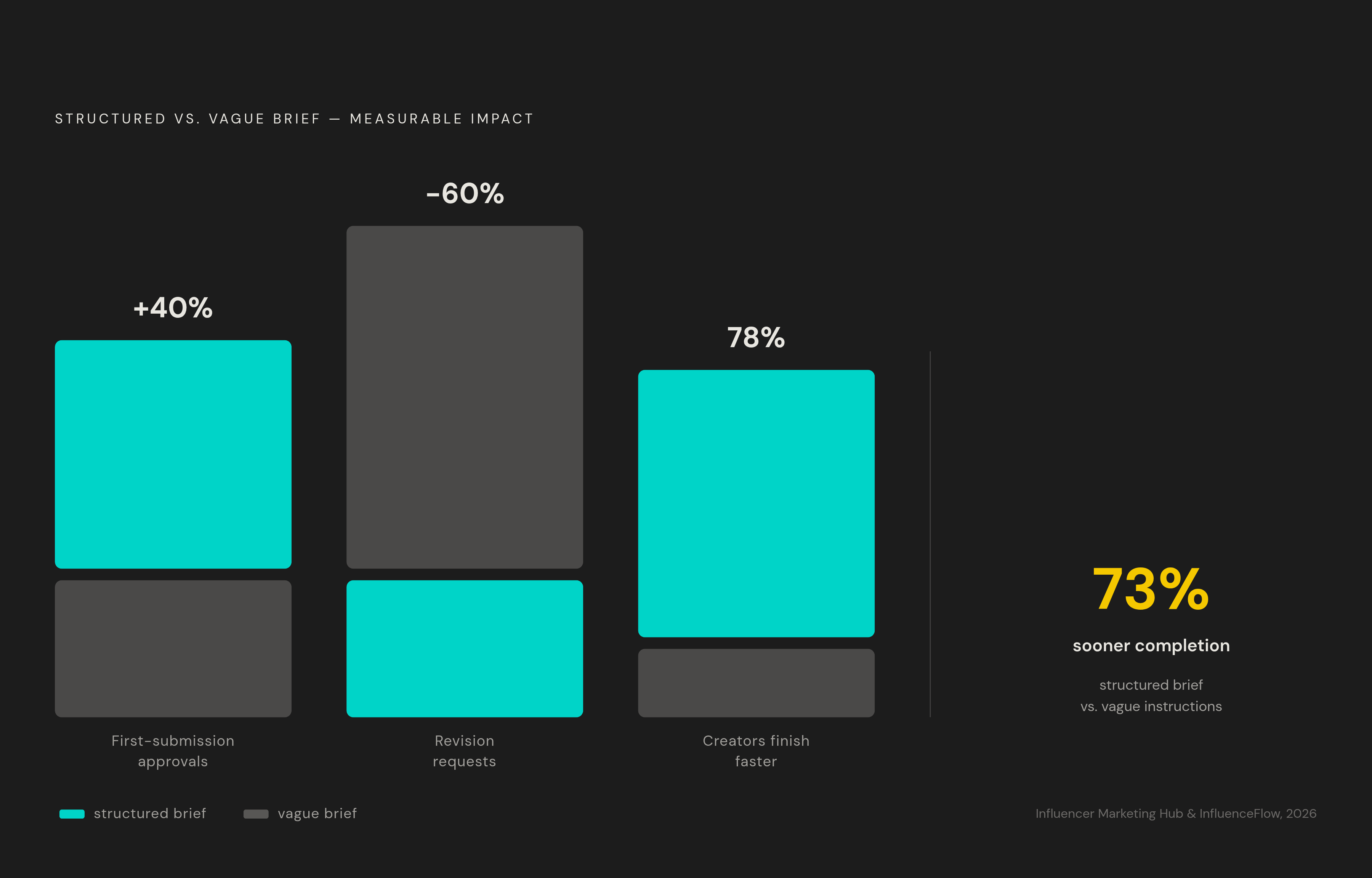
In 2026, Influencer Marketing Hub found that structured briefs improved first-submission approval rates by 40% and reduced revision requests by 60%. InfluenceFlow, in other 2026 findings, found brands with well-built briefs got completions 73% sooner than those handed vague instructions. The same Influencer Marketing Hub study found 78% of creators finish projects faster when the brief is detailed and well organized.
That arithmetic is simple. Putting one more hour into a good plan cuts out days of emails, and when you handle many projects at once, those gains add up quick. A weak brief kicks off a familiar loop: creators message to find out what the brand really needs, which by itself puts the schedule back. What comes back as Submissions is wildly inconsistent. Revision requests pile up. The material that goes out in the end is weaker and more delayed than needed.
UGC-based ads pull a 4x higher click-through than standard ones, but only if the material actually reads as authentic. A poor brief kills that edge before anything hits the feed. They’re not a handy shortcut added later. They're a brand's single cheapest lever, cheaper than a higher budget, cheaper than adding creators, cheaper than one more set of experiments. Treating your brief like a mere afterthought, just something dashed out between meetings, creates the most avoidable expense here, yet brands still foot that bill.
Brand voice parameters: encoding identity without writing the creator's lines
Voice is tricky in any brief, though many briefs do it poorly. Telling a creator to sound "casual and authentic" tells them nothing useful. Each brand believes it is authentic and relaxed. Without more detail, you've only put a hope on paper instead of giving actual guidance.
Good voice parameters are concrete and, whenever they can be, binary. Choose a main tone, like conversational, humorous, or empowering, plus a backup. Name the words the brand actually uses and the words it avoids: "swap," not "upgrade"; "real," not "innovative." That kind of word-level detail does more work than a paragraph of adjectives ever will.
Telling people what to skip usually beats telling them what to do. What tone does the brand avoid? When the creator sees what to skip, they have far less work than one given only a target. Give a concrete example sentence in the brand's voice rather than a label like "witty" or "professional," and link to one or two pieces of past content that hit the mark, with a note on exactly what makes them work.
The brand's voice stays the same. Each Creator brings a different voice. A well-built brief protects one while never erasing its opposite, and that's what this part is really about. Pack the document with too many tone rules and you get awkward, corporate posts, which is what you meant to avoid. This voice part should act as something that lets a creator test instincts, rather than some script to read aloud.
Messaging hierarchy: which claims must land, which are optional, and what to leave out
When UGC underperforms, it usually traces back to briefs pushing a creator to cram each detail, plus every single disclaimer and all promotional stuff, within 30 seconds. It sounds that way because, functionally, that's true. No genuine human speaks like this, and the viewers pick up on it right away.
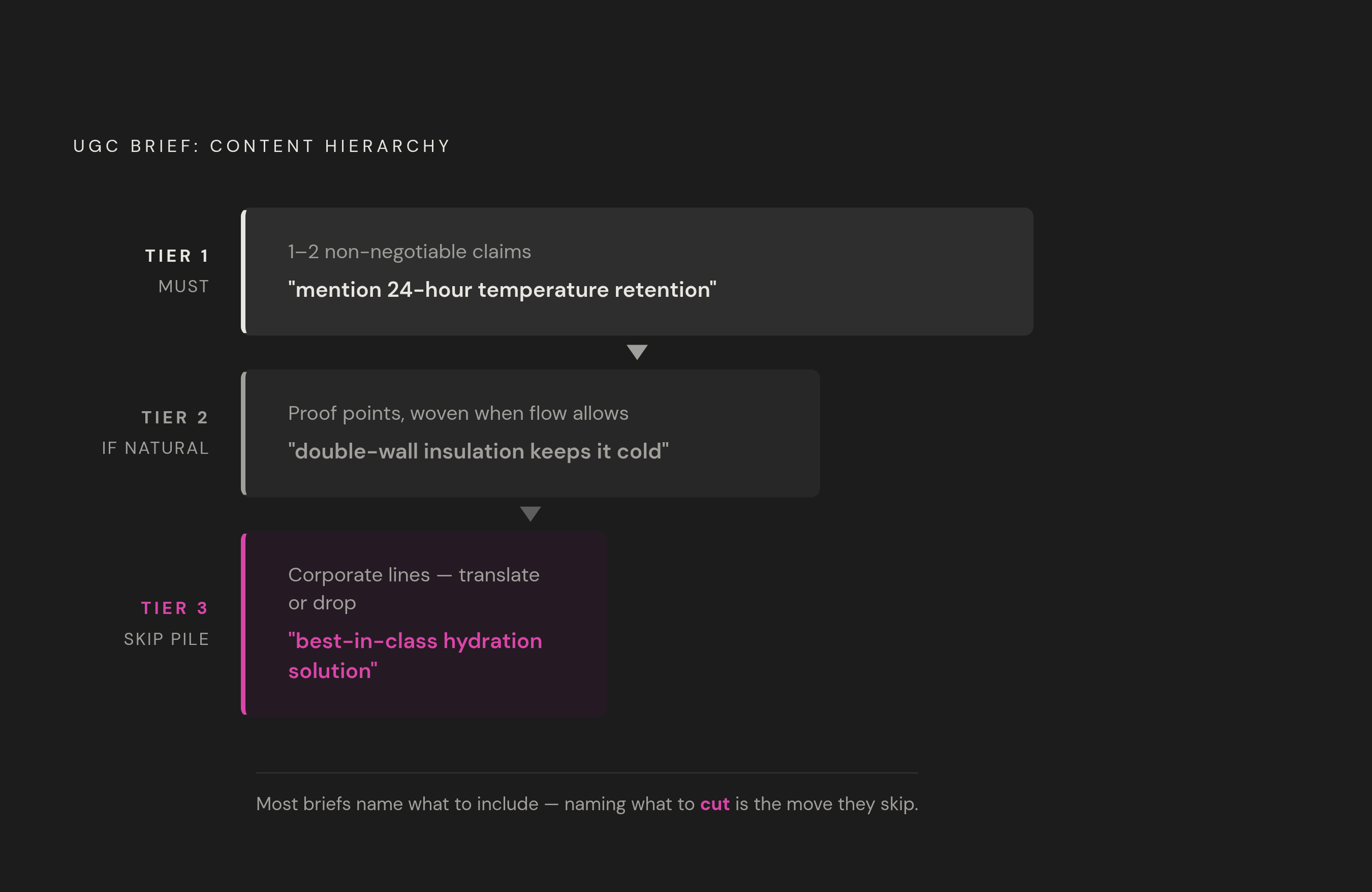
Set up the brief with its own three-tier hierarchy. Tier one is the must-include list: one or two claims that are genuinely non-negotiable, something like "mention the 24-hour temperature retention specifically." Tier two is should-include-if-natural, supporting proof points the creator can weave in when the flow allows, not when it's forced. Last comes the skip pile: company lines and product points that sound fake as soon as someone says them. Let your creator translate them however they like, or skip them entirely.
Every must-have should be specific, with a measurable test. "Show the product clearly for at least 3 seconds" gives a creator something to build around. "Feature the product prominently" gives them nothing to check their work against, the kind of line that shows up in briefs precisely because nobody wanted to make a real decision.
Red lines cut the other way: name what cannot show up. Competitor products inside the frame. Cost or promotional statements, unless expressly mandated. Branded overlays so thick they undercut how organic the clip looks. Testimonial phrasing so scripted it sounds lifted off a website.
A strong brief gives them 3 to 5 must-say points and a brief “don’t say” list. Anything else belongs to them; the brands pushing past that boundary get stiff, scripted delivery in return.
Visual dos-and-don'ts: giving creative direction without blocking authentic production
Visual direction isn't the same as voice and messaging. You're mostly explaining the background, naming exclusions upfront, instead of handing creators a shot list. When Brands still give creators a shot by shot list, they often receive back work that now looks like an ad dressed as UGC, which you don’t want.
Instead of angles, frame your direction around places and moments. So where does the product actually fit: at an office table mid-workday, tucked into how someone starts the day, clipped onto a backpack while heading out? It needs to fit the real life of your target audience, not a studio set-up. Lighting and production level need only one adjective pair, "natural light, no studio setup," or "polished but not overproduced." Say how visible logos and brand assets should be, if at all.
Under "don't": filters plus post-production, particularly when the brand's positioning rests upon authenticity. Off-brand locations, like a gym backdrop framing a product having nothing connected to working out, or an aspirational coastal villa for a brand known as cheap and useful. No rival products visible on camera.
Link to one or two inspiration videos, with a specific note on what the brand likes about each: "this energy, conversational, real-world use, no script feel." Two examples with clear notes beat ten examples that just overwhelm. Beyond some limit, extra examples just clash instead of clarifying anything. Resist the urge to over-control this layer: red lines like "don't smile too much" or "don't film in your bedroom" add friction without protecting anything, unless there's a genuine brand-identity reason behind them. A good brief is a page or two pages, with short lists plus simple headings, while anything visual specifically needs to be quickly scannable.
The hook: the brief element most brands under-specify
The bulk of UGC fails within the opening three seconds. Across TikTok plus Reels, those seconds determine if any viewer stays, yet brands most commonly make that part of the brief unclear, treating it as something to fix during filming, not the highest-leverage line in the document.
Consider two instructions. "Open with the problem moment: show the morning rush, the cold coffee, the thing that goes wrong right before the product shows up." That gives a creator an angle to build from. "Start with something that grabs attention" gives them nothing, because they already knew that much before opening the brief.
Name Three hook angles as choices, not mandates. A striking stat grabs attention mid-scroll with just the data. Leading with a problem-first framing builds relatability ahead of any product mention. Curiosity pulls viewers in with a teaser they need to stick around to resolve. Give two, maybe three, hook angles as examples instead of scripted lines, and a creator might adapt whichever fits. Their voice stays protected this way, and the hook still works.
The standard script order, hook through action, works here as a shape only. Brief only its form, not the script that goes in it. And state explicitly which platform, since Instagram’s and TikTok’s algorithms differ, changing what the hook should actually do.
Platform-specific brief variations: what changes by channel and what stays fixed
Who you are, your key points, and the look rules hold firm everywhere. That's exactly the template's fixed core, a part to keep identical across every project.
The platform layer is what changes. For TikTok, catching eyes in one to 3 seconds decides everything, the feel should be like a chat riding current waves, and clips can stretch to 10 minutes on the app or 60 if posted from files, using a 9:16 ratio. Compliance is crucial in regulated spaces, like supplements. Instagram Reels still needs a strong hook early, though pacing gets room for a bit more shine, and captions count for more than TikTok, meaning hashtag advice also fits the brief. YouTube Shorts lets you build context before your hook arrives, and while viewer behavior leans feed-driven, search still drives traffic for how-to topics, so that shifts the way you frame things.
For TikTok Shop, add three more items: placing the shop URL, when to make the on-camera ask, and how to word the commission note. Instagram's algorithm works differently than TikTok's; a brief must directly name its platform outright while specifying how success looks there, rather than making creators guess using metrics from elsewhere.
If your shop works with lots of clients at once, this layout keeps things simple: one set company section plus channel pieces you can trade out means you use it for every account without starting over. Permission terms must be settled per channel before work begins, not worked out later: organic posts, sponsored content, shopping pages, and a set term or an open-ended one.
Logistics and legal: the brief sections creators read first
Before looking at any creative direction, Creators read the logistics first. Vague wording in this part quickly leads to rejected work and missed deadlines, however strong the creative brief is behind it. When Brands bury payment info far down a document, they wind up begging creators to do revisions three more times, with nobody else at fault.
Deliverables need to state the exact format (ready-to-run ad, raw footage, social-ready cut, or all three), the quantity of videos or photos expected, the deadline for submission along with the revision window (48 hours for one round of revisions, for example), and the payment timeline, stated as something like "within X business days of final approval."
Licensing terms must be baked in, not tacked on later. List where it runs: social, e-commerce, and paid ads. Specify the term: for example, a set duration on social platforms, versus long-term rights. Big multi-channel work often requires long-term rights, so specify those in your brief early, not negotiated once the work is turned in.
Give Compliance its own spot: the specific sponsored tag plus where it goes, limits on statements about regulated topics (spelling out what to say or skip), and platform-specific guidelines.
State who approves each post, how revisions get communicated to creators, plus what precisely triggers payment. Unclear approval steps hold up campaigns more often than creative disagreements do. Keep this part, along with brand identity as well as creative direction, to one or two pages. If that document goes past this limit, something creative got over-specified and you should trim it.
How the brief feeds AI visibility, not just social performance
AI systems that handle product search now do more than crawling pages. These tools look at genuine buyer feedback and UGC to figure out how well an item works and what to suggest.
You can already see this in how people act. For people aged 18 to 34, 41% pick generative AI over regular search engines when looking up a product. Looking at all buyers, 24% turn to generative AI when searching for products, and 75% of that younger crowd count on its suggestions sometimes. Referral traffic from AI chatbots has already reached 1.1 billion.
The point is simple, and most companies still don't plan for it: real UGC that fits the brand has become a long-term resource, not just something to post on a profile. Basically, this stuff is what the tools use to pick what a customer sees when they haven't ever typed one query inside search at all. A brief that spits out staged, generic-looking clips will not just flop on TikTok either. It feeds weaker input into the layer many customers are routing purchases through today, and brands still building briefs like 2022 are teaching that same layer to pass over them.