Paid UGC Creator vs Organic Customer Content
Paid and organic UGC serve different purposes and shouldn't be swapped.

Brands keep lumping paid UGC creators in with organic customer content, and it's costing them. They tackle distinct jobs on separate timelines, so using them as interchangeable means a company airs a paid testimonial in place of a review, or stalls for customer volume right when a launch demanded creative ten days out. This is no technicality: it reveals a mixup in what each format is meant to get. One buys an ad-ready asset with clear usage rights. The other picks up unprompted feedback from an actual customer. Mix them up and the money targets the wrong need.
Organic UGC means content nobody paid a company to make or owns outright, like a PDP review, an unboxing video shared on TikTok, or Reddit chatter. Paid UGC works the other way. A business contracts a creator using a brief to film portrait clips, take item stills, or record a testimonial voiceover, then buys the file and rights to use it. Audience size doesn’t matter here, because the brand isn’t paying for exposure. If a creator has a modest following but lands the 15-second hook, they meet the brief just like someone with a much larger following would, since the company shares the finished file on its own accounts instead of that creator's audience. The brand puts the finished file on its own channels.
The boundary often blurs in use. So the difference fades away. Both can take the form of reviews, pictures, and short clips, so format doesn’t tell a viewer who was paid. An organic photo still requires a rights request before a Meta ad can feature it or a PDP can display it, meaning "organic" always indicated uncommissioned, not free to use. And paid UGC is built to look organic on purpose: the brief is often "make this feel like a customer filmed it in their bathroom," so the mimicry is the point, not an accident.
That mimicry won't last. Klaviyo's 2026 AI Consumer Trends Report, based on 8,000 consumers, noted 32% feel AI-produced marketing material hurts their confidence in a company. People now spot staged spontaneity with sharper eyes, and that instinct isn’t confined to plain AI content. That instinct spreads to how anyone takes in content that feels staged. Under the FTC's Endorsement Guides, paid or gifted content already needs a material-connection disclosure, so truthful paid UGC must say so out loud. Handled well, that disclosure shows the process doing its job.
The gap in trust between peer content and content from brands
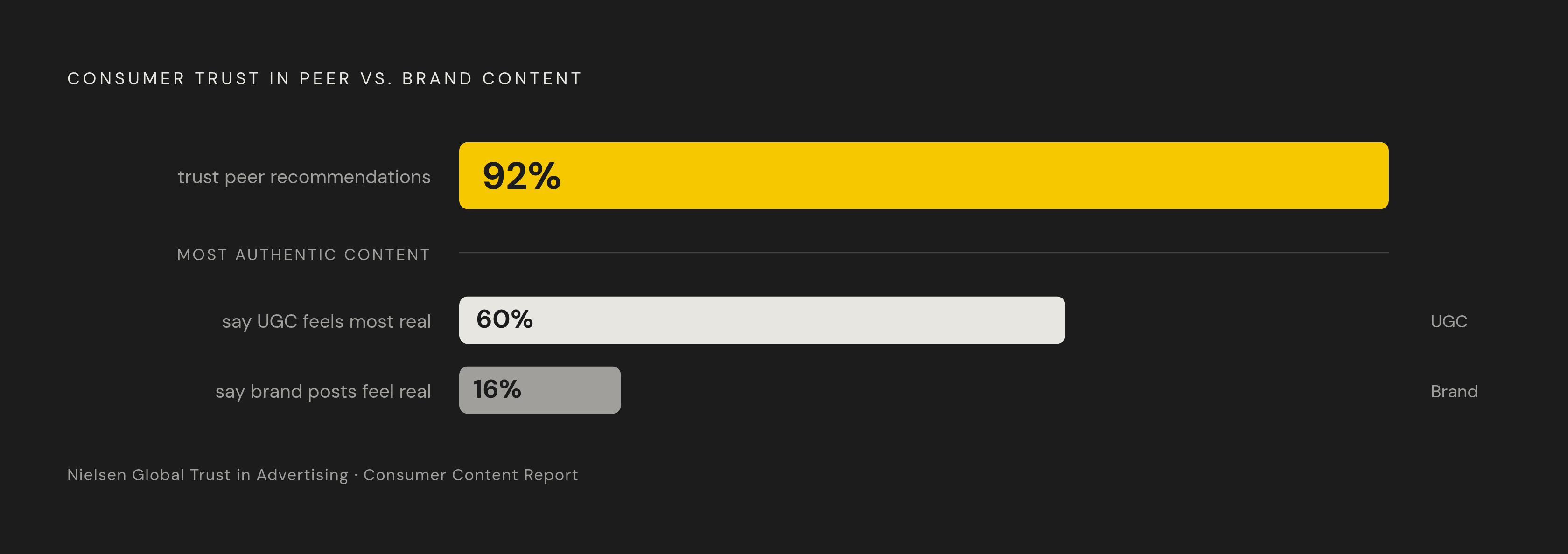
The asymmetry is rooted in a figure that's held steady for ages. Nielsen's Global Trust report on Advertising found 92% of consumers trust peer tips more than any other ad type. No matter how slick its marketing, a company’s claims can’t compete with that; no level of polish closes the gap.
The Consumer Content Report backs this up: 60% of people see UGC as the most real content, while just 16% say that about brand posts, a gap near 4:1. Paid UGC feels more like influencer content than a review someone wrote unprompted. Stackla's data shows UGC is several times as impactful compared to influencer content right when people pick what to get, and consumers say authenticity, cited by the large majority, is a purchase input, not some soft value floating above it. A hard factor at the point of buying, not some vague feel-good floating above it. That is a purchase input.
Sourcing, not feeling, is what matters here. UGC gets trust by design when only real customers are allowed to post. The "real" gets built into who's allowed to post, not asserted by a marketing team after the fact. With handheld shots, unpolished footage, and relaxed voiceover, paid UGC can mimic the look. It can't use the gate. It's commissioned labor dressed up as spontaneous, and as the audience learns to see through it, the markdown on that content only deepens. As paid creator content and AI-generated work pass for real, trust in content without proof falls, and real content with proof matters more because people believe less now.
Where organic customer content wins and falls short
On a PDP, organic content is a company’s best asset. Period. Shoppers who check reviews convert 161% higher with UGC, while Bazaarvoice's data indicates ten reviews can boost conversion by 45%. This is the PDP's core, not a nice-to-have. It works as the gate: 55% of shoppers hesitate before purchase without UGC, while 40% refuse if it's missing.
Organic content piles up outside the company's reach, and that exact fact means it skips any credibility penalty too. G2 comparisons, Reddit posts, Trustpilot reviews: they leave a buyer history with no company fingerprints, so people trust it down the road. Once that volume is rolling, the brand barely pays anything to make more of it.
All of it involves friction. A company can't make user posts appear whenever it wants, and a launch can't hang back until buyers decide to share it. Newer brands that haven't built a buyer community can't pull that lever yet. The standard drops hard too: some reviews come in with good pictures and a real story, some are a blurry snap and a line or two, and even once a brand wins rights plenty of it still isn't usable. Every item still requires a rights request before appearing in a paid Meta ad or PDP, so calling organic free content skips an actual legal step.
Negative reviews have a place here too, and they aren't a problem to fix. PowerReviews reports 96% of shoppers look for negative reviews before they buy. Curating them out won’t keep trust intact. It destroys it.
Where paid UGC helps and where it doesn't
Paid UGC gives brands the say organic never gets. A brief specifies what hook and format to use plus the exact feature to push, while the creator delivers by a date the company picks instead of relying on customer goodwill. So it fits launches, and can fill ads on Meta or TikTok when studio-produced creative begins to fatigue.
The performance argument is solid. Studies find creator ads earn 4x higher CTR and 31% higher recall than standard ad creative. Meta’s 2022 Marketing Science study, from 15 advertiser A/B checks, showed Partnership Ads (brand content placed as sponsored posts) did better than usual ads on both CPA and CTR. Usage rights get worked out early, usually a 30 to 90 day run with paid social rights included, so nobody ends up chasing permission later. For a company still lacking organic reach, paid UGC answers the need.
But it comes with a ceiling, and that ceiling is baked into its nature. It's commissioned content, so when the audience clocks that brief or recognizes the standard playbook, it gets discounted next to a verified buyer. It also keeps costing money: creator payments, testing spend, and usage renewals go on without end, while a review just compounds by itself at no cost. Disclosure rules make labeled pieces seem, correctly, solicited and not spontaneous, while paid UGC on a brand's TikTok stays exactly there, absent from Reddit and uncited in G2 review pages. Creator costs differ by format and follower count, with moving pictures typically earning more than still ones, so rate benchmarks should be locked in before a brief goes out. Paid UGC serves to create and test content. Using it to substitute for accumulated buyer trust is an exact misallocation that drains money without improving the metric that mattered.
Mapping each option to aims: creative testing for ads, PDP conversion and community trust
Paid UGC is the best choice for creative testing. A brief can isolate a single hook and deliver a testable asset quickly, with rights already locked in for paid use. Organic content can get boosted once it's located, but without a brief behind it, it wasn't designed to address one creative point. Paid UGC in the form of Spark Ads can outperform regular in-feed ads on key metrics like conversion and interaction. The platform's setup favors creative that fits in the app, the kind paid UGC is made to create.
The hierarchy flips for PDP conversion, and organic comes out way ahead. Content from real customers (star scores, written feedback, buyer images, Q&A discussions) serves as the main resource because it addresses the concerns a buyer brings to purchase. PowerReviews looked at data from 1.5 million listings on 1,200 e-commerce shops and found shoppers who use UGC convert substantially more often than those who scroll by it, while Q and visual UGC both drive outsized lift. Paid UGC might cover that gap briefly, during a launch before organic volume shows up, but it requires clear labeling and a way to drop or add to it as reviews accumulate. Bazaarvoice found that 60% of shoppers pick ten reviews with visual elements instead of 200 text-only reviews, showing recency and visual detail outweigh sheer volume.
Community trust is a space where organic UGC has no genuine paid replacement. No other content accumulates credibly across forums, community areas, or review platforms where the company can't speak or steer things, so people take what they see there as true. The vast majority of consumers say UGC makes them trust brands more, and that trust grows out of peer validation, something paid UGC can copy visually but can't replicate structurally. A paid creator video brings nothing to that accumulation. Its value stops with the creative asset. The only thing that counts is the current task and how much runway is left to finish it.
Organic customer content serving as a standalone asset for AI discoverability
How people look things up is shifting so quickly it redefines visibility. Gartner projected in 2024 that traditional search engine volume would drop 25% by 2026, while Web traffic referred from AI engines grew 527% year-over-year in 2026, with AI Overviews now triggering on roughly 48% of tracked queries.
Erlin's data shows 68% of AI citations draw on third-party outlets, and just 32% originate on a brand's own site. This stat should make them reorder budgets, since the page drawing most content spend is its weakest citation option.
Organic UGC shows up where AI models tend to look. Lily Ray found Reddit in Perplexity at 46.7% and in Google AI Overviews at 21%, making a UGC-native site one of the top named sources in AI answers. It's intuitive: customer reviews are harder to fake in large numbers than polished marketing language, so they fit exactly the kind of evidence these models were designed to value. A specific line like "the battery lasted 12 hours" is more extractable, and more citable, than a generic claim about quality, for the same reason it reads as more credible to a human shopper.
Using more outlets compounds the impact. Brands relying on one kind of channel get about 18% average AI exposure, while brands on five or more reach 78%. Stacker's found distributing content on many platforms may lift AI citations as much as 325% compared to using only a brand-run domain.
Paid UGC simply doesn't fit here. Even if a branded TikTok performs highly on paid social, it won’t propagate into the third-party ecosystem AI uses. It stays exactly where it was put up. But it works the other way too: when AI surfaces old feedback, overlooked issues, or inaccurate claims from forums, brands must address them directly, not ad money. Because Organic UGC's part in AI visibility matters, brands have a durable push to build review volume and real community presence, separate from paid social performance and impossible for paid UGC to substitute.
How agencies managing various brands balance UGC within a portfolio
Managing UGC for a whole portfolio offers something single-brand groups can't match. If one account gets high click-through from its paid UGC hook, that creative idea can guide the brief for another. Brands quit depending only on their testing spend, since a team managing many clients already knows which pacing, format, or hook performed before.
Organic won't build on itself through a portfolio, since it isn't borrowed. Every company must collect its own reviews, show up on the outside sites AI draws from, and watch which posts pop up in answers. The Influencer Marketing Benchmark Report found half of marketers plan to work with UGC creators this year, with 14.2% launching a first UGC campaign entirely, so agencies are fielding this exact question, organic versus paid, across many clients at once, often in the same week.
Managing that across many brands demands serious process. Each company must keep its voice rules, visual do's, don'ts, plus messaging apart, while creative lessons pass easily between them. Creator vetting, on the other hand, only needs to happen once: when a creator delivers for one label, they can take the next brief without fresh scrutiny. AI citation tracking has to happen at the same time as standard owned-content work, because each brand tends to surface in different ways and shouldn't be treated as uniform. And reports must track organic UGC performance (citation presence in AI answers, review volume) apart from paid UGC performance (CPA, click-through rate, evidence of creative fatigue), instead of blending them into a single vague "content is working" metric.
Agencies face their biggest problem with tracking results. Across 500 brands, Erlin's data found just 16% track AI performance systematically. Firms that can't tell brands how their organic footprint performs within AI answers leave out a piece of the value, and that gap will only grow.