B2B Influencer Marketing Strategy for Demand Generation
Expert credibility shapes B2B buying decisions long before sales enters the conversation.
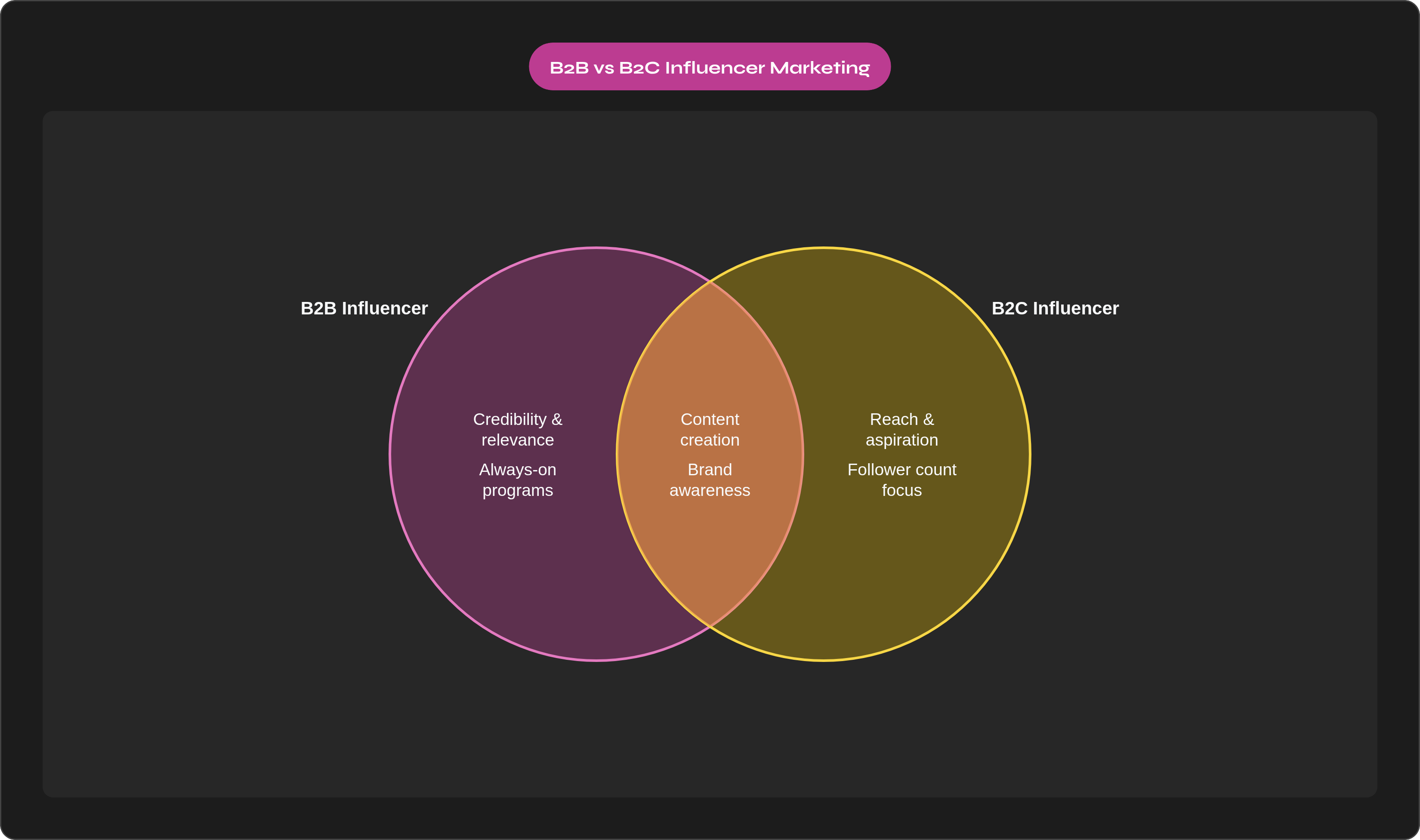
The B2C influencer model optimizes for reach and aspiration. B2B influence runs on credibility and relevance. Those are not the same objective, and they barely rhyme. Different selection criteria, different content formats, different success metrics entirely. Conflating them is how you end up with programs that look active on a dashboard and produce nothing in a pipeline.
Here's the core dynamic: B2B buyers are far more likely to trust a peer recommendation than anything a brand generates itself, and expert endorsements consistently outperform vendor-produced content when it comes to actually tipping a competitive evaluation. Being named the top solution by analysts or industry experts ranks as the most influential trust signal for a significant share of B2B buyers, ahead of video testimonials, ahead of written case studies. These claims are supported by the Edelman-LinkedIn B2B Thought Leadership Impact Report, which documents how expert credibility functions as a primary trust channel in B2B purchase decisions. The influencer's credibility is the trust channel. The brand is just the beneficiary.
What makes this harder than B2C isn't the content. It's the committee. The average B2B buying group includes six to ten stakeholders, per Gartner's research on buying group dynamics, and more than 40% of deals stall because of internal misalignment within those groups, per Forrester's research. So the marketing problem isn't just reaching the economic buyer. It's reaching everyone shaping the internal conversation before a vendor ever enters it. The Edelman-LinkedIn B2B Thought Leadership Impact Report found that a large majority of "hidden decision-makers," people who are invisible in the formal sales process, spend more than an hour per week consuming thought leadership, and that it helps them surface needs they hadn't previously named. Influence shapes internal champions, not just the person signing the contract.
Forrester's Buyers' Journey Survey puts a number to how early this starts: 92% of B2B buyers begin their journey with at least one vendor already in mind, and 85% have defined their requirements before they raise their hand to any vendor. Demand gets shaped in channels brands don't own, well before any formal sales motion begins. Influencer marketing is one of the only ways to have a presence in those channels when it counts.
The Four Types of B2B Influencers and Where Each One Earns Its Place
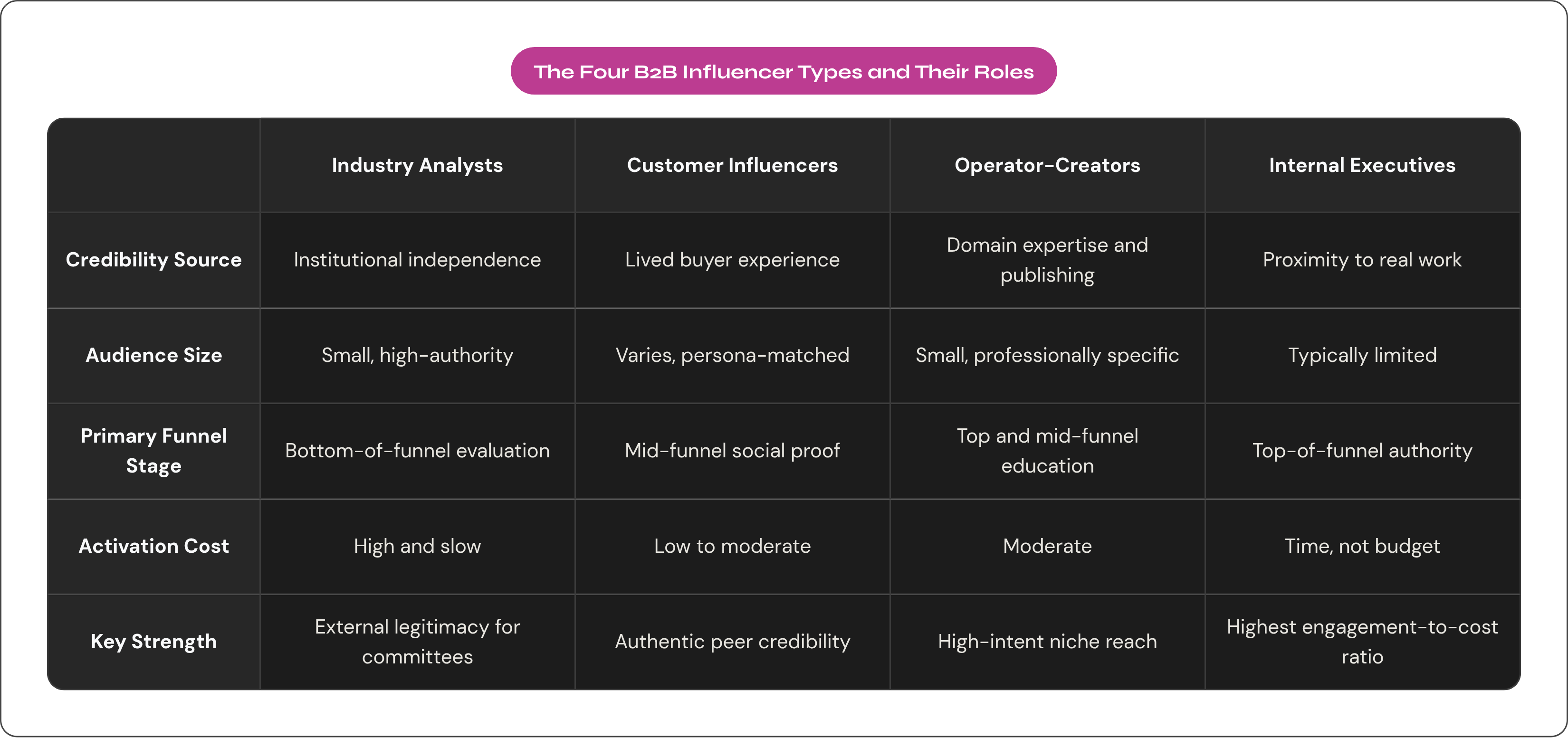
Treating the B2B influencer landscape as a single tier is where most programs go sideways. There are four distinct types, and each one does a different job. Running them all through the same brief, the same metrics, and the same activation logic will leave your program unfocused and nearly impossible to evaluate honestly.
Industry Analysts and Independent Researchers
Analysts carry significant weight during final vendor evaluation, because their independence is the source of their authority. They are slow and expensive to activate. But they do something no other influencer type fully replicates: they provide external legitimacy at the exact moment a buying committee is looking for permission to commit to a decision they've already emotionally made.
One thing that often gets overlooked is the rise of the independent analyst tier, former institutional researchers who now publish on LinkedIn, Substack, and podcasts. In specific categories, they carry authority that rivals their former employers, frequently with far less friction in partnership conversations. They are underutilized and worth identifying early. Primary fit: bottom-of-funnel evaluation and buying committee reassurance.
Customer Influencers
These are existing buyers who have built professional followings by talking openly about their work. Their credibility is structural, not manufactured. They are advocates for problems they already live with, not paid spokespeople performing enthusiasm. They can also represent a cost-efficient starting point for your program, activated through community structures, co-marketing arrangements, or advisory roles.
Early-stage programs routinely overindex on analyst relationships and underestimate how much a credible customer voice can do mid-funnel. That's a resource allocation mistake. Primary fit: social proof for analogous buyer personas in active evaluation.
Operator-Creators and Practitioners
These are independent creators who built an audience through consistent, genuinely useful professional thinking. Not analysts. Not customers. Practitioners with domain expertise and a publishing cadence. Their audiences are smaller, but professionally specific and high-intent, and that specificity is the entire point.
A cybersecurity platform reaching 4,000 CISOs through three operator-creator partnerships is doing more valuable work than reaching 400,000 mixed professionals through a single macro-influencer. Research cited by Neil Patel found that micro-influencers in the 10,000 to 50,000 follower range drive three times more conversions than macro-influencers, because their audiences treat them as peer advisors rather than celebrities. That trust dynamic doesn't scale down from macro-influencer relationships. It has to be built from a different starting point entirely. Primary fit: sustained top-of-funnel awareness and mid-funnel education within a defined professional niche.
Internal Executive Voices
Internal executive voices are the most underutilized category in most B2B programs, and the highest-return one relative to investment. Subject-matter experts and executives already inside the organization carry credibility that comes from proximity to actual work, and they cost nothing to activate beyond time and editorial investment. A Refine Labs study found that personal profiles generate five times more engagement than company pages for equivalent content, despite typically having fewer followers. Primary fit: thought leadership content series, brand authority building, and amplification through LinkedIn Thought Leader Ads.
The selection principle is consistent across all four types: match the influencer to the specific job that needs doing at a specific funnel stage, not to follower count.
Mapping Influencer Roles to the Buyer Journey Rather Than the Campaign Calendar
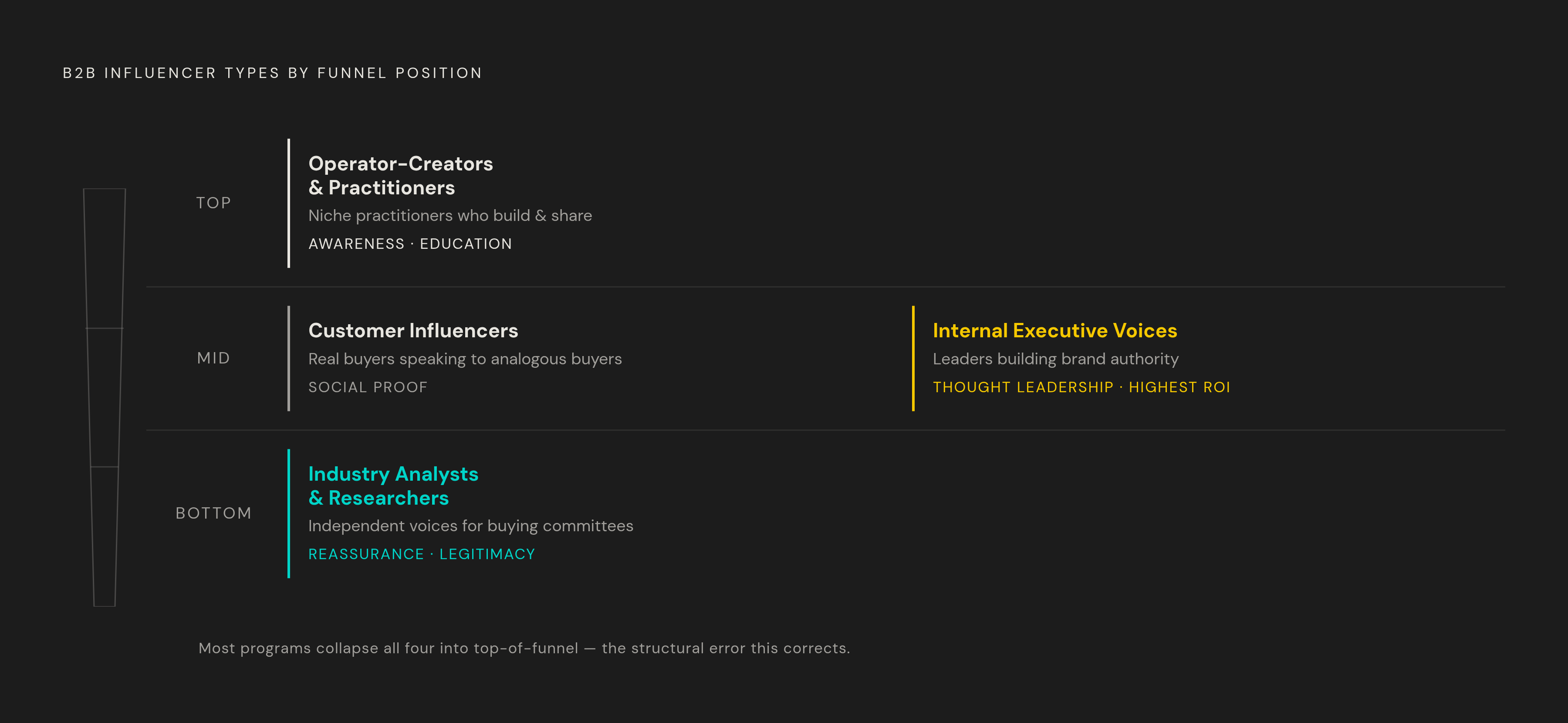
The most damaging structural mistake in B2B influencer marketing is treating it as a series of discrete awareness campaigns rather than a continuous presence across the full buyer journey. B2B marketer and content creator Nick Bennett has noted that a substantial share of companies doing influencer marketing remain focused entirely on top-of-funnel awareness. The programs producing pipeline impact are the ones that extend well beyond it, which most programs fail to do.
Top of Funnel: Shaping Preference Before Intent Surfaces
Operator-creators and internal executive voices do the primary work here: recurring LinkedIn content, newsletter contributions, podcast appearances. The goal is brand familiarity established within the buying committee before any RFP or vendor shortlist ever forms. Social media takeovers and webinar co-hosting extend reach into audiences the brand doesn't already own. By the time a buyer begins formal evaluation, your brand should feel familiar through repeated, substantive exposure from trusted voices, not through retargeting ads.
Middle of Funnel: Building Credibility During Active Evaluation
Research-based content co-created with influencers performs consistently well at this stage. The TopRank-Ascend2 2026 State of B2B Thought Leadership Report found that 74% of B2B marketers who frequently collaborate with influencers rate their research-based content as very effective, compared to just 29% of those who don't collaborate. That gap doesn't close with better creative direction. It closes with the right structural partnerships. Customer influencers sharing peer-to-peer use-case content through workshops, testimonial formats, or advisory roundtables carry authenticity that vendor-controlled content simply cannot replicate, no matter how well-written.
Bottom of Funnel: Converting Committee-Level Trust Into Decision Momentum
Analyst endorsements and independent researcher validation carry the most weight here. Buying committees in final evaluation are looking for external legitimacy; they want someone outside the vendor relationship to confirm what they're already inclined to believe. Hidden decision-maker engagement is particularly critical at this stage. Content that surfaces unrecognized needs can accelerate internal alignment and reduce deal stalling in ways no sales motion can replicate from the outside.
Influencer content briefs must specify funnel stage and target persona, not just topic. The same influencer can serve different content jobs at different stages. The brief determines which job they're doing.
Why Always-On Programs Outperform Campaign-Based Activations
Campaign-based activations produce awareness spikes. Always-on programs build the ambient credibility that determines which vendors get shortlisted before a campaign could even reach a buyer. Those are not equivalent outcomes. Treating them as alternatives is a structural error.
TopRank Marketing's B2B Influencer Marketing Research puts the performance gap in specific terms: marketers relying on campaign-based approaches are 17 times more likely to report that their program is somewhat or very ineffective. Among marketers with mature, always-on programs, the share reporting outstanding results climbs significantly compared to the broader population. Program longevity is itself a performance variable.
In practice, always-on looks like this: influencers contributing on a defined cadence, weekly LinkedIn posts, monthly newsletter sections, quarterly research co-authorships. Consistent guest placement on category-specific podcasts, because senior B2B buyers consume podcasts heavily and a consistent presence maintains attention in a way that periodic appearances cannot. Customer influencers participating in structured community programs rather than fielding one-off case study requests every eighteen months. Brands amplifying influencer content through Thought Leader Ads as a standing practice, not only when a campaign is active.
A majority of B2B marketing teams with an existing influencer budget plan to increase it, per TopRank Marketing's research, and the marketers with the most advanced strategies overwhelmingly have a dedicated budget they expect to grow. The programs that have been running long enough to see the results are the ones investing more, not less.
How to Identify and Qualify the Right Influencers Before Any Outreach Begins
The most common activation mistake is selecting influencers on follower count or brand familiarity rather than audience fit and genuine credibility. Follower count answers the wrong question in a B2B context. It's a B2C heuristic being applied to a B2B problem, and it reliably produces B2C-style results: visibility without conversion.
Start with audience specificity instead. The relevant question isn't how many followers an influencer has; it's how many of those followers match your actual buyer personas. A 4,000-person CISO audience outperforms a 400,000-person mixed professional audience for a security platform in terms of qualified reach and downstream intent.
Credibility signals matter more than reach signals. Look for engagement quality: substantive comments from identifiable professionals, not generic reactions from anonymous accounts. Look for how frequently the influencer is cited or referenced by peers in the field. Look for a history of independent opinion rather than undifferentiated endorsement of multiple partners. Does this person have a defined professional point of view they return to consistently, or do they produce broad-topic content that attracts a large but shallow audience? That distinction separates practitioners from aggregators, and the difference in program performance is substantial.
Platform fit matters, too. LinkedIn is the primary channel for most B2B programs and consistently ranks as the most effective channel for thought leadership among B2B marketers, per TopRank Marketing's research. YouTube and podcasts function as strong secondary channels, particularly for technical content and executive-buyer formats.
A few red flags worth watching for before outreach begins: (i) influencers whose engagement comes predominantly from other marketers rather than the buyer personas you're targeting, (ii) influencers with no public track record of forming and defending a professional opinion under pressure, and (iii) accounts with follower-to-engagement ratios that suggest audience inflation. Any of those should prompt closer scrutiny, not just a note in a spreadsheet.
Build a tiered shortlist across all four influencer types before approaching anyone. Map your program's funnel coverage before launch; don't assemble it reactively as each campaign gets planned. Qualification rigor at the front end is what saves budget downstream. It's unglamorous work, but it's where most of the actual program value gets determined.
Structuring Partnerships So Influencers Produce Content That Actually Moves Buyers
There's a gap most programs fall into, and it's a brief-level problem. The brief tells the influencer what to say about the product instead of what perspective to develop for a specific audience at a specific funnel stage. That produces content that sounds like a vendor wrote it, because functionally, a vendor did. The influencer's name is on it, but their voice isn't.
A demand-generating brief specifies the target persona and their primary professional concern, not just their job title. It identifies the funnel stage the content is designed for and the belief or behavior it needs to shift. It names the influencer's specific point of view or domain expertise that makes them credible on this particular topic, because the brief should amplify their voice, not replace it with brand messaging dressed up in their tone. And it specifies format matched to stage: social posts and webinars for awareness; workshops, research co-authorships, and peer testimonials for consideration; analyst commentary for evaluation.
Co-authored research deserves particular attention here. It gives the influencer genuine intellectual ownership of the content, which is what makes their promotion of it feel authentic rather than obligatory, and it gives the brand third-party credibility it couldn't manufacture internally. That 74% effectiveness rating for research-based content among marketers who frequently collaborate with influencers, compared to 29% among those who rarely do, per the TopRank-Ascend2 2026 State of B2B Thought Leadership Report, is a clear signal that format selection isn't a creative preference. It's a strategic decision with measurable consequences.
Every content decision should trace back to a buyer persona, a funnel stage, and a specific belief or behavior the content is designed to shift. When a program is built around that logic from the start, influencer marketing functions as a demand-shaping mechanism. Without it, it's a brand awareness line item with inconsistent results and no clear owner, which is exactly how most programs end up getting cut.