Influencer Marketing Campaign Case Study Analysis
Most influencer campaigns fail because brands optimize for reach instead of audience fit.
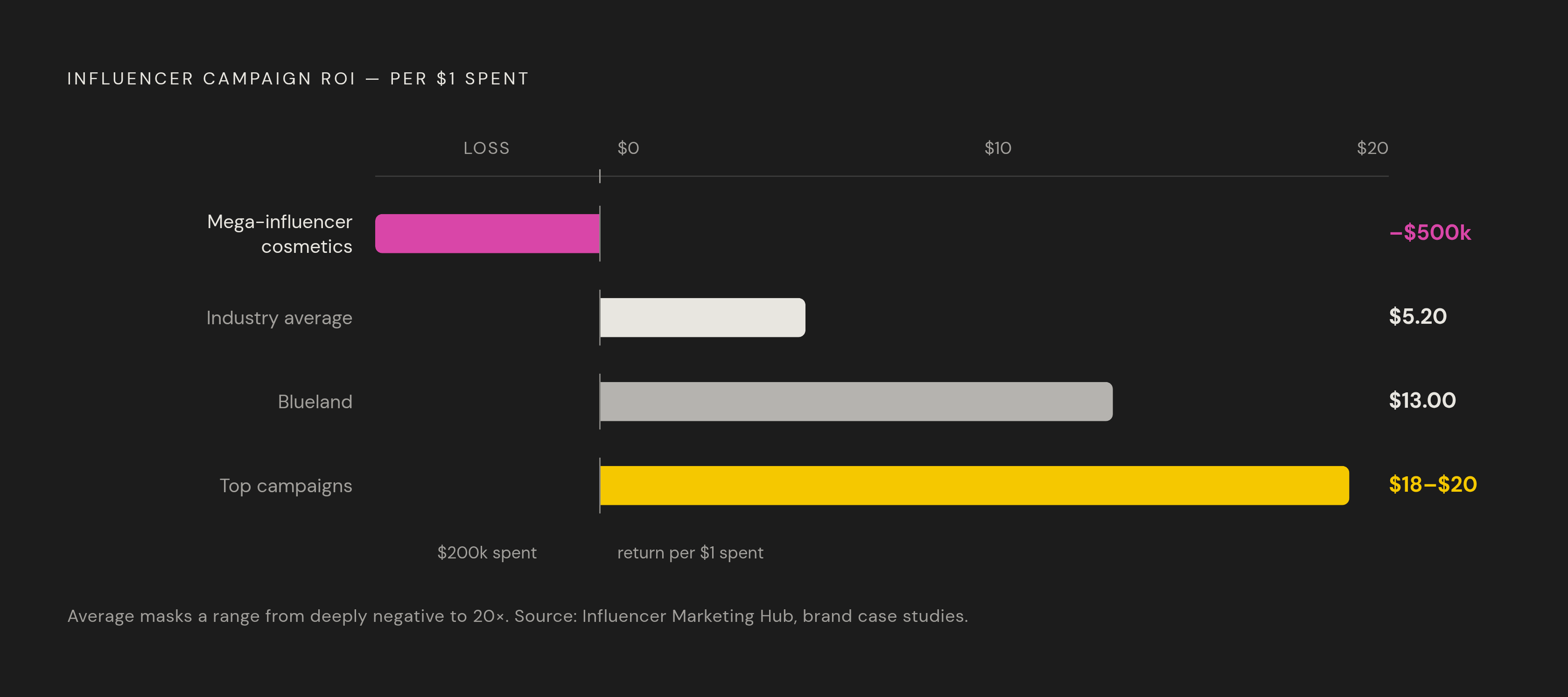
The influencer marketing industry will spend over $10 billion in the U.S. alone in 2025, and a meaningful portion of that will produce almost nothing. The average return sits around $5.20 per dollar spent, but the top campaigns return $18 to $20 per dollar. That spread is not a footnote. It is a structural indictment of how most campaigns get planned, and the culprit is almost always the same thing: someone optimized for the number they could show in a deck instead of the decision that would actually move product.
A $40,000 Gen Z fashion campaign generated $89,000 in tracked revenue. A $200,000 mega-influencer cosmetics campaign generated an estimated negative $500,000 in impact. Same industry. Wildly different outcomes. The difference was not budget size or creative quality or timing. It was a set of deliberate decisions made before the brief ever went out.
The instinct to buy reach is understandable. Bigger number, bigger outcome — the logic feels airtight until you watch it fail at scale, repeatedly, with real money. In 2024, 44% of brands preferred nano-influencers and 26% preferred micro-influencers. Only 17% favored macro-influencers. This is not frugality. It is a recognition, hard-earned by brands who wasted serious money chasing audience size, that tight topic-audience alignment converts better than raw reach. Chasing follower count without context is like fishing in a swimming pool — the water is there, but nothing's biting.
Blueland, the eco-cleaning brand, ran a campaign across 211 micro-influencers using a product gifting model, no large fees attached. Amazon seller rank jumped 6.3 times. Monthly unit sales grew 4.7 times. ROI came in at 13 times. The mechanism was not the number of influencers. It was that those influencers were already operating in the eco-cleaning space, talking to people who were already predisposed to care. Their audiences trusted the recommendation because it was consistent with everything else they had ever seen from that creator. The product felt like a discovery, not a placement. That distinction is the whole game.
Iceland, the UK grocery chain, deployed 50 micro-influencers to depict real, everyday use of frozen food. Not aspirational lifestyle content. Not polished kitchen sequences with a professional food stylist standing just out of frame. Just people cooking dinner. Brand approval rating moved from 10% to 70%. Video retention on Facebook sat at 55%, which is genuinely high for a brand campaign, because the content matched the actual context of the audience watching it.
The failure case inverts the lesson precisely. The $200,000 mega-influencer cosmetics partnership purchased access to 8 million followers and used follower count as the primary selection criterion. No visible mechanism for vetting audience alignment, content history, or values fit. The campaign collapsed within two weeks. Creator fit means topic alignment, audience demographic overlap, and content style match. Reach follows from those three things. It does not substitute for them.
What "Authentic Content" Actually Means Structurally, and Why Production Quality Can Hurt
Authenticity is the most overused word in influencer marketing, which is saying something given the competition. But the case studies give it a specific, testable shape. And that shape is worth understanding precisely, because brands keep making the same expensive mistake in the opposite direction.
In the Gen Z fashion campaign, professional production decreased engagement by 22% compared to unpolished, creator-native content. Not a soft preference. Not an aesthetic quirk. A measurable conversion penalty. Audiences read high production value as advertising. They read rough cuts as peer recommendation. The cognitive pathway is different, and so is the behavioral response. You can spend more money and get worse results, and this is one of the clearest ways to do it. Over-produced content is a bit like a friend showing up to dinner in a tuxedo — technically impressive, but suddenly you trust them a lot less about where to eat.
TikTok nano-influencers average 18% engagement rates, the highest of any platform-tier combination in the current data, partly because the platform's aesthetic norms actively resist polish. Content that looks produced looks out of place. Content that looks native looks trustworthy. Those two things are not interchangeable.
The Samsung Galaxy S25 campaign understood this. Creators demonstrated real AI-powered workflow improvements inside their own existing workflows. Not scripted demos. Not brand-supplied talking points delivered to camera. The content was structurally native to what each creator already made, which meant audiences encountered it the same way they encountered everything else from that creator. Indistinguishable from organic content because it functionally was organic content, with a product in it.
The structural markers of content that consistently performs are: (i) the creator's own voice and framing, (ii) the product shown in actual use rather than staged showcase, and (iii) format native to the platform. A Reel should be cut like a Reel. A TikTok should feel like a TikTok. When brands supply scripts, shot lists, and approved language, they are purchasing the creator's audience while systematically dismantling the reason that audience trusts the creator in the first place. The winning brief supplies a key claim, a required disclosure, and stops there. Everything else is the creator's job.
Platform Choice as a Strategic Decision, Not a Default
Instagram commands the largest influencer spend in the U.S., but roughly half of marketers believe TikTok offers better return. The most-spent platform and the best-return platform are not the same, and most campaigns just go wherever the creative assets already live, or wherever the brand ran last year. That is not a strategy. It is inertia wearing a media plan.
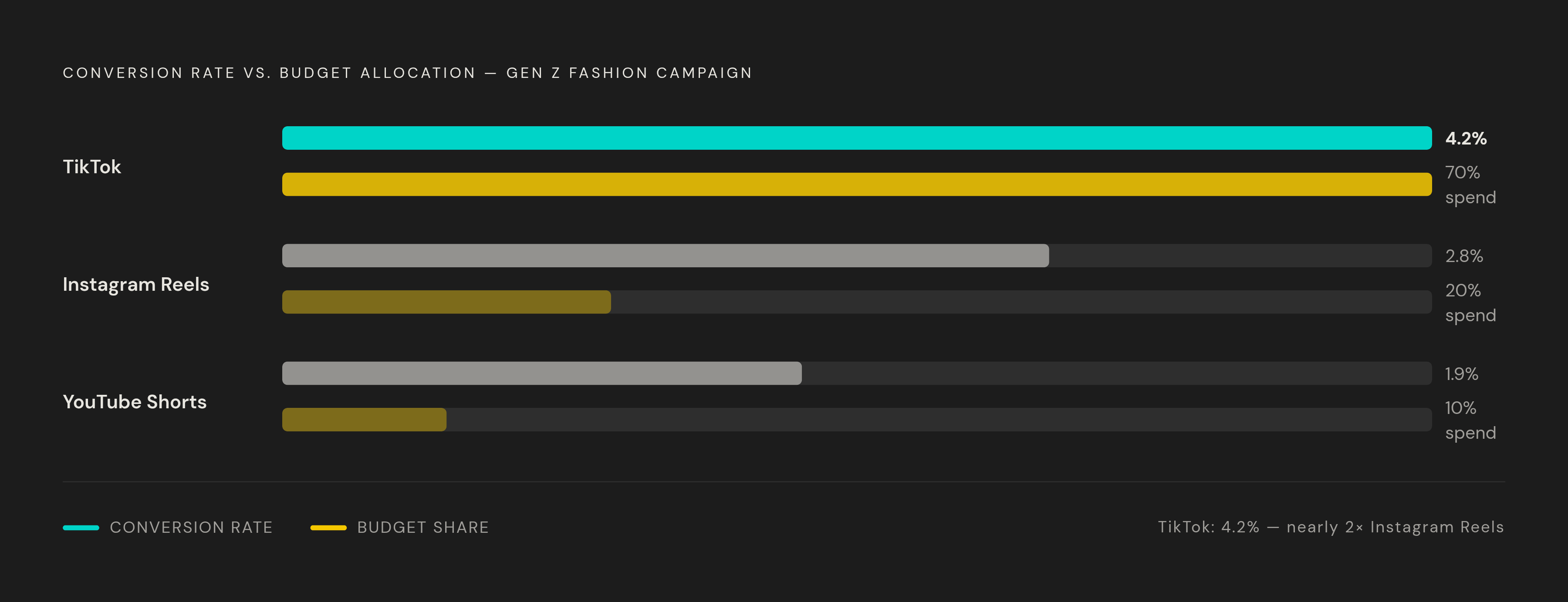
The Gen Z fashion campaign distributed spend deliberately: 70% to TikTok, 20% to Instagram Reels, 10% to YouTube Shorts. TikTok conversion rate was 4.2%. Instagram Reels came in at 2.8%. YouTube Shorts landed at 1.9%. The weighting matched where Gen Z actually converts, not where the industry concentrates its dollars. Over a quarter of Gen Z engages with influencers on TikTok specifically, compared to 15% of all consumers. The channel allocation followed audience behavior, full stop.
Iceland made the opposite platform call and was equally correct. Facebook and YouTube, not TikTok, because the target was older household shoppers who were not spending their evenings scrolling through short-form video. The 55% video retention rate reflects platform-audience fit, not some inherent superiority of Facebook as a medium. There is no universally superior platform. There is only the platform your specific audience uses to discover your specific category, and the discipline to go there even when your internal teams are more comfortable somewhere else.
The B2B context follows the same logic. LinkedIn video views grew 36% year-over-year, and the proportion of B2B marketers running influencer programs has climbed substantially. Pick the platform where your audience goes when they are in a discovery mindset for your category. The aggregate industry spend numbers are somebody else's problem.
How Campaign Structure, Duration, Incentive Model, and Creator Count Shaped Results
One-off posts are the most common campaign structure. They are also, consistently, the weakest. And the pricing dynamics of the creator economy itself signal this: a significant majority of influencers offer discounts for longer-term partnerships, because they know sustained relationships produce better content. The market has already priced in what most campaign plans ignore.
Blueland's campaign ran for three months. Amazon seller rank improvements accumulate over time; reviews compound; a single wave of posts would not have moved seller rank 6.3 times, because rank is a function of sustained sales velocity, not a single traffic spike. The structure matched the mechanism. That correspondence between campaign architecture and intended outcome is what most campaigns skip.
The BFCM e-commerce campaign used a different structural logic entirely: 50 to 100 influencers per month, with deliberate concentration around high-purchase-intent seasonal moments. That campaign generated $448,000 in Q4 revenue, including a $34,000 single-day spike. The goal was timed concentration rather than slow accumulation, and the architecture reflected that distinction specifically.
Adidas's football campaign integrated creators into matchday coverage as ongoing participants, then amplified top-performing clips with paid media. Football-related social engagement grew 44% during the tournament. Creators had recurring reasons to post rather than a single brief and a single deliverable. No individual post had to carry the full weight alone, which is a fundamentally more forgiving structure.
Incentive model is part of this calculus too. Blueland's product-gifting approach kept creator count high and content volume high on a controlled budget, front-loading product cost rather than creator fees. That changes where the risk lives. The mega-influencer flat fee front-loads everything — cost and risk alike — into a single transaction. Before any campaign launches, the team should be able to answer three things: are we building toward accumulation, concentration at a moment, or ongoing integration? And do the creator count, duration, and incentive model actually correspond to that intent?
What the Mega-Influencer Crisis Reveals About How Risk Concentrates at the Top of the Funnel
The cosmetics campaign put $200,000, 16 weeks, and the brand's reputation into a single creator with 8 million followers. Two weeks after launch, past discriminatory posts surfaced. Within 48 hours, more than 15,000 negative brand mentions appeared. Instagram engagement dropped 22%. Retail partnerships were paused. The estimated revenue impact reached $500,000.
Here is the thing: the risk was not the creator's past behavior. Past behavior exists for every creator. It is a constant, not a variable. The risk was the structural decision to make one person the entire campaign. When that person became a liability, there was nothing else there. No distributed architecture to absorb the damage, no other 49 creators still posting, no parallel narrative the brand could point to. One thread pulled, and the whole thing unraveled — like pulling the single load-bearing wall out of a house and being surprised when the ceiling follows.
Distributed models hedge this inherently. A campaign running across 50 or 211 creators absorbs a single creator's controversy without structural collapse. The individual post disappears; the campaign continues. This is not pessimism about creators specifically. It is basic concentration risk, the same logic that governs financial portfolios and supply chains. Nobody puts their entire retirement savings in one stock and calls it diversification.
The Redken and Sabrina Carpenter partnership shows the inverse dynamic. That collaboration was timed to her rising credibility, not purchased at peak price. The audience trust was already established before the brand entered the picture. Single-creator partnerships can work, but they require earned trust as a genuine precondition, not a hoped-for outcome. Vetting — audience alignment, content history, values screening, real reputational due diligence — is not a preliminary step before campaign structure. It is part of campaign structure. Treat it like a line item.
The Measurability Gap That Prevents Most Campaigns from Learning What Worked
Most ROI figures in influencer marketing are averages that obscure enormous variation. An average return of $5.20 per dollar means almost nothing when the spread runs from deeply negative to 13 times positive. The variance is where the actual information lives. Most campaigns are not built to read it.
E-commerce brands with strong attribution consistently see higher returns than B2B awareness campaigns, and that gap is not only a vertical difference. It is a measurement difference. E-commerce has a purchase event: timestamped, attributable, tied to a creator-specific link or code. B2B awareness campaigns often lack a discrete conversion event, so they measure impressions and engagement and learn almost nothing actionable. They cannot tell you what worked because they never defined what working would look like. So they run the same experiment next quarter and call it a strategy.
More than half of influencer-driven purchases happen through direct links or influencer storefronts. The purchase signal exists. It is trackable. It just needs to be captured, which means you should build tracking infrastructure before launch, not retrofit it afterward when someone in finance asks for the numbers and you are left explaining why you have 14 million impressions and no conversion data.
The Gen Z fashion campaign could report conversion rates by platform because separate tracking was assigned to each channel from the start. TikTok at 4.2%, Reels at 2.8%, Shorts at 1.9%. That granularity only exists because someone made a setup decision before anything went live. Blueland could report 13 times ROI because the campaign designated Amazon seller rank and unit sales as primary KPIs, with a documented baseline above #36,000 before any post went out. You cannot measure lift if you do not know where you started.
Campaigns that report only impressions and engagement are measuring what was seen, not what converted. Useful for one thing: it looks like a result when you have no result. The setup that makes campaigns actually legible requires: (i) a specific conversion event defined before launch, (ii) creator-specific tracking links or discount codes, (iii) a documented baseline, and (iv) a measurement window that corresponds to the campaign's actual structural logic rather than whatever calendar quarter someone picked arbitrarily.
The Strategic Patterns That Separate Winning Campaigns from Equally Funded Ones
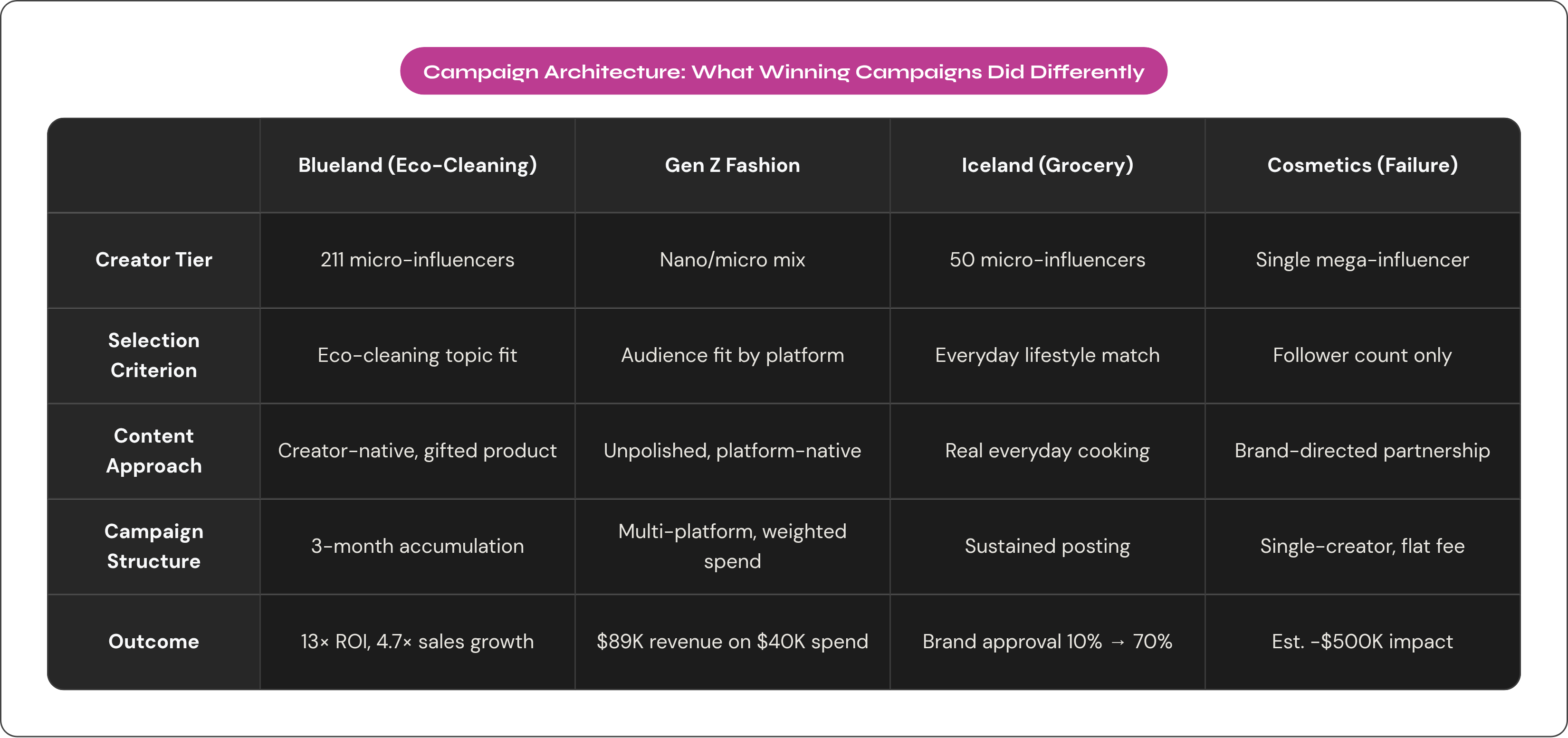
These patterns appear across different verticals, different budget levels, and different platform environments. What the winning campaigns shared was not access to better creators or larger budgets. It was decisions made before the brief went out, and the discipline to build campaign architecture that matched those decisions rather than defaulting to whatever was most familiar.
Creator selection on the basis of fit rather than follower count is not a discovery at this point; it is the established conclusion of every high-ROI campaign in the data. Nano and micro tiers dominated the winners not because they are cheaper but because their audiences are more contextually aligned with specific product categories. Reach follows from fit. Selecting for reach alone is working backward.
Format sovereignty produced consistently better results than production investment. Winning briefs defined the outcome and stopped. Creators who controlled their own format, voice, and execution outperformed those who received scripts or pre-produced assets, because the creative constraint is the brand's job and everything that makes the constraint work is the creator's.
Platform allocation was treated as an audience decision in every winning campaign, made once and deliberately. Channel weighting followed where the specific target audience converts in their specific category — not industry spend concentration, not internal creative compatibility, not last year's plan.
Structural alignment between campaign architecture and campaign goal separated the campaigns that moved metrics from those that generated content. Duration, creator count, and incentive model either correspond to a defined intent or they undermine it. There is not a lot of middle ground.
Risk, in the context of creator selection and campaign structure, is mostly a function of concentration. The more dependent a campaign is on a single variable — one creator, one platform, one moment — the more fragile it is. Distributed architecture does not guarantee success, but it does make failure survivable in a way that single-creator, single-wave campaigns simply are not.
Measurement infrastructure built before launch is what separates campaigns that generate numbers from campaigns that generate learning. And learning is the only asset that compounds from one campaign to the next. Every campaign that cannot report conversion is starting over from zero the next time the budget conversation happens.
The competitive advantage in influencer marketing right now is not access. You can reach almost any tier of creator at almost any budget level. What is actually scarce is the organizational discipline to make these decisions before your brief goes out, rather than improvising them mid-execution when the results are already mostly determined.