Influencer Collaboration Examples from D2C Brands
D2C brands succeed with influencers by matching creator fit, format, and conversion goals.

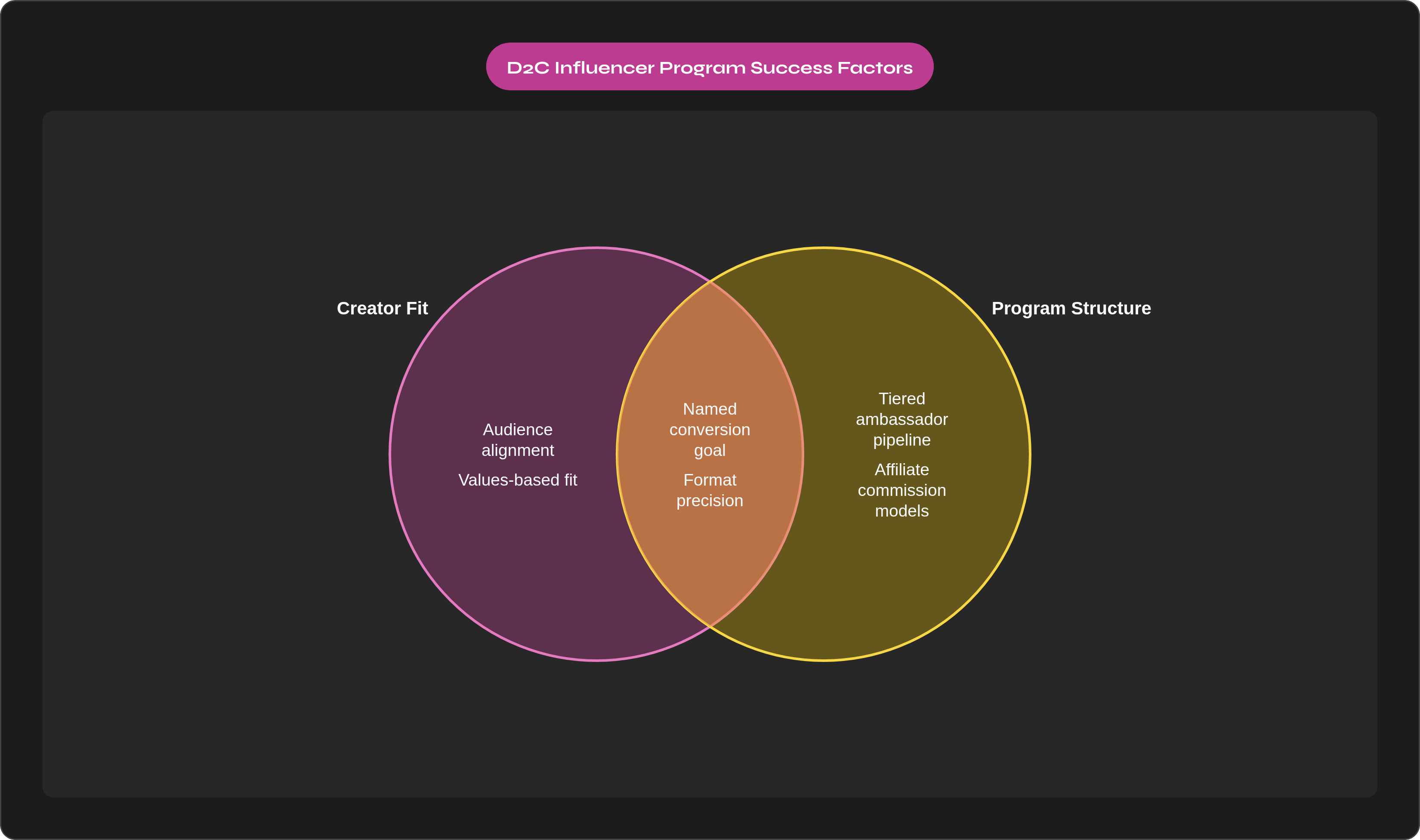
The most instructive influencer collaborations from D2C brands are not accidents. They share three deliberate structural choices: a creator whose identity or audience genuinely reinforces the brand's positioning, a format matched to what the audience can realistically do next, and a conversion goal named before the brief is written. Examine the brands that built category presence without retail shelf space or massive ad budgets, and those three variables appear every time. The ones that missed, missed on at least one of them.
The financial logic for the channel is compelling. The average return on influencer spend, as of 2025 data, sits at $5.78 for every dollar invested, with top performers reaching $18. Consumer trust dynamics make that math possible: 63% of consumers trust influencer opinions more than brand advertising, per Business2Community's 2024 findings. D2C brands, by structural necessity, need trusted intermediaries. They lack the shelf presence that establishes implicit credibility and they cannot outspend category incumbents in paid search or display. Influencer partnerships solve a specific problem: credibility and discovery at lower customer acquisition cost than most alternatives.
Gymshark is the origin story worth understanding first. Ben Francis sent free apparel to fitness YouTubers he admired because he had no ad budget. The constraint created the model. That's not revisionist mythology; it's the cleanest illustration of what happens when a founder has to find a lever that doesn't require capital. The strategic sophistication came later. The budget restriction came first.
There is a counter-pressure worth naming before going further. Sixty-eight percent of shoppers report frustration with the volume of sponsored content, according to Business of Fashion and McKinsey's 2025 data. Authenticity is no longer a differentiator you earn by default; it's one you have to engineer.
What "the right creator fit" actually means in practice
Fit is not follower count. It's the degree to which the creator's identity, audience, and content context reinforce the brand's positioning without requiring visible strain to do so.
Gymshark's Head of PR articulated this precisely: the vast majority of Gymshark ambassadors were fans and consumers of the brand before they were partners. Fit preceded the partnership, which means the content that followed didn't read like a transaction. The audience could sense the difference because there wasn't one.
Jaxon Lane, a men's skincare brand, took that logic to a hyper-niche extreme. They targeted creators with just a few thousand followers who specialized in sheet mask content specifically. Not skincare broadly. Sheet masks. That level of contextual precision means the audience a creator reaches is not just demographically adjacent; they are actively looking for exactly what the brand offers. Within a year, that micro-influencer coverage chain created enough ambient credibility that it led to a Wall Street Journal interview. The path to a national press mention ran through nano-creators with granular specializations.
Glossier demonstrates a different version of fit: peer-based fit, where the influencer is an existing customer rather than a media figure. Seventy percent of Glossier's sales came from peer-to-peer referrals, with 80% of customers referred by friends. The "creator" in many of those transactions was someone who genuinely used the product and told their network. The influencer infrastructure was the customer base itself.
The Allbirds and Leonardo DiCaprio collaboration illustrates values-based fit. DiCaprio is an environmental activist with a public record on sustainability. Allbirds is a sustainability-positioned footwear brand. The partnership added credibility the product couldn't claim by itself, because the creator's identity carried associations that transferred to the brand on contact. No amount of ad copy produces that effect as efficiently.
These three types of fit, audience-based, values-based, and identity-based, produce different kinds of credibility signals. Audience-based fit drives conversion efficiency because the creator's followers are already in the consideration set. Values-based fit elevates brand positioning and legitimizes claims. Identity-based fit, the Gymshark athlete model, builds community coherence over time. Each is valid; each requires a different selection process.
The tier question is downstream of this. Once fit is established, the data consistently favors smaller tiers for engagement efficiency. Nano-influencers averaged 6.23% engagement on Instagram compared to 0.61% for macro-influencers, per eMarketer's 2024 figures. That differential exists precisely because fit is easier to achieve authentically at smaller scale, where creator and audience share context more tightly.
How format and platform shape what a collaboration can accomplish
The same creator in the wrong format is a missed conversion. Format determines what action the audience can realistically take after encountering the content, and that action has to connect to the goal.
Product seeding at scale operates on a different logic than a standard paid partnership. Obvi sent products to more than 100 micro-influencers weekly with no posting requirement. The goal was authentic UGC volume, not guaranteed placements. Removing the obligation removes the performative quality that audiences detect and discount. Some creators posted. Some didn't. The ones who posted did so because they wanted to, and that distinction showed.
Challenge formats convert passive viewers into active participants. Gymshark's #Gymshark66, a 66-day fitness challenge, accumulated over 700,000 views and, per the brand, drives 30% higher repeat purchase rates among participants. The format works because it asks for behavior, not attention. Community participation creates a different attachment than content consumption.
Co-creation and limited editions operate through scarcity and identity fusion. Whitney Simmons's collections with Gymshark sold out rapidly because the creator's identity became the product's identity. Customers weren't buying leggings; they were buying alignment with a person they'd chosen to follow. The format collapses the distance between admiration and purchase.
The Dunkin' and Charli D'Amelio collaboration is the most instructive case of format making the creator's identity the product rather than just the messenger. Charli was already an organic fan of Dunkin' before any partnership existed. Naming a cold brew after her formalized what the audience already believed was a genuine preference. The result: a 57% increase in app downloads and a 45% surge in cold brew sales. The format, a named menu item requiring app-based ordering, created a measurable funnel step. That specificity is not incidental. It's the mechanism.
Daniel Wellington's gifting-plus-discount-code model demonstrates how affiliate formats extend creator value beyond the initial post. The brand repurposed influencer content on its own channels and website, meaning a single creator relationship generated both earned content and owned content simultaneously.
Platform context compounds with format in ways that aren't always obvious. Away's #TravelAway campaign generated more than 58,000 tagged posts, but that volume was a product of platform context, not just campaign execution. Instagram's aspirational visual grammar aligned perfectly with travel content, making UGC aggregation feel natural rather than orchestrated. The platform was doing work the brand didn't have to pay for separately.
Platform economics vary considerably. YouTube averages $791 per collaboration, TikTok $460, and Instagram $363. TikTok is favored for ROI by half of marketers as of 2025 data. Instagram commands the largest absolute spend, at $2.21 billion in 2024, and is the platform preference for the majority of brands. These numbers don't prescribe a choice; they describe tradeoffs. The relevant question is whether the platform's content grammar matches the format you need to execute.
Building programs that compound rather than campaigns that expire
A campaign generates a spike. A program generates compounding awareness, loyalty signals, and creator relationships that grow more efficient over time. The distinction sounds obvious; most marketing organizations still operate as if campaigns are the unit.
Gymshark's three-tier ambassador pipeline is the clearest structural example in D2C. Nano fans graduate to affiliate creators, who graduate to named athletes. Affiliate economics, meaning commission structures, keep creators posting between campaigns without requiring coordinated activation each time. The pipeline self-perpetuates. The brand doesn't have to restart the relationship from zero with each activation.
Revolve built a roster of more than 3,500 influencers and attributes nearly 70% of total sales to those partnerships. That is not a campaign result. No single collaboration, regardless of how well-fitted the creator or how precisely the format matched the goal, could produce that kind of revenue attribution. The scale of the program is the mechanism.
Glossier's "Generation Glossier" affiliate program attributed 8% of sales directly to Instagram ambassador activity. The commission structure meant creator incentives aligned with long-term conversion rather than one-time reach metrics. When a creator's income depends on whether their audience actually buys, the quality of the recommendation changes.
Daniel Wellington's program management is visible in its creator retention data. Of the brand's unique influencers in one tracked dataset, a meaningful subset, about 7%, posted across three or more separate calendar months, and sponsored post volume spiked substantially above the monthly average in November. That pattern suggests DW actively manages creator calendars rather than treating each post as a discrete transaction.
The Allbirds case is instructive as a failure pattern. The brand launched its influencer program in 2020 without consistent infrastructure, experienced wide variance in content quality and results, and had to rebuild with an external partner. The lesson isn't that the channel failed them; it's that program infrastructure is not optional once you've moved past opportunistic gifting. Without it, the output is as variable as the creators you happen to activate.
Programs also carry better budget logic. Fixed onboarding costs, creator vetting, briefing, legal review, amortize across more content. Performance models shift risk toward output rather than exposure. The longer a relationship runs, the more context the creator accumulates about the brand, and the more efficient the content production becomes.
The conversion goal has to be named before the brief is written
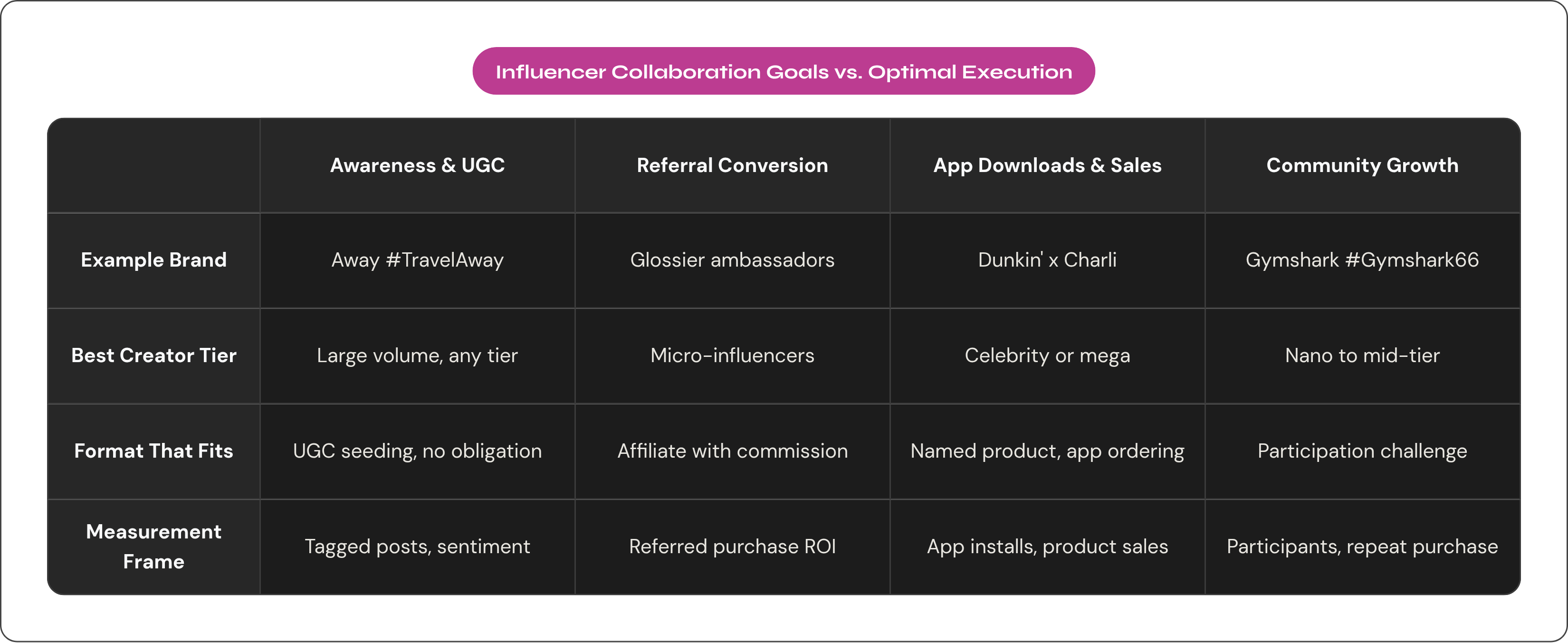
Naming the conversion goal before writing the brief is what makes every downstream decision, creator tier, format, platform, and measurement, coherent rather than guesswork. Not all conversion goals are purchase events; they include awareness reach, UGC volume, email capture, app downloads, and community growth. Conflating these produces unreadable results and wasted budget, because the format, tier, and platform combination that optimally drives app downloads is not the same combination that optimally drives earned UGC.
Dunkin' named its goal precisely. The Charli D'Amelio collaboration was designed to drive app downloads and product sales simultaneously. The named drink on the menu pushed users to the app to order it, creating a measurable funnel step. That specificity is what made the 57% increase in app downloads and 45% surge in cold brew sales legible as success. If the goal had been vague, those numbers would have been celebrated but not understood.
Away's early influencer campaign, involving roughly 1,000 creators, was oriented toward awareness and UGC generation, not direct conversion. The brand was pre-scale. Building ambient presence and a library of authentic travel content was the right goal for the moment. Measuring that campaign against cost-per-acquisition would have produced a misleading read. The goal matched the channel and the brand's developmental stage.
Glossier's data shows what happens when the goal is referral conversion and measurement is precise: micro-influencer ROI came in at a positive 36.71%, while macro-influencer ROI registered at negative 12.04%. A nearly 49-percentage-point spread that only becomes visible if you're measuring the right output against the right tier. Macro reach drove impressions; it didn't drive referred purchases. Micro fit did.
OUTFITTERY's collaboration managed through The Cirqle produced a 40% increase in online sales within three months and a 70% reduction in cost per acquisition. Those are performance metrics with real meaning, but they presuppose that conversion was the named goal from the start. You don't report a 70% reduction in CPA unless CPA was your measurement frame before the program launched.
Obvi's seeding model, no posting requirement, no guaranteed placements, had UGC volume and sentiment as its explicit goal. If the team had measured against cost-per-acquisition, the program would have looked like an unqualified failure. Goal definition changes what the numbers mean. It also changes what decisions you make in the middle of a program, when early data arrives and you need to know whether to adjust or stay the course.
The brief should specify: the conversion event, the measurement method, and the tier and format combination that can plausibly connect to that goal. In that order. Everything downstream of a vague brief is interpretation.
The patterns across these examples and where they break down
The consistent pattern is this: creator fit grounded in audience, values, or identity alignment; format matched to a named conversion goal; and program structure that extends the relationship past any single activation window. Every brand in these examples that scaled quickly demonstrates all three. Every instructive failure is missing at least one.
The brands that built fastest, Gymshark, Glossier, Revolve, did not start with macro-influencers. They started with authentic fit at small scale and built upward as brand identity solidified. That sequencing matters. Macro and celebrity tier becomes viable once you already have brand equity to amplify. Daniel Wellington's eventual partnerships with Hailey Bieber and Odell Beckham Jr. for its Link collection are not contradictions of this model; they are continuations of it. Celebrity amplifies what already exists. It does not construct what doesn't.
Audience fatigue is a real constraint. Sixty-five percent of consumers follow fewer fashion influencers than they did a few years ago, per Business of Fashion and McKinsey's 2025 data. Channel spend is growing; audience receptivity is not growing proportionally. The margin for undifferentiated content is shrinking. This is not a reason to abandon the channel. It is a reason to take creator fit and format precision more seriously, not less.
The survivorship bias in these case studies deserves explicit acknowledgment. Published examples are, by definition, the partnerships that worked. The creators who didn't convert, the campaigns that spent budget and produced no measurable result, the seeding programs where no one posted, those are absent from the record. The patterns identified here are real, but they are drawn from visible wins. That doesn't invalidate the framework; it means the framework is a starting condition, not a guarantee.
Forty-four percent of businesses now prefer working with nano-influencers, per Sixth City Marketing's 2025 data. The industry is consolidating toward the model that early D2C successes proved: fit over reach, smaller tiers, authentic alignment. That convergence is significant because it means the window for differentiation through that approach is narrowing. The replicable part was never the specific creator or platform anyway. It was the decision logic: name the conversion goal, select for fit, choose a format the creator can execute without visible strain, and build enough program structure that the relationship outlasts any single post.
That framework is still available. It just requires more discipline to execute as the channel matures.