Micro Influencer Marketing Strategy for Niche Brands
Nano and micro-influencers deliver higher engagement and authentic trust within niche communities.

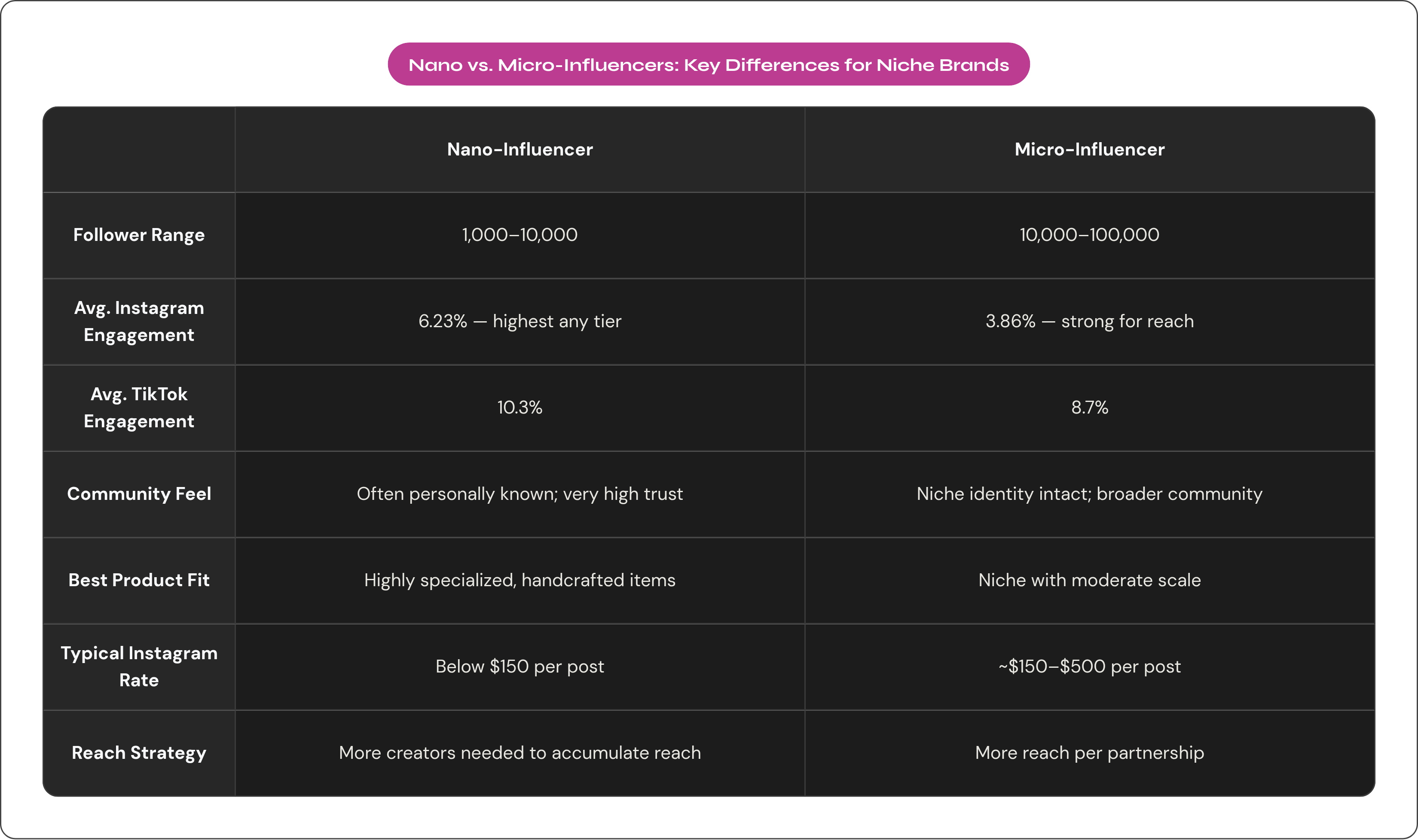
The industry groups creators into tiers, and those tiers aren't arbitrary. Nano-influencers hold between 1,000 and 10,000 followers; micro-influencers sit between 10,000 and 100,000. That gap sounds modest; the dynamics it produces are not.
Nano-influencers, in a lot of cases, actually know their followers. The community is small enough that dialogue is real, trust runs high, and a product recommendation reads less like sponsored content and more like a tip from someone who's been deep in the hobby for fifteen years. As of 2025, nano-influencers comprise 75.9% of Instagram's total influencer ecosystem, per the Influencer Marketing Hub Benchmark Report. For niche brands, that fragmentation isn't a problem to solve; it's a structural advantage hiding in plain sight.
Micro-influencers offer wider reach within a niche, with community relationships that still hold. The audience is larger, but the creator hasn't gone broad enough to dilute what they're actually about. A fly-fishing micro-influencer with 60,000 followers is still, fundamentally, a fly-fishing creator; that identity is the thing you're paying for.
Which tier you pursue should follow from what you actually need. If your product is highly specialized, handcrafted Dungeon Master kits or artisan fishing lures, a nano campaign delivers maximum trust signal inside a very tight community. If your niche has more scale, sustainable fashion or specialty pet food, micro-influencers give you meaningful reach without sacrificing relevance. A nano campaign requires more creators to accumulate reach; a micro campaign reaches more people per partnership. The budget math works differently for each, and neither is inherently superior.
One thing worth saying plainly: follower count is a weak proxy for niche fit on its own. A creator with 50,000 followers squarely inside your space is worth more than one with 90,000 in an adjacent category that doesn't quite map to your buyer. Proximity to a niche is not the same as being inside it — like standing outside a fishing shop and insisting you're an angler.
The Engagement Rate Case for Smaller Creators (and What the Numbers Actually Mean)
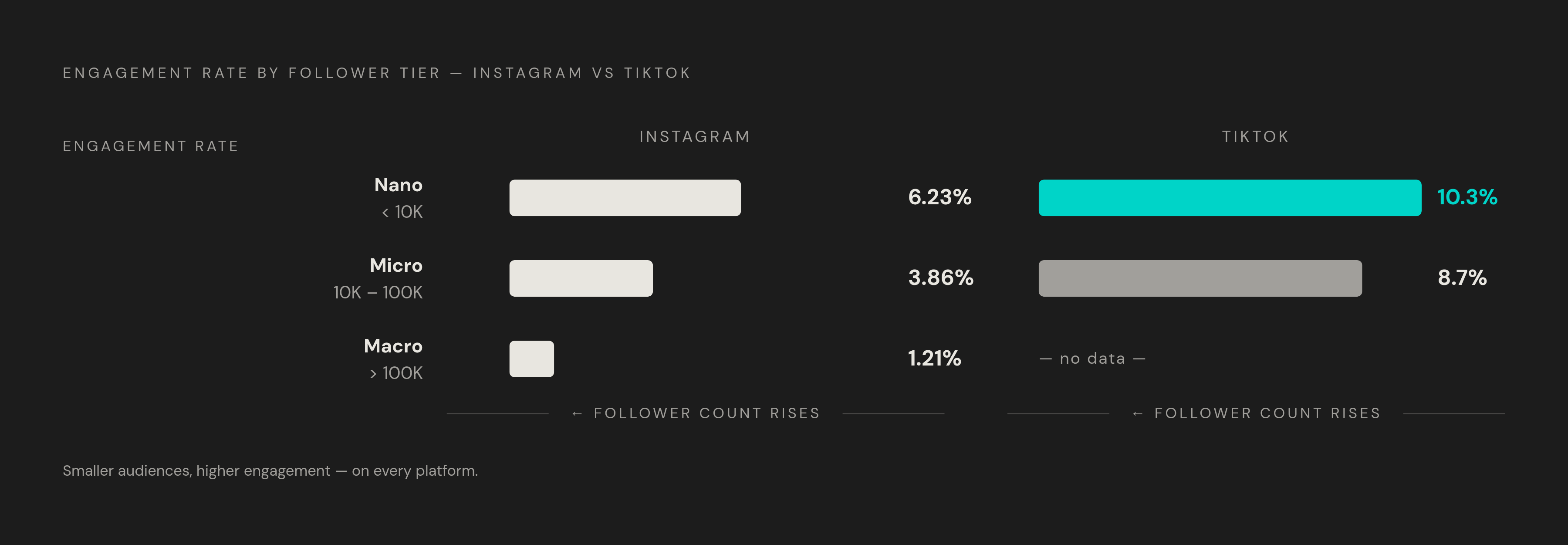
The data here is consistent, and it points in one direction. On Instagram, micro-influencers average 3.86% engagement versus 1.21% for macro-influencers; nano-influencers average 6.23%, the highest of any tier on the platform, according to Captiv8's 2024 Organic Benchmark Report. On TikTok, nano-influencers hit 10.3% and micro-influencers reach 8.7%, both far outpacing macro and mega tiers per HypeAuditor's State of Influencer Marketing 2025. The inverse relationship between follower count and engagement rate holds across platforms.
For niche brands, this matters beyond the headline figure. High engagement inside a specific community is a trust signal. A 6% engagement rate on a fishing tech account means the audience is actively watching, commenting, and asking questions about fishing gear; that is the conversion environment Deeper Sonars needs to be inside. A 1% engagement rate on a macro lifestyle account, even when that 1% represents large absolute numbers, reflects passive impressions from people with no particular interest in your product category. Those aren't buyers; they're background noise.
Engagement rate is necessary but not sufficient. Look at comment quality. Are followers asking where to buy? Sharing their own experiences with similar products? Tagging friends who'd actually care? Those behaviors signal a purchasing community. The engagement rate tells you whether people are paying attention; what's happening in the comment section tells you whether they'd ever open their wallets.
How to Find Creators Whose Audience Specificity Matches the Brand's Niche
The selection principle is simple, even if executing it takes patience: the creator's niche and the brand's niche should overlap almost completely, not tangentially. A cake-decorating creator for piping tips; a D&D influencer for a Dungeon Master kit. The product should fit naturally inside the creator's existing content world, without requiring them to reframe what they do to accommodate it. Think of it as a key and a lock — you're not looking for a key that's close; you're looking for the one that actually turns.
If you're working without agency infrastructure, the discovery process is replicable. Search hashtags and topic keywords on Instagram and TikTok, and look specifically for creators already talking about your product category without any brand relationship; that unprompted behavior is the strongest signal you can find. Then check your existing customers. Glossier built a significant portion of its creator network from buyers who were already fans. Deeper Sonars recruited more than 7,000 ambassadors across 30 countries with a team of five marketers by systematically identifying people who already cared. Survey your buyers, check your tagged posts, read your reviews; your best creators are probably already in your customer base.
Community platforms are chronically underused for this. Reddit, Discord, and niche Facebook Groups contain trusted voices who haven't been tapped by brands. These communities have implicit hierarchies (people whose recommendations others wait for before making a decision); those are the people worth finding, and most brands never look there.
Creator marketplaces like AspireIQ, Grin, and Modash allow filtering by category, follower count, engagement rate, and audience demographics, which makes initial qualification faster. No tool replaces actually reading a creator's content and comments, though; the tool gets you to a shortlist. What you do next is judgment.
Look for content consistency inside the niche, not occasional forays into it. Look for creators who respond to comments, because that back-and-forth is a reliable marker of real community. Watch for engagement inflation: sudden follower spikes, generic comments, follower-to-engagement ratios that don't hold up under basic scrutiny. Creators who post across wildly different categories are a flag, because that breadth usually signals an audience assembled by algorithm, not by shared interest.
What to Look for in a Creator's Audience, Not Just the Creator Themselves
The creator is the channel; the audience is the target. Both need separate evaluation. Most brands stop at the creator, which is why so many niche campaigns underperform on the back end even when the creator seemed like a great fit on paper.
Start with the baseline: age, gender, geographic distribution. Does this map to your actual buyer profile? If your product ships only within the United States and 40% of a creator's audience is international, that's a structural mismatch regardless of how well their content aligns with your category. This is an embarrassingly easy thing to check and an embarrassingly common thing to miss.
Audience interest overlap is more revealing than demographics alone. Many creator analytics tools surface what else a given audience follows. A fishing tech brand wants an audience that also follows outdoor gear brands, tackle retailers, and conservation organizations (not a general sports audience with fishing as a minor subcategory); that granularity separates a genuinely niche audience from one that merely resembles it on the surface.
Check follower authenticity. A meaningful percentage of inactive accounts or bots doesn't just inflate engagement metrics; it means the community isn't real, and community is the asset you're paying to access.
Niche audiences are more attuned to inauthenticity than most brand marketers appreciate. They know their creators' voices well. When a creator suddenly features a product that doesn't belong in their world, that community notices immediately, and the trust that made the partnership worth pursuing evaporates before you can measure it. A second chance at that rarely comes.
The practical step is this: before you agree to anything, request an audience insights screenshot or media kit. Reputable micro-influencers can provide Instagram Insights or TikTok Analytics data; if they can't or won't, that tells you what you need to know.
Setting Campaign Goals That Are Specific Enough to Guide Both the Brief and the Measurement
Brand awareness is the most commonly cited goal for influencer collaborations, and it's also the goal that produces the most vague campaigns. For niche brands, awareness without a defined target community is not a goal. The relevant measure isn't awareness in the aggregate; it's awareness within the right community, among people who are plausible buyers.
Niche brands typically need to choose between three goal types, or at minimum explicitly prioritize among them. Community awareness is about getting the brand known and trusted inside a specific niche audience; it's measured by reach within the target segment and share of voice in niche conversations. Conversion is trackable via affiliate links, discount codes, or UTM parameters at the creator level, and the data is clean enough to evaluate individual partnerships. Content creation is a third goal that doesn't get enough credit; repurposing influencer-generated content for paid advertising grew 80% year-over-year according to Statusphere's analysis of more than 34,000 creator posts in 2025, and niche brands with limited production budgets should take that seriously.
Goals determine deliverables. An awareness goal points toward Reels or TikToks with high share potential. A conversion goal requires posts with clear calls to action, discount codes, or affiliate links. A content collection goal requires a brief that specifies usable formats: aspect ratio, with or without voiceover, whether the creator's face needs to appear.
Brands that combine affiliate strategies with influencer partnerships consistently see higher affiliate-based sales than brands using affiliates alone. For niche brands, this dynamic is particularly pronounced because the community is often already pre-sold on the product category and needs only a trusted introduction to the specific brand.
One campaign can serve multiple goals, but you need to rank them; a brief that treats awareness, conversion, and content collection as equally weighted will pull the creator in three directions and serve none of them.
Writing a Creator Brief That Gives Direction Without Killing the Authenticity That Makes Micro-Influencer Content Work
The core tension in briefing is genuine: niche audiences trust their creators precisely because the content feels unscripted. Over-briefing produces content the audience can identify as paid within seconds; once that happens, the trust that made the partnership valuable is gone, and you've essentially bought a very expensive display ad with worse targeting.
A good micro-influencer brief for a niche brand contains a small number of things. First, the one thing: the single message or feeling the content should leave the audience with. Not three messages; one. Second, required mentions: specific product features or claims that must appear, often for legal or compliance reasons. Third, what not to say: competitor references to avoid, off-brand framings, claims the brand can't support. Fourth, format and platform specifications, including length. Statusphere's analysis of more than 2,000 creator videos found optimal performance in short-form content under 30 seconds on TikTok and Reels; the brief should specify this as the default, rather than leave format open-ended. Fifth, FTC-compliant disclosure requirements, which are non-negotiable. Sixth, tone guidance that references the creator's own established voice, not the brand's marketing language.
What your brief should not contain: a script, a mandated list of adjectives, required camera angles, or anything else that removes the creator's natural voice from the content. The creative latitude is the mechanism through which the content earns trust; constrain it, and you've paid for something that performs worse than a basic display ad.
Platform context also shapes what authenticity looks like in practice: TikTok content needs to feel native and spontaneous; Instagram Reels tolerate slightly more polish; YouTube integrations carry the weight of longer product explanations without losing the audience. A brief that doesn't account for these differences hasn't been thought through.
Choosing the Right Platform for the Niche, Not Just the Platform With the Biggest Numbers
Instagram is where the majority of influencer campaigns run. That's a market average across industries and brand types, and market averages are not always useful guides for your brand; the right platform is where your specific audience is most active and most engaged, which is frequently not Instagram.
TikTok's average engagement rate in the U.S. market runs dramatically higher than Instagram's. That advantage is real, but it only matters if your target audience is there in meaningful numbers. If your niche is home improvement buyers over 45, TikTok's engagement numbers won't help you; if your niche is Gen Z skincare, they are the most important numbers you have. Roughly 60 to 70 percent of Gen Z report discovering new brands on TikTok, and a substantial majority indicate a genuine propensity to purchase there.
Instagram remains strongest for visually driven niches: beauty, fashion, food, home decor. Static feed posts have declined sharply in brand use; Reels now dominate. YouTube is the right environment for niches where demonstration matters (fishing gear, cooking equipment, tech products), because micro-influencers there achieve meaningfully higher engagement than their macro counterparts while retaining the depth to actually explain a product. Facebook and Pinterest are underestimated for older demographics and specific hobby niches including home improvement, crafting, and gardening.
Cost per engagement also varies dramatically by platform. Aspire's 2024 report shows TikTok's cost per engagement running around $0.27 versus roughly $15.30 on Facebook in certain influencer campaign analyses; for niche brands with constrained budgets, that efficiency gap is a real constraint on platform choice, not a footnote.
Go where your niche's organic conversations already happen. Find the platform where community members tag each other unprompted, share product finds, and argue about gear specifications at 11pm; that is the right platform, regardless of where the aggregate numbers are largest.
Compensation Structures That Work When Budgets Are Modest and Creator Relationships Matter
You can often work with 10 to 15 micro-influencers for the cost of a single macro-influencer partnership; that volume advantage is real, and it can compound over time as those creator relationships develop.
Current rate benchmarks for micro-influencers, per the Influencer Marketing Hub Benchmark Report 2025: Instagram posts in the 10,000 to 100,000 follower tier run roughly $150 to $500 per post for standard feed content; TikTok videos in the same follower range run around $200 to $800. YouTube rates vary significantly by niche due to higher production requirements.
A flat fee per deliverable is the most common structure, and it offers predictability for both you and the creator. Product gifting works in specific contexts: when the product has genuine perceived value to the creator, and when the creator already has an organic interest in the category. Gifting a $15 product to a creator with 30,000 followers and asking for a video in return is not a compensation strategy; gifting a $200 specialty item to someone who already talks about that product category is a legitimate opening to a real relationship. The distinction matters more than brands want to admit.
Affiliate structures, where the creator earns a commission on tracked sales, align incentives well for niche brands, especially when the community is already primed to buy. Paired with a flat fee, affiliate arrangements reward performance without asking the creator to work entirely on speculation.
Long-term ambassador relationships are where the real value accumulates. A creator who features your brand repeatedly over months builds associative trust in a way that a single post cannot — like a friend who keeps recommending the same restaurant until you finally go, and it's exactly as good as they said. For niche brands where community credibility is the primary asset, repeated authentic exposure from a trusted voice compounds in a way that's genuinely difficult to price and even harder to replicate through any other channel. Budget for ongoing relationships, not just single activations. If you treat creator partnerships as a roster rather than a transaction, you're more likely to end up with something durable.