Influencer Campaign Brief Writing Best Practices
Clear direction combined with creative freedom produces higher engagement than over-scripted briefs.

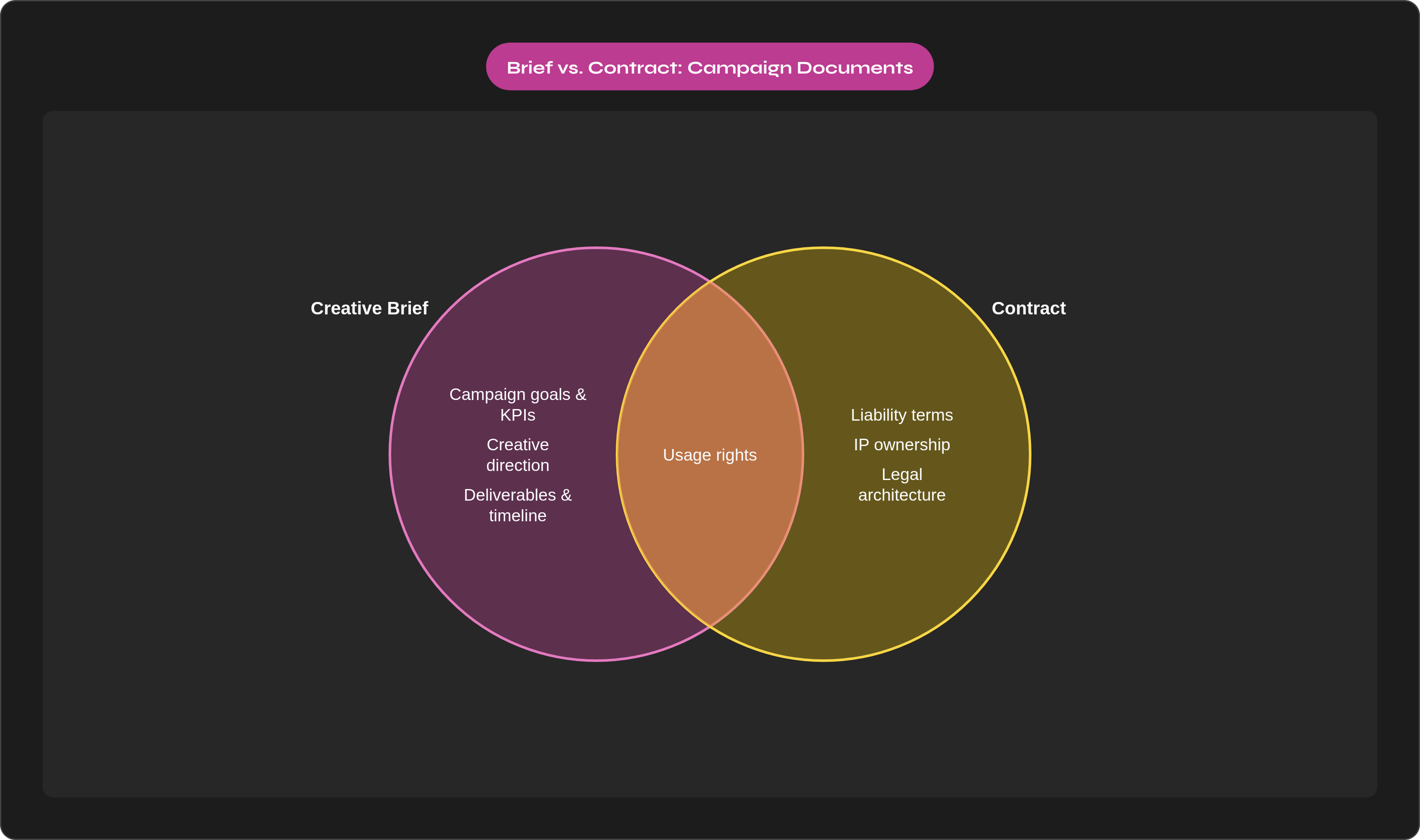
A brief is a campaign document. It carries goals, deliverables, creative direction, and expectations. A contract handles the legal and financial architecture: compensation, liability, IP ownership. These are separate documents, and conflating them creates problems in both directions, usually simultaneously.
The brief serves two purposes at once. It gives the creator everything they need to make good work without guessing. It gives the brand confidence that the creative is aligned before anyone starts filming. Both outcomes depend on the brief being genuinely self-contained, not a summary of a conversation you had over email three weeks ago.
The most useful analogy I've found is a creative brief from an agency to a film director: direction plus latitude, not a storyboard. The brief communicates intent. It tells the creator what the brand needs to accomplish and who the audience is. It does not tell the creator how to open the video, which personal story to tell, or what music to use under the b-roll. Those decisions are precisely where the creator's value lives, and a brief that colonizes that territory is a brief that undermines its own purpose.
When to Send the Brief and What Version to Send at Each Stage
When you send the brief matters as much as what's in it. Experienced brands and agencies work in two stages, and the sequencing matters more than most people realize.
The first is initial outreach: a brief overview, enough to signal campaign fit and attract the right creators, sent before full requirements are shared. The second stage delivers the complete brief after a creator has confirmed interest, and critically, before any agreement is finalized.
Sending the full brief too early, in cold outreach, can read as a demand list and reduce response rates. Sending it too late, after a contract is already signed, creates friction when creator expectations diverge from what the brand actually needs. Neither outcome is recoverable without real cost, usually time, money, or both.
The governing principle is simple: the full brief must be in hand before any agreement is signed. Revisions to scope after signing create legal and relational friction, and they signal to the creator that the brand didn't know what it wanted going in. Creators talk. That reputation follows you into the next campaign.
The Eight Elements Every Brief Needs to Include
These eight elements appear consistently across campaigns that work. The absence of any one of them tends to generate exactly the category of problem it was designed to prevent.
Brand overview. Who the brand is, who it sells to, and its tone of voice. Include three to five personality words the brand claims, and three to five words the brand would never use. That contrast does more practical work than a full brand bible, because it gives the creator both a positive and a negative space to navigate.
Campaign goal and KPIs. Measurable, specific objectives. Also clarify campaign type: a content campaign and a reach campaign require different creator selection criteria and different deliverable formats. If this isn't specified, the creator optimizes for the wrong thing, and then you're both frustrated.
Target audience. Who the creator should be speaking to, framed around pain points rather than demographic tables. "Women 25 to 34" tells a creator almost nothing. "People who've tried every productivity system and still feel behind" gives them something to actually write to.
Key messages. Three is the cap. Beyond three, the post starts to sound like a sponsored read, and audiences feel the strain before they can articulate why. Give the creator the claims they must land, not the script for landing them.
Deliverables and timeline. Exact format, platform, length, posting window, and minimum post duration. "One Instagram Reel, vertical, 30 to 45 seconds, posted October 14 between 7 p.m. and 9 p.m. CET, live for a minimum of 90 days" is a deliverable. "Some Instagram content this month" is a wish.
Compensation. Payment form, amount, timing, and any affiliate links or discount codes. If a separate contract covers compensation, say so explicitly in the brief. Ambiguity here stalls agreements and erodes trust before a single frame is shot.
Disclosure requirements. Exact language, placement instructions, and platform-specific notes. Instagram caption placement differs from a TikTok overlay, and those differences matter for compliance. FTC disclosure is not optional; the brief is where it gets documented, because verbal confirmation leaves no record that holds up.
Content usage rights. Where the brand can repurpose the content and for how long. The industry standard is six to twelve months, after which additional licensing fees apply. In 2025, also clarify whether the content can be used in shoppable video or platform commerce placements, because these generate direct revenue and warrant separate negotiation. A creator who discovers their content is driving sales they weren't compensated for is a creator who won't work with you again, and who will tell others why.
How to Handle Visual and Creative Direction Without Over-Specifying
Creative direction should give creators enough context to work confidently without dictating choices that belong to them. A mood board is more efficient than written style descriptions. Three example creatives give a creator a feel for tone, resolution, and composition in seconds. Trying to describe those same qualities in prose takes a paragraph and still lands less precisely.
Do's and don'ts belong in the brief, but only the ones that genuinely matter. Brand language specifics, like "use 'global,' never 'international,'" protect consistency at scale without constraining creative. Topics the brand has a position on and doesn't want wandered into belong here. Visual dealbreakers, such as competitor products visible in the shot or certain color associations, belong here.
What does not belong: hook phrasing, story structure, personal anecdote direction, music choice. These are where creator voice lives. Specifying them doesn't make the content more on-brand; it makes the content less effective, and usually in ways that don't surface until the analytics do.
The test for any do or don't is this: if breaking it would genuinely harm the brand's legal standing, compliance posture, or core identity, it belongs in the brief. If it's a stylistic preference, it doesn't. Applying that test honestly is harder than it sounds, because most brand stakeholders have opinions about style. Strong opinions, often. The brief is not the place for those opinions, and you'll need to say that out loud in some rooms.
Why Over-Controlling the Brief Destroys the Thing That Makes Influencer Content Work
Over-controlling a brief actively degrades the content quality it was meant to protect. The instinct to over-script is understandable. Brands want message consistency and legal safety, and a script feels like it guarantees both. What it actually produces is content that looks and sounds like an ad, which both algorithms and audiences penalize, usually at the same time.
TikTok for Business data shows that creator-led ads with native storytelling formats outperform brand-produced creative by 83% on completion rates. That gap doesn't shrink when brands write tighter scripts. It widens, because the content loses the structural cues that signal authenticity to a platform-native audience. You cannot script your way to that signal.
A 2025 study published in the Journal of Marketing identified authenticity not as a vibe but as a measurable result of an evolving relationship between creators, brands, and consumers, built on five properties: expertise, connectedness, originality, transparency, and integrity. Briefs that script the content suppress at least three of those five properties. Originality disappears when the hook is pre-written. Connectedness disappears when the creator is performing a brand voice rather than their own. Integrity disappears when the audience senses the performance, and they do sense it, faster than any focus group will tell you.
The 2025 Sprout Social Influencer Marketing Report found that 65% of influencers prefer joining strategy conversations early rather than following a rigid brief. That preference isn't for less direction; it's for co-ownership of the strategy. The brands that understand this distinction get better content and more committed creators. The ones that don't spend their budgets on polished underperformance, and usually blame the channel when it doesn't convert.
The "Musts and Maybes" Framework for Calibrating What to Control and What to Release
Divide every brief element into two columns.
Musts are non-negotiables that protect legal, performance, and brand identity stakes: one approved claim, not a list; one clear CTA; core brand visuals like logo usage and product presence; exact disclosure language and placement; delivery deadlines and minimum post duration. That's it. The list is short because it should be.
Maybes are everything the creator should own: hook phrasing and opening structure, story angle and personal anecdote, filming style and setting, music choice, caption tone and length. These aren't suggestions; they're deliberate delegations. The brand defines the truth and the constraints. The creator authors the expression. That division respects both parties' expertise and produces better content than either could generate alone.
When you're unsure which column something belongs in, apply one question: would getting it wrong create a legal, compliance, or fundamental brand-identity problem? If yes, it's a Must. If it's a preference, it's a Maybe. Honest application of that question will move most items out of the Musts column, which is exactly where they should end up.
A practical secondary benefit: a brief organized this way is shorter and faster to read, which increases the probability that creators actually engage with it before they start filming. That alone is worth the reorganization.
How to Adjust Brief Structure and Control Level by Creator Tier
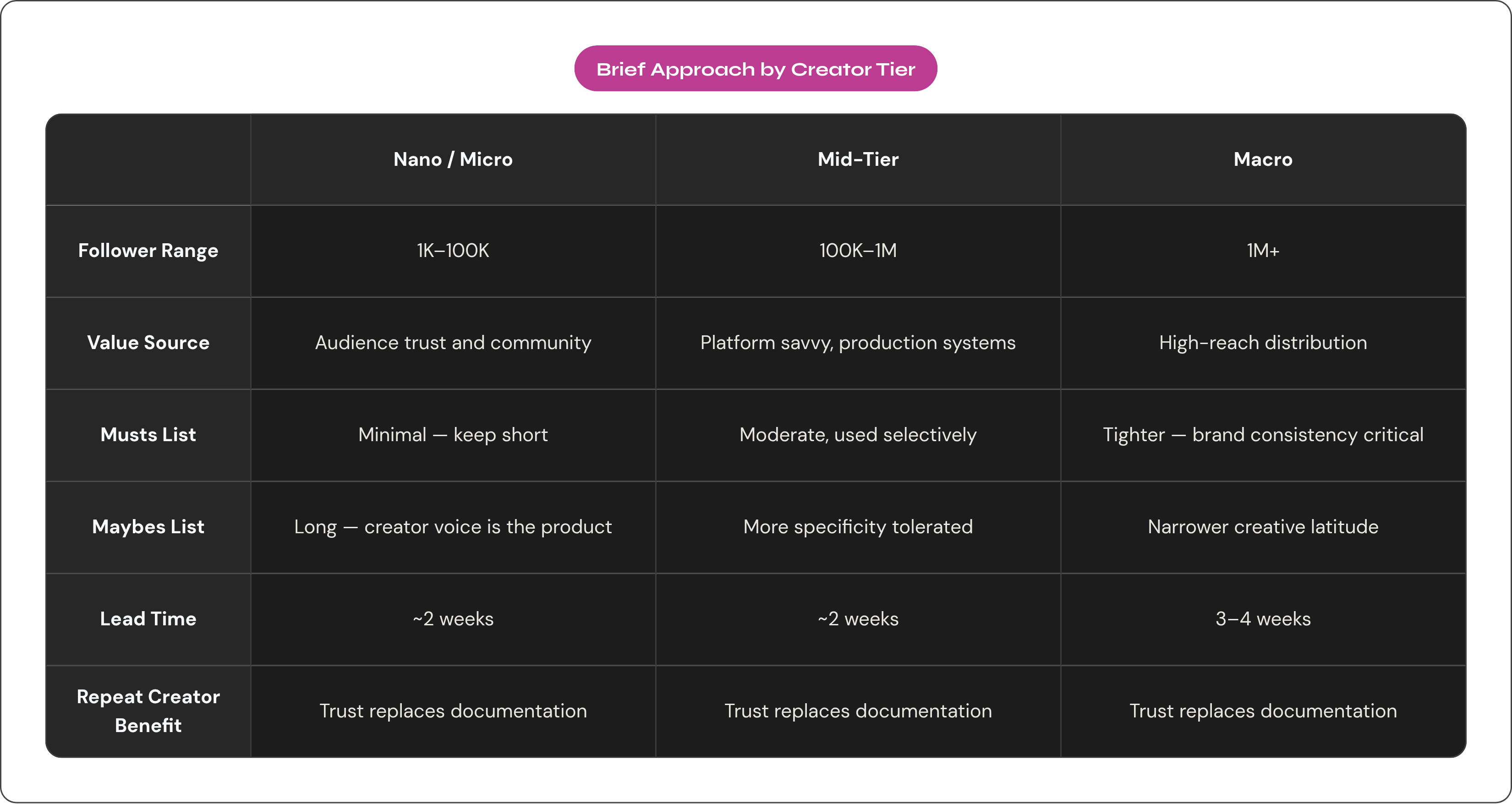
The tiers behave differently, and the brief should reflect that honestly.
Nano creators (1,000 to 10,000 followers) and micro creators (10,000 to 100,000) derive their value from audience trust. Engagement rates in these tiers sit between roughly 6% and 7%, driven by tight community relationships. A micro-creator's audience follows them specifically because of how they communicate, and that communication style is not transferable to a brand script. Briefs for these tiers should carry a long Maybes list and a minimal Musts list. The more you constrain a micro-creator, the less you get what you paid for.
Mid-tier creators (100,000 to 1,000,000) are often more platform-savvy and have developed real content production systems. They can handle more detailed briefs without losing authenticity, and they're frequently better at translating brand direction into native-feeling content. More room for specificity here, used selectively.
Macro creators (1,000,000 and above) are typically managing teams. They need tighter creative and legal parameters to maintain brand consistency across high-reach distribution. They also have longer production lead times: allow three to four weeks rather than the two weeks that works for micro-influencers.
One more thing worth knowing. Half of influencers charge $250 to $1,000 per post, but 71% offer discounts for longer-term partnerships, per the 2025 Sprout Social Influencer Marketing Report. A brief for a repeat creator can reasonably carry fewer instructions, because the relationship history replaces documentation. Trust, accumulated over multiple campaigns, becomes its own form of alignment. Repeat creators earn a shorter Musts list over time. That's not looseness; that's efficiency.
How to Write the Approval Process Section So It Protects Quality Without Creating Friction
A clearly documented approval process prevents the most common source of late-campaign friction: misaligned expectations about revisions and sign-off. The approval process must appear in the brief itself, not communicated verbally after a creator submits their first draft. Verbal agreements about revision rounds don't hold when timelines compress and stakeholders change, and both of those things happen on every campaign eventually.
Specify four things: the review timeline in business days, the number of revision rounds included, who at the brand gives final sign-off, and how feedback gets delivered. A shared document, a specific platform, or email are all viable. Ambiguity about the delivery mechanism wastes time at exactly the moment timelines are tightest.
Brands average two to three approval rounds before final acceptance, per 2025 influencer marketing data. Fast-track processes, typically used for trusted creators with straightforward content, can reduce this to 24 hours. The brief should state which process applies, so neither party is surprised mid-campaign.
Effective feedback is specific and anchored to Musts. "Please add the disclosure hashtag in the first three lines of the caption" is actionable and bounded. "Can you make this feel more energetic?" is a request for a Maybe the creator should have owned from the start. If revision requests consistently land in the Maybes column, the brief failed to communicate what it actually cared about. The fix belongs in the next brief, not the current revision thread.
Format and Length Decisions That Affect Whether Creators Actually Read the Brief
Brief length and format directly affect whether creators actually read and absorb the document before they start work. One page for most campaigns. Two pages maximum for complex multi-influencer launches. Beyond that, information overload defeats the purpose. A brief that requires real effort to parse signals to the creator that the brand hasn't done the work of knowing what it actually needs, which is not a confidence-inspiring start to a creative relationship.
A reusable template saves time and enforces consistency. Lock in the permanent elements: brand overview, contact details, disclosure language, core brand values. Edit only the campaign-specific sections each time. This also reduces the probability of omitting one of the eight required elements under deadline pressure, which is when omissions happen most.
Several format choices reliably improve readability. Separate Musts visually from Maybes: a two-column layout or clearly labeled sections both work. Embed the mood board rather than describing it in prose. Present deliverables in a single table with columns for format, platform, length, posting date, and minimum live duration. Present the approval timeline as a numbered sequence, not a paragraph.
The brief's readability is itself a signal. A clear, concise brief communicates that the brand is organized and knows what it wants. That impression increases creator confidence, reduces the interpretive guesswork that generates avoidable revisions, and establishes the collaborative tone that produces the content the brief was designed to make possible in the first place.