Why Influencer Marketing Outperforms Traditional Digital Ads
Influencers build trust through relationships; traditional ads interrupt with messaging.

Reach was always a proxy. The actual goal was influence: changing what someone thought, felt, or did. When reach degrades, the proxy collapses, and you're left staring at the thing that actually moves people.
That thing is trust. Not a fuzzy, brand-sentiment version of it. The specific, relational kind that makes someone act on a recommendation rather than scroll past it. HubSpot's 2024 State of Marketing report found that 71% of consumers say they're more likely to trust a recommendation from a social media personality than a traditional advertisement, and 69% say they trust recommendations from friends, family, or influencers more than information coming directly from a brand. That's not a marginal channel preference. That's a structural shift in who people take seriously.
Here's the part that gets lost: influencer content doesn't arrive as an interruption. It lands inside a relationship the creator already built, over months or years of consistent content, demonstrated expertise, and some degree of visible value alignment between what they say and how they live. That context cannot be purchased. The trust is already there before the brand enters the frame. You're borrowing it, and the terms are set entirely by how well the brand fits the creator's established identity.
Peer-reviewed research published in 2025 in the Academy of Marketing Studies Journal, drawing on 500 respondents, found that influencer credibility and authenticity are the primary drivers of consumer purchase intention. A separate 2025 study in the Journal of Interactive Marketing gets more specific about the mechanics: trust is built through perceived expertise, consistency, and ethical transparency; authenticity emerges through personal storytelling, selective brand endorsement, and coherent value alignment between creator and product.
What I'd add from watching campaigns work and fail: authenticity is not a feeling or an aesthetic. It is a set of observable creator behaviors that audiences, especially younger ones, have grown extremely sophisticated at reading. Statista's 2024 data shows 60% of Gen Z users follow at least one influencer. This is also the most skeptical cohort of overt marketing that has ever existed, and yet they remain genuinely responsive to peer-adjacent recommendations that feel native to the platform. The distinction they're drawing is between earned credibility and manufactured messaging, and they are, frankly, better at detecting the difference than most brand managers are at hiding it.
How the trust gap shows up in engagement and ROI numbers
The trust differential is not abstract. It shows up consistently enough in the numbers that attributing the pattern to category effects or timing becomes increasingly implausible.
Influencer content generates 8.8 times more engagement than branded content across social media, per a 2024 Statista report. Influencer campaigns achieve an average engagement rate of 4.2%, compared to display ad click-through rates measured in fractions of a percent, per the 2024 Influencer Marketing Benchmark Report from Influencer Marketing Hub. These are not close comparisons, and they hold up across categories that have nothing obvious in common.
ROI follows the same direction. Brands see an average return of $5.78 for every dollar spent on influencer campaigns, up from $4.87 two years prior, per the same 2024 Benchmark Report. PPC returns roughly $2 per dollar spent, per WordStream's 2024 benchmarks. Influencer Marketing Hub has reported that influencer marketing delivers eleven times the ROI of other forms of digital media, though that figure comes from self-reported brand surveys rather than controlled studies, so it should inform intuition more than it should anchor a budget justification.
One figure from Meta's 2024 Q1 Advertising Report deserves more attention than it typically gets: influencer content used inside paid ads produced 28% lower cost-per-click than traditional creative. Even in a purely paid media context, with algorithmic delivery, the trust signal embedded in creator-originated content outperforms brand-originated content. The advantage travels across channels. It is not a property of any particular platform. It is a property of the relationship itself, and that distinction matters enormously for how campaigns should be structured.
Why smaller audiences often produce stronger results than larger ones
Most brand marketers still resist this, because it cuts against the reach intuition that has dominated media planning for a long time. But the evidence here is consistent: smaller audiences frequently outperform larger ones.
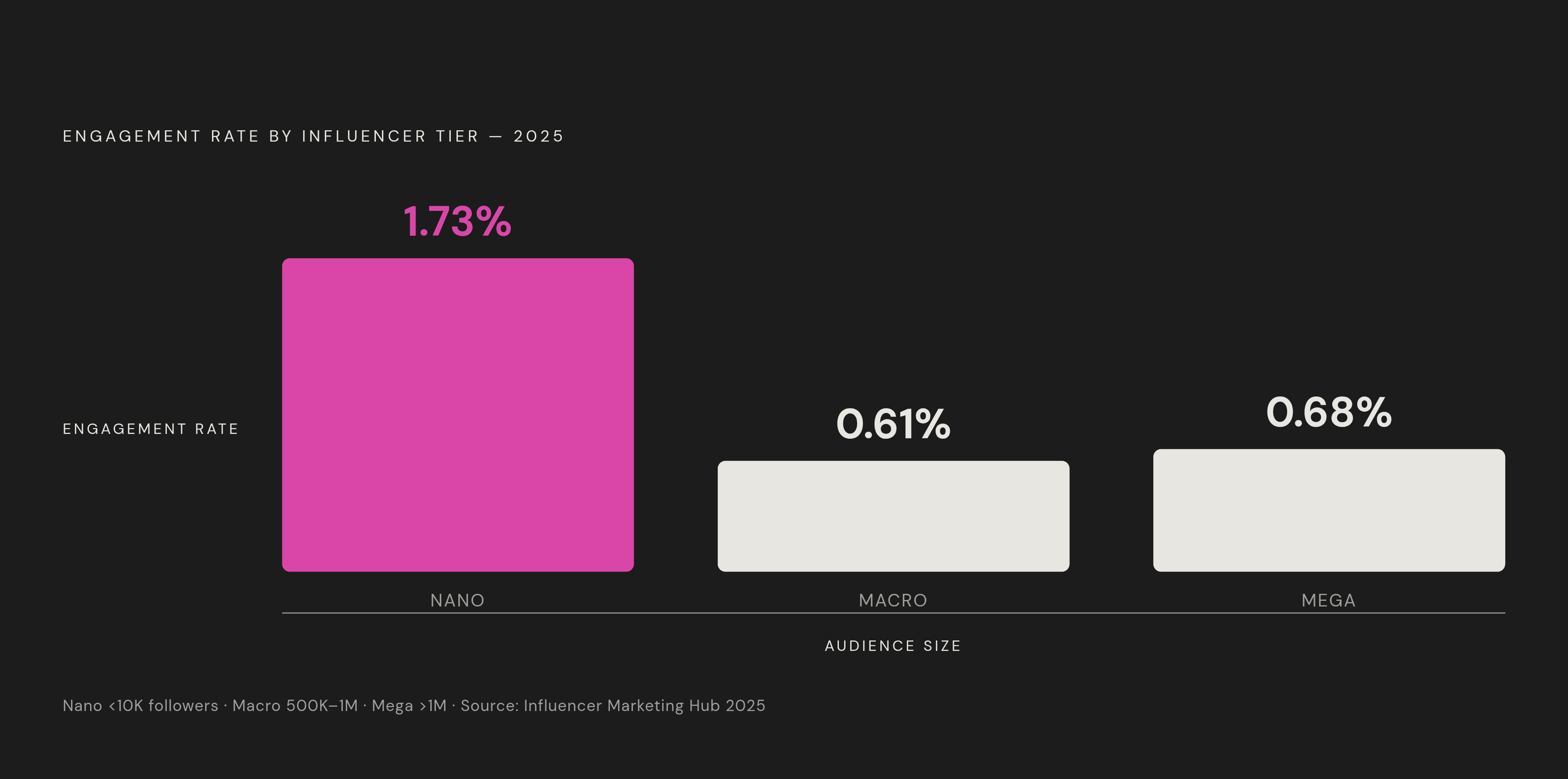
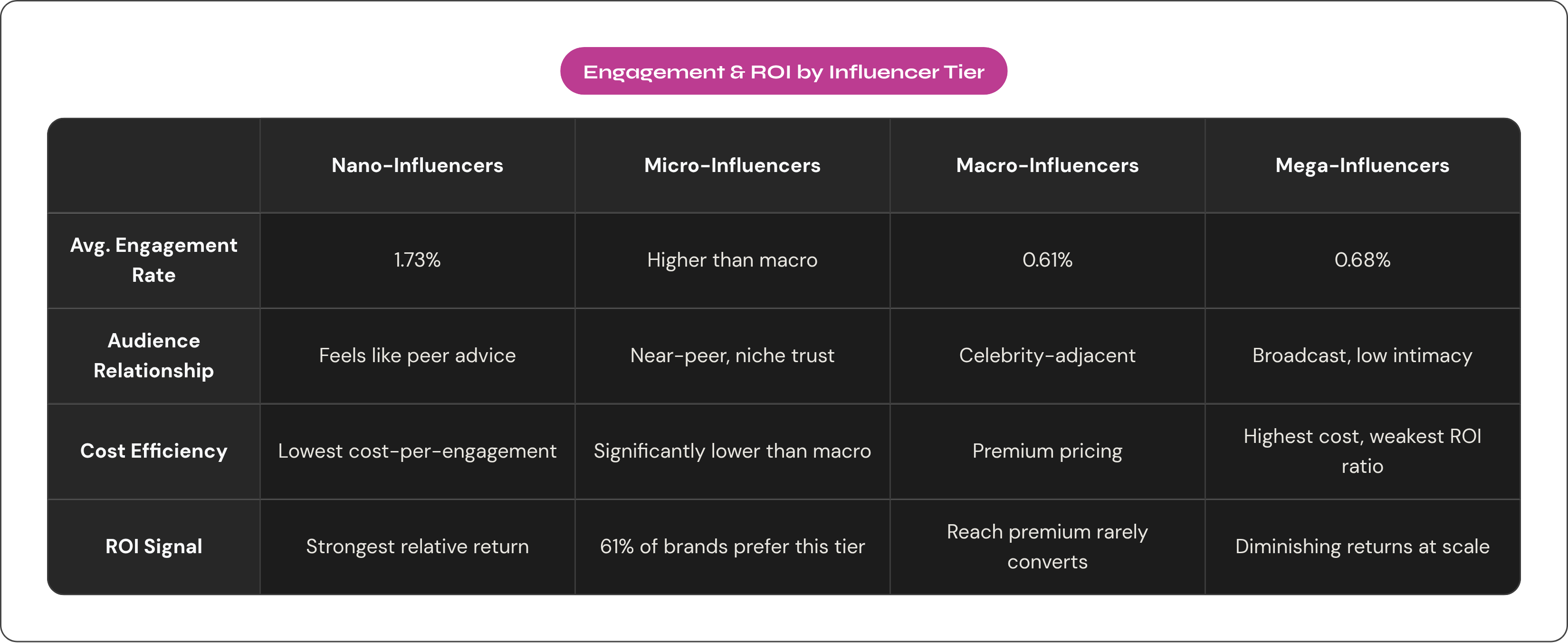
Nano-influencers achieved an average engagement rate of 1.73% in 2024, per Influencer Marketing Hub's 2025 Benchmark Report. Macro-influencers came in at 0.61%. Mega-influencers came in at 0.68%. The relationship between audience size and engagement is inverse, not proportional, and it has been replicated across enough datasets that it should no longer register as surprising.
The explanation is relational, not algorithmic. Smaller creators maintain tighter parasocial bonds with their audiences. At the nano and micro tier, followers are more likely to experience a recommendation as peer advice than as celebrity endorsement. There's a real phenomenological difference between following someone because everyone follows them and following someone because their content consistently feels like it was made for a specific kind of person who happens to be you. The latter produces an audience that is genuinely attentive.
Cost efficiency compounds the advantage further. Micro-influencer sponsored posts cost a fraction of macro-influencer placements, and cost-per-engagement at the micro tier is significantly lower, per the same 2025 Benchmark Report. Sixty-one percent of brands report higher ROI from micro-influencers than from macro-influencers. The premium brands pay for reach at the macro level does not translate into proportionally more action. It rarely does.
The SKIMS menswear launch in 2025 illustrates this in concrete terms. According to reporting by Marketing Brew, micro-influencer whitelisted ads achieved substantially lower customer acquisition cost compared to brand-owned creative. Branded search volume for "SKIMS men" increased 3.4 times. Site sessions spiked sharply at launch and remained meaningfully above baseline four weeks later. What's notable there isn't just the acquisition efficiency; it's the durable search behavior, which signals that trust converted into ongoing purchase intent rather than a single-session spike.
The variable most brands are still optimizing is audience size. What actually predicts performance is audience relationship quality, and that quality is consistently densest at smaller scale.
Social commerce turns creator trust into a closed purchase loop
Social commerce is collapsing the distance between creator trust and the moment of purchase, turning influencer content into a closed loop from discovery to transaction. For most of influencer marketing's history, the channel operated primarily at the top of the funnel. A creator built awareness and preference, then handed the audience off to a brand site or retail environment to complete the transaction. That handoff created friction and attribution loss. The trust was earned in one context; the purchase happened somewhere disconnected from it.
That architecture is changing. Influencer content and commerce infrastructure are converging into a single session, where a viewer can discover a product, hear a trusted creator endorse it, and complete the purchase without ever leaving the platform.
US social commerce sales will reach $87.02 billion in 2025, up 21.5% year over year, per EMARKETER. TikTok Shop illustrates the velocity more vividly: US monthly gross merchandise value grew from $15.1 million in July 2023 to $1.1 billion by July 2025, per Bloomberg Second Measure data. Tarte Cosmetics generated over $40 million in TikTok Shop revenue, with 88% coming from affiliate creators rather than brand ads or the brand's own account, per TikTok's 2024 Creator Commerce report.
Approximately 60% of TikTok users say they're more likely to trust a brand they learn about through an influencer than from an in-feed advertisement, per Capital One Shopping research. That trust differential, which was already producing engagement and ROI advantages at the awareness layer, now operates all the way through to the moment of transaction. Live shopping events, where a creator hosts real-time product demonstrations and purchases can be completed immediately, convert at rates that substantially exceed traditional ecommerce averages, per Coresight Research's 2024 Live Commerce report. The synchronous format activates urgency and trust in combination, and that combination is difficult to replicate with a static ad unit.
Creator-driven commerce is no longer a top-of-funnel awareness play with a separate conversion mechanism bolted on. It is a complete loop, from discovery through purchase, inside a single trusted relationship.
What the performance gap means for how marketers should allocate attention
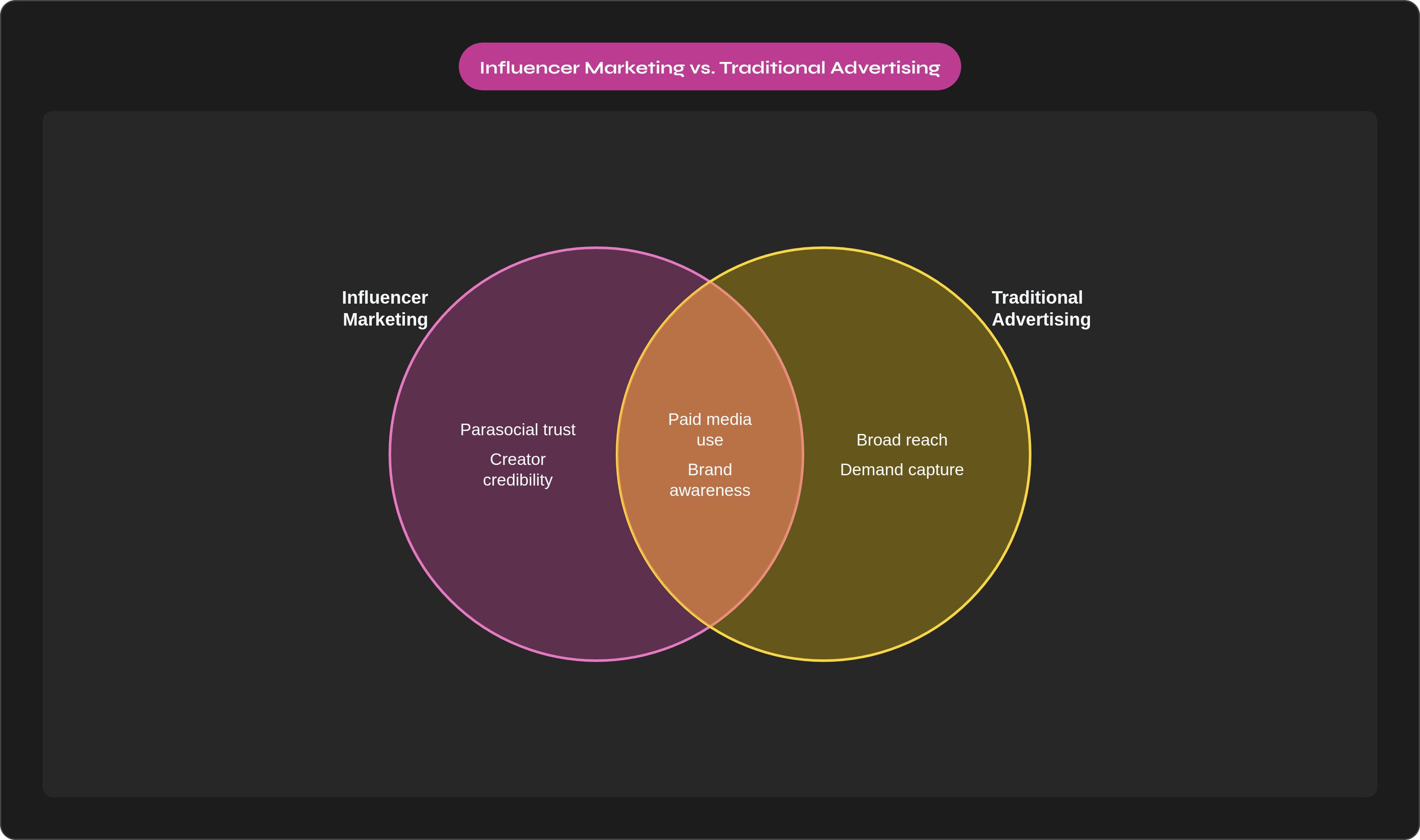
Influencer marketing outperforms because it is built on a relational foundation that traditional advertising cannot replicate. It delivers trust rather than reach, and trust is the actual variable that moves purchase behavior.
Budget allocation is already shifting to reflect this. Eighty-six percent of marketers used influencer marketing in 2025, up from 83% in 2024, per Influencer Marketing Hub's 2025 Benchmark Report. Average annual influencer marketing budgets increased 171% year-over-year between 2024 and 2025, per CreatorIQ's 2025 Creator Marketing Report. This is mainstream reallocation, not early-adopter positioning, and it is accelerating.
The practical implication is not to abandon paid media entirely. Paid search and display serve a legitimate function: capturing demand that already exists. Influencer marketing serves a different function, creating demand by embedding a product recommendation inside a trusted relationship. These are genuinely different jobs, and conflating them produces poor strategic decisions in both directions. The more salient point is that creator-driven demand generation is considerably harder for competitors to replicate quickly, because the relationships that make it work are built over time and cannot be purchased overnight regardless of budget.
The single most consequential error in influencer strategy remains optimizing for reach. Campaigns built around follower counts will consistently underperform campaigns built around audience relationship quality. Creator selection, fit, and the coherence between a creator's established identity and the brand being promoted matter more than any reach metric on a media plan.
Ad-blocking adoption is growing. Platform costs are rising. The brands sustaining attention are the ones that earned it, and the distance between them and everyone else compounds every quarter spent optimizing the wrong variable.