
Long read Brand Partnerships
Influencer Partnership Contract Terms to Negotiate
Vague clauses cause most creator-brand disputes, so here is what to pin down.
Influencer Partnership Contract Terms to Negotiate.
Why influencer contracts have become genuinely complex
The global influencer marketing market was valued at $31.07 billion in 2025 and is projected to reach $40.51 billion in 2026, a scale that changes what a contract needs to do. That scale changes what a contract needs to do. A category this large no longer runs on a handshake and a product mailer; it runs on legal terms negotiated by people who understand what they're signing, or ought to. Yet 34% of brand-influencer partnerships end in conflict over unclear contract terms, and the cause isn't the industry's growth so much as a failure of the paperwork to keep pace with it.
Three categories of dispute dominate the legal cases that do surface: payment disagreements, content rights ambiguity, and FTC compliance failures. Every clause negotiated in an influencer agreement maps back to one of those three failure modes. An influencer contract needs the 10 essential clauses, each meant to help prevent payment disputes, content rights ambiguity, or FTC compliance failures.
Call it the risk of relying on a two-line email. A brand sends a creator a short message confirming a fee and a post date, the creator agrees, and both sides treat that exchange as the deal. What that email doesn't do is grant reuse rights, protect any exclusivity window, or give either party recourse if the post never goes live. Informality does not balance the two parties' interests equally; it defaults to whichever side has better lawyers or deeper pockets when a dispute actually lands in a courtroom. A contract gap defaults to whichever side has better lawyers or deeper pockets when a dispute actually lands in a courtroom. It's a vacuum that state law fills, usually to the detriment of whoever can't afford to litigate it.
This piece works through the clauses that matter, one at a time, from scope of work through governing law, with an eye on where each side's leverage actually sits and why.
What to settle before drafting: campaign type, relationship length, and influencer tier shape every clause
Before anyone drafts a single clause, both sides need to agree on what kind of instrument they're actually building. A one-off sponsored post, a long-term ambassador program (6 to 12 months), an affiliate deal, and a gift-in-exchange arrangement each require different clause weight and specificity. Trying to force an ambassador relationship into a template built for a single post is how brands end up with contracts that are technically signed and practically useless.
Tier matters just as much as campaign type. At the macro and celebrity level, $25,000 and up, exclusivity gets stricter, the IP terms get genuinely complicated, and kill fee provisions stop being optional.
Platform adds another layer that a lot of standard templates simply haven't caught up to. A creator working within a platform's own monetization structure, such as a Creator Fund or Bonus Program, may already carry exclusivity obligations that a brand's contract needs to account for rather than contradict. Long-form YouTube partnerships need different deliverable language than Shorts, and platforms that are newer to the monetization conversation entirely need contract language that most templates haven't caught up to yet. None of this is a checklist to rush through. It's the conversation that determines what the contract actually needs to contain, and skipping it is how brands end up with clause gaps they don't discover until a creator points them out mid-dispute. For micro-influencers, in the $500–$5,000 per campaign range, scope of work, deliverables, and payment terms clauses carry the most weight (influenceflow.io). For mid-tier influencers, in the $5,000–$25,000 per campaign range, exclusivity and usage rights become central (influenceflow.io).
Scope of work and deliverables: the clause where vague language does the most damage
"Multiple social media posts" is a phrase that invites disagreement later about what was actually promised. It's an invitation to disagree later about what was actually promised, and it appears repeatedly as a red flag across contract guidance in this space, because vague deliverable language leaves both sides free to claim different expectations after the fact. A properly specified deliverable names the exact count of pieces, the platform each one runs on, whether it's Instagram, TikTok, or YouTube, and the format, whether that's a Story, a Reel, a static post, a long-form video, or a Short. It names the publishing window or the exact date. It spells out the required tags, hashtags, and disclosure language. It specifies technical requirements too, file resolution, affiliate link placement, the kind of detail that sounds pedantic until it's the thing a brand is disputing three weeks after the post goes live.
Revision limits belong in this same clause, and they're easy to skip. Creators need to negotiate a specific number here.
Words like "engaging," "authentic," and "on-brand" feel like reasonable performance standards, but they're not enforceable, because nobody can point to a metric or a checklist and prove a post met them or didn't; that gap in language produces disputes because there's no verifiable standard to appeal to. Every requirement in a scope-of-work clause should be concrete enough that a third party could verify compliance without needing to ask either side what they meant. Specificity cuts both ways here: it protects the brand from content that misses the brief, and it protects the creator's time from a brand that treats "revisions" as a bottomless well. The content approval workflow, draft deadlines, the brand's review window, the number of revision rounds, what counts as approval, belongs directly alongside this clause or immediately after it, not buried somewhere else in the document where nobody thinks to look for it.
Compensation structure and payment terms: what the schedule and the penalty clause must say
Three payment structures occur repeatedly across influencer contracts in current use. The 50/50 split, half at signing and half at publish, is the standard and the one most guidance recommends by default. Net-30, full payment 30 days after the post goes live, is acceptable and common. Milestone-tied payment, where the creator gets paid per draft and again on final delivery, works well for longer or more complex campaigns where the deliverables come in stages.
Net-60 terms are workable for enterprise brands with established procurement cycles, but anything longer than that should read as a warning sign, and creators are within their rights to reject or renegotiate it. What protects a creator when payment slips isn't hope, it's a penalty clause: a late fee of 1.5% per month on overdue balances is standard practice, not an aggressive ask, and a brand that resists including it is telling a creator something about how seriously it takes its own payment terms.
Performance-contingent pay needs the same precision as the scope-of-work clause. If any part of a creator's fee ties to engagement numbers or conversions, the contract has to name the exact metric, define how it's measured, and get both sides to agree on that definition before signing, not after the campaign runs and the numbers come in lower than expected. Expenses are another quiet gap: studio time, props, travel, extra edits. If the contract doesn't say who covers these costs, the default in practice tends to fall on the creator, simply because nobody wrote down otherwise. Chargeback and clawback provisions, if a brand insists on including them at all, need narrow, named triggering reasons and a hard time limit; open-ended language that lets a brand claw back payment for any reason it later decides is unsatisfactory is a red flag no creator should accept. And for international partnerships specifically, payment method, currency, and invoicing terms deserve their own line, since wire fees and currency conversion can quietly erode a fee that looked fine on paper.
Intellectual property and content ownership: the distinction between owning content and licensing it
The default assumption in most influencer deals, and the correct one, is that the creator keeps ownership of the content they produce and grants the brand a license to use it. Ownership and permission are not the same thing, and a lot of disputes trace back to one side assuming the other understood that distinction. "Work made for hire" language, or an outright assignment clause, transfers ownership to the brand entirely. A creator who signs that without recognizing what it does gives up all downstream control, and with it, any future leverage to charge for additional use.
A license, properly written, needs to specify where the brand can actually use the content: reposts, the company website, email marketing, product pages, each named rather than implied. It needs to say whether the license covers paid advertising or organic use only, whether the brand can edit or modify the footage, and whether the brand can hand the content off to third parties or partners. Duration and territory matter just as much as the use case itself.
Perpetuity is the clause creators should watch closest. "In perpetuity" Perpetuity means forever, and it is visible constantly as one of the biggest red flags in influencer contract guidance, because it lets a brand return to that same piece of content years later without paying anything further or asking permission again. A time-limited license, 6 to 12 months is the common range, gives both sides a natural point to renegotiate, and it's the standard counter recommended in contract guidance for exactly this reason. Duration and territory aren't fine print here, they're direct multipliers on fee, and creators who treat them as boilerplate are leaving money on the table. The same goes for phrases like "all usage rights" or "full usage rights," which typically include paid advertising by default. A creator who signs that language without a separate usage fee or an explicit carve-out has likely handed over advertising value worth considerably more than the original creative fee.
Every clause negotiated in an influencer agreement maps back to one of those three failure modes.
Whitelisting as a separately priced right, not a bundled afterthought
Most standard influencer agreements only grant organic usage: the brand can repost the content but can't run it as a paid ad from any account without separate authorization, and doing so anyway is copyright infringement. Whitelisting is the term for a brand running paid ads through the creator's own account rather than the brand's, and it's a distinct, premium service, because ads that appear to come from a creator's handle carry an authenticity signal that a brand's own paid ad simply cannot replicate.
A whitelisting clause needs to name a duration, specify which ad formats are covered, give the creator approval rights over which specific ads run and how they're targeted, and set a separate fee tied to this right rather than folding it into the base creative rate. The value exchange here runs in both directions: whitelisting meaningfully extends what a brand gets out of a piece of content, and that's why it deserves its own line item rather than getting absorbed into a flat fee. A lot of creators sign away this value without realizing it, simply because "full usage rights" sounded like standard language rather than a specific grant with real financial weight behind it. If a creator doesn't want to grant whitelisting at all, the contract needs to say so explicitly. Silence on this point doesn't protect the creator; it just creates ambiguity that a court has no obligation to resolve in their favor.
Exclusivity clauses: what a legitimate window looks like versus terms that quietly kill a creator's income
Exclusivity clauses stop a creator from working with a competing brand, or promoting a similar product, for some defined stretch of time, and that window can run from a few weeks to several months, sometimes covering a single product category and sometimes an entire industry. The risk to a creator's income is not abstract: it means turning down real deals in the same space, an entire vertical going untouched during the window, and sometimes a blackout period that stretches well past the campaign's actual run.
Five red flags recur across exclusivity guidance: scope so broad it covers more categories or industries than the campaign warrants, duration that runs far longer than the campaign itself needs, no working definition of what actually counts as a "competing brand," no additional pay to offset the opportunities the creator has to turn down, and automatic renewal that kicks in without the creator's explicit sign-off. A clause built the right way names a specific category rather than a sprawling list of competitors, sets a defined window tied to the campaign's actual timeline, and triggers additional compensation if it ends up blocking real opportunities elsewhere.
Tier matters here too. A micro-influencer agreement can usually get away with a lighter exclusivity ask, while a celebrity-level partnership might reasonably justify something stricter and longer, but the fee needs to scale right alongside it. Exclusivity is legitimate commercial protection for a brand, and no one disputes that. But it's a right the brand pays for, not a courtesy it gets by default because the clause got buried in the deliverables section where nobody read it closely.
FTC disclosure requirements: contract language, liability, and fines
Disclosure language in a 2026 contract needs to be specific, not aspirational. Current guidance calls for exact wording: the creator will use the platform's official paid-partnership tag and include "paid partnership" or "#ad" visibly in the first frame of video, the first line of caption, or both. Vague instructions to "disclose appropriately" don't hold up, because they leave the actual compliance work to the creator's judgment in the moment, which is precisely where things go wrong.
The stakes are real money. FTC penalties in 2026 reach $43,792 per violation, and both the brand and the creator can be held liable when disclosure fails. The FTC fined brands $112 million in 2025 for disclosure violations, a meaningful share of which trace back to contracts that never specified disclosure requirements clearly in the first place. That's the direct, provable cost of leaving this clause vague. It's the direct, provable cost of leaving this clause vague.
Disclosure language belongs in the body of the contract itself. Liability allocation should run in a specific direction: the contract should include the creator's representation that disclosure will meet FTC requirements, paired with an indemnification clause making the creator financially responsible for any penalty that traces back to their own failure to disclose properly. For a creator, there's one absolute line here: any brand that asks a creator to hide, minimize, or obscure disclosure is asking the creator to absorb regulatory risk on the brand's behalf, and that's a deal-breaker, not a negotiating point. Content in sports, video games, finance, crypto, or health carries heightened regulatory exposure across the board, and contracts in those categories warrant stronger validation language than a standard lifestyle post would need.
Kill fee and termination: the clause most contracts skip and most disputes would have been settled by
A kill fee compensates a creator when a campaign gets cancelled after they've already committed time, resources, or an exclusivity window to it. It exists because cancellations happen for reasons that have nothing to do with the creator's performance, and the creator's losses are just as real regardless of which side pulled the plug. This is, by a wide margin, the clause most contracts skip, and it's also the one that would have resolved most of the disputes that end up in front of a lawyer once a brand's internal priorities shift or a creator's account gets restricted mid-campaign.
A clause that just promises "reasonable compensation" isn't worth much in an actual dispute, because reasonable is exactly the word two disagreeing parties argue about. It needs a dollar floor or a percentage, stated directly.
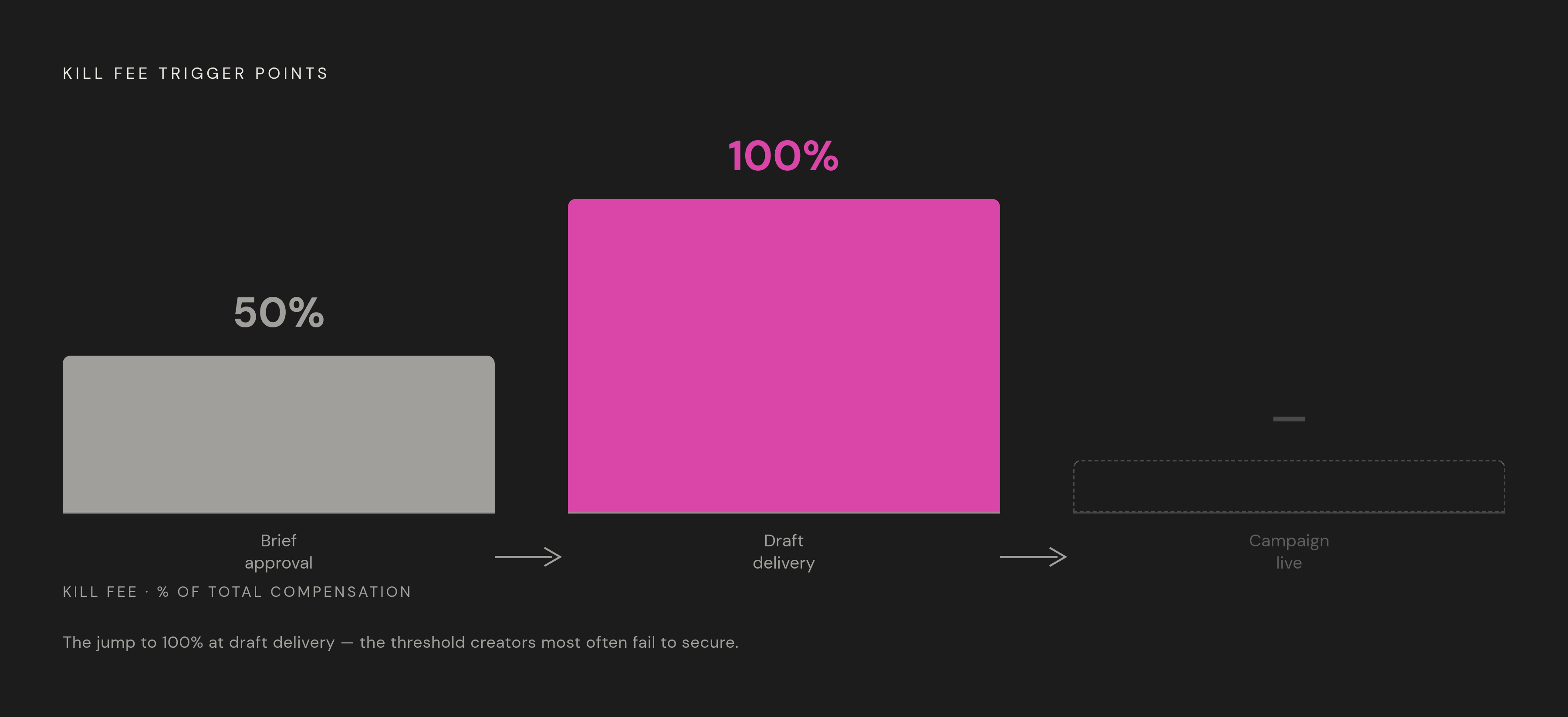
If a brand wants the right to terminate for convenience, with no cause required, the creator needs a kill fee or a prorated payment tied to whatever's already been completed: concepting, filming, drafts. Without that, a creator can spend days producing content and walk away with nothing to show for it. A morality clause, sometimes called a brand safety or conduct clause, gives the brand the right to terminate and pull content down if the creator's conduct is judged reputationally damaging. Creators should push for an actual definition of what triggers this, rather than leaving it to the brand's discretion after the fact. And termination for cause needs to work differently than termination for convenience: cause-based termination should come with notice and a chance to cure the problem, while termination for convenience should trigger the kill fee automatically, no negotiation required in the moment. A kill fee of 50% of compensation applies if cancelled after brief approval. A kill fee of 100% of compensation applies if cancelled after draft delivery.
Dispute resolution and governing law: the clause both sides ignore until it is the only one that matters
Nobody negotiates the dispute resolution clause with much energy, because at signing, both sides are focused on the deal working, not on the deal falling apart. That's why it matters. Once a real disagreement lands, this clause decides everything about how it gets resolved: which state's law applies, whether the dispute goes to arbitration or to court, and where that process physically happens.
A brand based in one state and a creator based in another is not a hypothetical. It's the default setup for most influencer deals, given how much of this work happens across state and even international lines. Without a named governing law and a named venue, resolving a dispute means figuring out jurisdiction before either side can even argue the merits of the actual disagreement, and that alone can turn a straightforward payment dispute into a drawn-out procedural fight. Arbitration clauses tend to favor whichever party has more experience with the arbitration process itself, so a creator without legal counsel should read this section as closely as the payment terms, not skim past it because it looks like standard boilerplate. The arbitration section is rarely standard boilerplate. It's the clause that decides whether every other clause in the contract is actually enforceable when it counts.
Notes
- Influencer Marketing Guides & Resources - InfluenceFlow
Provided the figure on FTC fines levied on brands in 2025.
- Contract Template for Influencer Partnerships |...
Supplied the statistic on partnerships ending in conflict over unclear terms.
- How to Structure Influencer Contracts | InfluenceFlow
Provided the per-violation FTC penalty figure.
- Influencer Contract Template 2026: Free Download + 10 Must-Have Clauses
Supplied the standard late-fee rate and the must-have clause framework.
- https://influenceflow.io/resources/influencer-agreement-best-practices-the-complete-2026-guide/
Provided the campaign fee tiers that determine which clauses matter most.
- 2026 Influencer Contract Checklist: Instagram & TikTok Tips
Informed the checklist of specific scope, deliverable and disclosure details a contract should name.
- How to Draft Influencer Collaboration Contract in 2026
Supported the guidance on drafting scope, payment, and rights clauses.
- https://influenceflow.io/resources/platform-specific-influencer-contract-clauses-a-complete-2026-guide/
Informed the discussion of platform-specific monetization programs and exclusivity obligations.