UGC Content Rights and Usage Licensing for Paid Ads
Brands need explicit licensing across four layers to legally run paid ads using creator content.
The creator owns the Copyright in a UGC video the moment they start filming. Most brands miss this when they grab a creator’s TikTok video they tagged and seemed thrilled about, then put ad money behind it. That goodwill does not carry commercial rights. Hearts, tags, and a hashtag are just social signals; the copyright statute behind those rights pays no attention to any of them. Here's where it really gets messy for teams, sitting between organic versus paid: putting a creator's video on a brand Instagram counts as one use. Putting that same video into a paid ad for new viewers is another use requiring its own authorization.
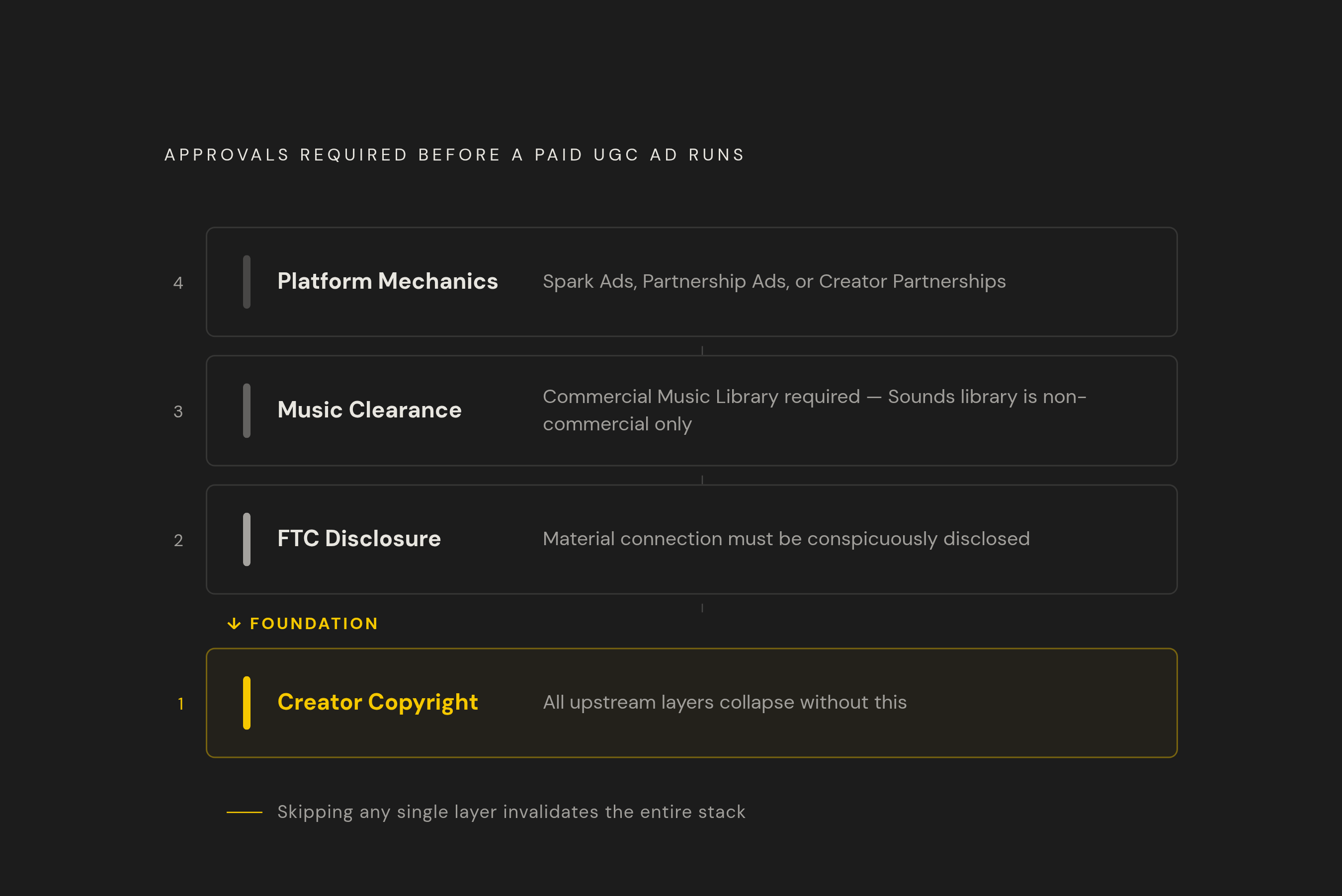
Paid UGC ads need four licensing steps.
Most teams treat "getting rights" as a single checkbox, and that's the wrong model. Approvals stacked in sequence are required, and skipping even one puts the whole effort at risk, regardless of how strong the rest appear.
It starts with the creator's copyright. The rest sits above it, meaning without that base, downstream steps fall apart. The next Layer is FTC disclosure, a rule that sits with copyright: even with a complete license in hand, an ad that fails to disclose the material connection linking advertiser and creator leaves the advertiser responsible when it appears on the creator's handle rather than the advertiser's. Music clearance is layer three, and it's the one brands most commonly think they've already handled. TikTok's music licenses for the Sounds library are intended for non-commercial use. TikTok's Commercial Music Library (CML) must clear any paid or commercial use, covering organic content and TikTok paid video ads only. Layer 4 is platform mechanics, explained below, and governs the ad's actual setup and who controls it once active.
The three-tier rights structure: organic, paid, and whitelisting
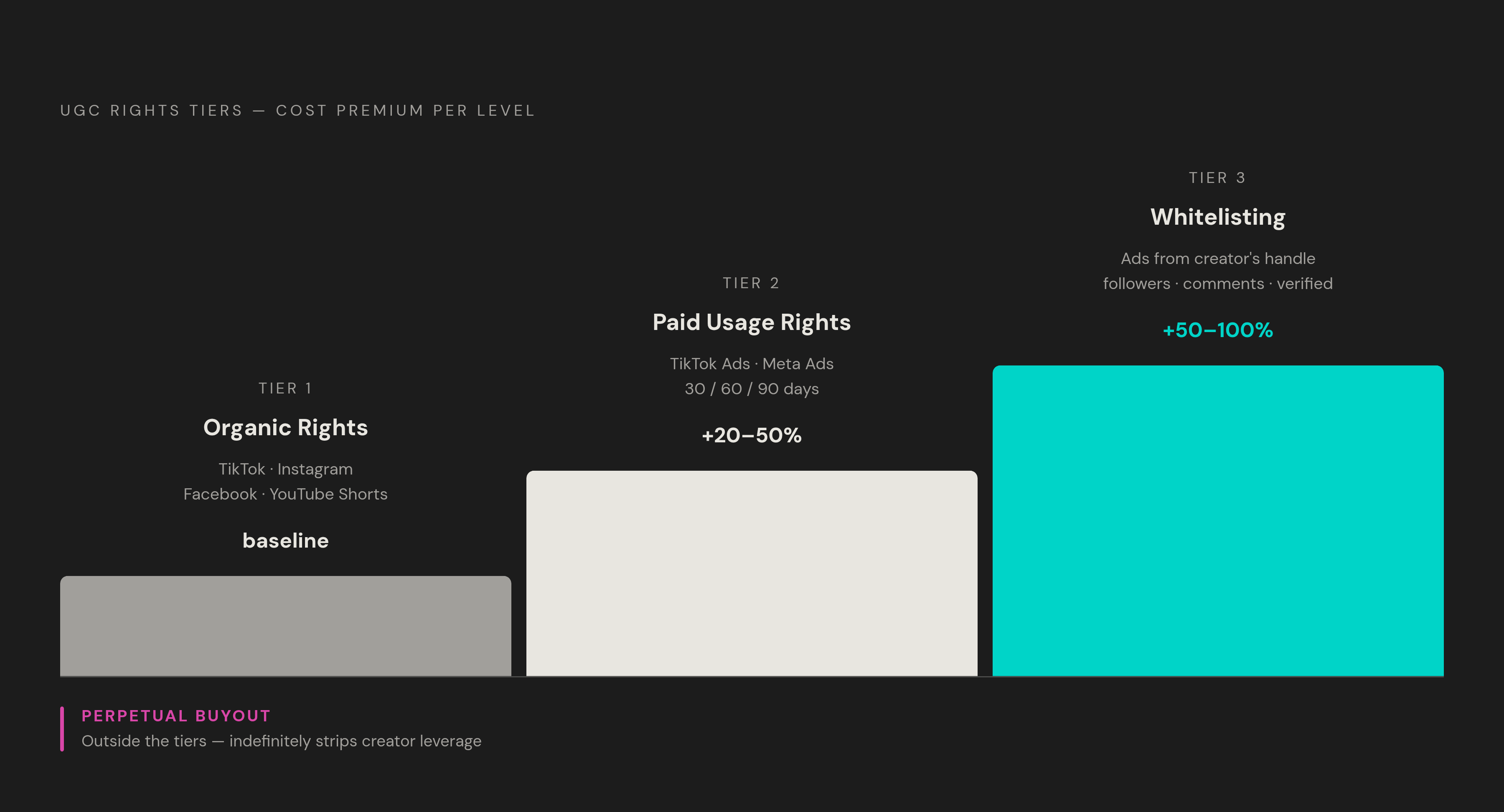
Rights conversations tend to flatten into "do we have permission or not." That framing is too crude. What actually needs documenting and a price tag is which of the 3 tiers a company is getting, since treating them as interchangeable sends budgets sideways.
Organic rights start with the brand's own uses: permission for repost creator content across TikTok, Instagram, Facebook, YouTube Shorts, and its site. No wording elsewhere in the contract makes this tier cover paid ads.
Paid usage rights come next. This is permission to put the content in paid ads through the brand’s own TikTok Ads Manager or Meta Ads Manager, and UGC usually works best here as a format. Paid usage rights usually run for a set period, often 30, 60, or 90 days, and after that the ad stops or the rights get extended. Expect to pay 20 to 50% more for this tier.
Whitelisting, also known as creator authorization, sits at the top tier and feels the most native. The creator's own handle becomes the source of the paid ads, so the creator's follower total, past comments, and verified status stay intact. That feels like genuine social proof rather than brand messaging, and that authenticity carries a 50 to 100% premium on the standard video fee. Usage rights give permission to use content in any way; whitelisting sits inside usage, not as a synonym for all of it, and teams that mix them up risk underpaying or misdocumenting it.
A rarer option is a perpetual buyout, where the company acquires rights to content indefinitely. These deals shouldn't happen often and must be priced high, because they strip leverage from the creator and block them from letting anyone else license that same work.
A defensible license requires these specifications before any asset ships
A license lists the conditions. Think of a handshake with someone's name stapled to it. Before any asset ships, all 6 points must be explicit, since vague phrasing in one can invite a fight.
Every channel must be listed individually: TikTok, Instagram, YouTube, Meta ads, site, inbox. "Digital use" won't hold up once a disagreement reaches legal. A push may last a few weeks, but paid usage licenses typically span 6 to 12 months; renegotiating mid-flight hands the creator leverage once results show, making it a terrible time to learn the license lapsed. Paid advertising permission must be spelled out explicitly, apart from broader content licensing. In most deals, one won't cover the other.
Derivative rights specify if a company can subtitle, resize, use overlays, or make a 15-second bumper from a 60-second video. Altering the unedited asset without that permission breaks the agreement, even if a license covers it. Territory terms must say worldwide or by market, and entering another market without fresh terms breaks the first contract, not a maybe. Exclusivity, which keeps the creator from taking on rival brands, runs a good deal higher than non-exclusive deals, and it's only worth paying for when the brand really needs that lockout, not something thrown in by default.
Identity, appearance, likeness, and sound are often bundled with content rights in the same deal. Advertising deals always group these together, yet the bundle needs boundaries on duration, geography, and use matching everything else covered by the contract. What drives cost higher, in each of these areas, is running paid media, longer duration, broader reach, and exclusivity. A license that's 30-day, US-only paid doesn't equal one covering the whole globe for ages, even if the video matches frame by frame.
Watch for language that should stop a signature before it happens: "irrevocable," "worldwide," "in perpetuity," "unrestricted right to modify," "right to sublicense," "all media now known or later developed." Any one of those phrases quietly turns a bounded license into something close to a permanent, unrestricted transfer.
How TikTok, YouTube, and Meta each handle platform mechanics
TikTok's Spark Ads allow companies to promote already-published creator videos with their own ad spend and clickable call-to-action, plus targeting, through authorization from the creator. Each one is locked to a single video, with set durations: 7 or 30 or 60 or 365 days. Asking for the 30-day pass upfront prevents a mid-campaign rush once it runs out while the ad is still performing. Once authorized, Brands lose caption control; their options shrink to inserting a CTA and swapping the URL. TikTok's Commercial Music Library only clears audio for ads running on the platform itself. It only covers on-platform paid use, not embedded use or off-platform else.
Meta's Partnership Ads use a branded content tool. A creator enables branded content on a chosen piece and approves the company for advertising, then that company moves the tagged item over to Meta Ads Manager. The ad carries the creator's handle plus the words "Paid Partnership", with no account access needed between company and creator. Meta's Partnership Ads API came out in 2025 and helps standardize this process for brands managing lots of accounts together.
Creator Partnerships came out after Spark Ads and Partnership Ads from Meta, so companies using it now are moving faster than the system can handle. Creator Partnerships consolidated in March 2026, with advertiser access through Display & Video 360 following the next month, and parts of the rollout are still reaching roughly two dozen countries. Most brands doing UGC work still lean on Meta and TikTok for ads running through creator handles. YouTube is still behind, not ahead, so treating it as a comparable pick today is a strategic error.
All three tools only permit ads to run on their own platform. They don't replace the creator's copyright license, they don't satisfy FTC disclosure requirements, and they don't cover likeness rights for any identifiable person who ends up in frame.
Pricing benchmarks teams can use to budget before a brief goes out
Cost depends on format and creator tier, but 3 ranges work as budget benchmarks. A basic license, covering a single format or platform for one-month use, costs $100 to $300. An extended license, covering several platforms or a lengthier timeframe, sells for between $500 and $1,000. A license letting one company alone use the content climbs into the $1,500 to $5,000 range.
ugcroster points to a DTC clothing label that paid $750 for a three-month extended license spanning Instagram and Facebook. That amount sits squarely in the extended-license numbers above, showing what these tiers actually cost once a brief reaches a creator instead of living on a planning sheet.
How teams over many brands operationalize rights across all accounts
More volume makes it a different challenge. A firm handling several client accounts faces constant licensing choices for many pieces of content each cycle, and the checklist method that suits one company stops working when that number climbs.
A workable setup gives each account its own workspace with that brand's voice rules, messaging, what to do and what to skip, plus rights documentation, keeping creators and approvers focused on the right account. Results, though, should be open to anyone in the group who needs them.
Creator vetting works the same way. Check a creator once at the platform, and after one good run with a brand, they're set for the following brief with no extra vetting pass. Since the brief makes content brand-specific rather than the creator, treating each pairing as another vetting round wastes effort the checklist can skip. Ready-made brief templates also lower the number of one-off reviews, which helps when a single strategist approves work for multiple client accounts at once.
A pre-launch rights checklist teams can run on every asset before it ships
Use this checklist as a filter. Use it before an asset reaches the platform, not once the ads have been up for a week and counsel wants the license.
On copyright: does the creator have a license on file, does it call out paid advertising as an allowed practice, and does it reach every platform in the media plan rather than just "digital"?
For FTC disclosure, is the ad's material connection between company and creator disclosed conspicuously in the ad, and does the company save proof of that disclosure for each run, not just the initial one?
Regarding music: if the asset includes audio, is it licensed for paid use across every platform in the media plan, or just organic, in-app posting? TikTok's platform music licenses, for example, won't cover paid placements, even if terms allow organic use.
Sources
- Mastering UGC usage rights: what brands need to know about licensing creator content
- UGC Usage Rights Pricing Guide (2026): Avoid Perpetuity
- Real UGC Usage Rights Pricing: What 500+ Creators Charge
- UGC Usage Rights: The Ultimate Guide for Brands
- UGC Licensing Rights: Paid Ads vs Organic Usage
- conbersa.ai
- Music licensing in UGC video, the hidden legal risk
- auditsocials.com